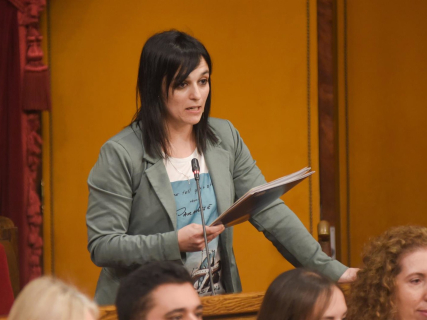
Orriols brings the battle of independence to the eve of the Diada: "We have come to save Catalonia"

Catalan Alliance and leftist independentist collectives exchange insults at the Fossar de les Moreres, separated by several cordons of the Mossos d'Esquadra.

2 minutes

fotonoticia 20260806124842 1920

fotonoticia 20260806124842 1920

Add DEMÓCRATA to Google

Ask FREN

Published

Last updated

2 minutes

Most read

The eve of the Diada of September 11 has begun with tension between two opposing sectors of Catalan independence. Supporters of Aliança Catalana and groups from the so-called Esquerra Independentista, linked to the CUP environment, exchanged insults this Thursday during the event led by Sílvia Orriols at the Fossar de les Moreres, in Barcelona.

"We have come to save Catalonia", proclaimed the leader of Aliança Catalana and mayor of Ripoll during her speech, which was met with applause from her supporters and boos from the counter-protest gathered against her.

The organization had mobilized eight buses from different Catalan regions to participate in its offering at the Fossar de les Moreres, one of the locations with the greatest symbolic significance for independence during the events leading up to September 11.

In front of them, members and supporters of organizations such as Arran, Endavant, Alerta Solidària, and the Sindicat d'Estudiants dels Països Catalans (SEPC) had gathered, having previously called for a protest against the presence of Aliança Catalana.

Mossos cordons between both groups

The tension has forced the two groups to be kept apart during the afternoon by several cordons of the Mossos d'Esquadra. Insults and chants were exchanged from both sides, although no reports of more serious incidents have been made.

The immediate precedent was the Diada of 2025. Aliança Catalana had already made its offering at this same location then, and confrontations occurred with leftist groups, which had raised concerns about the possibility of new incidents this year.

The Fossar de les Moreres has strong significance within Catalan nationalism. The space housed the remains of some of the defenders of Barcelona who died during the siege that ended with the fall of the city to the Bourbon troops of Philip V in 1714, during the War of Succession.

The offering of Aliança Catalana has thus turned the enclave back into a stage for the growing confrontation within the independence space itself, with Orriols' formation facing the sectors situated to its left.

"Catalonia Catalan"

During the event, Orriols and leaders of Aliança Catalana spoke, while among their supporters chants such as "Catalonia Catalan" and "Sílvia Orriols is the solution" could be heard.

In the environment of the cauldron dedicated to the dead "in defense of the freedoms and constitutions of Catalonia at the site of Barcelona (1713-1714)" estelades, flags of Aliança Catalana and other identity symbols have been exhibited.

One of them has been the figure 33, used in reference to the two letters C of the motto "Catalonia Catalan". The flag of the phoenix over the cross of Saint George has also been seen.

The main coincidence between the two opposing groups has been Els Segadors, the official anthem of Catalonia, although sung by each sector at different times.

The scene anticipates a Diada also marked by the internal struggle of independence, at a time when Aliança Catalana tries to consolidate its political space against traditional independence formations and finds frontal opposition among the secessionist leftist collectives.

More key points, information and questions with FREN

AI-GENERATED CONTENT

What is the status of the parliamentary processing of Aliança Catalana's political proposals?

As of September 10, 2026, the “political proposals” linked to Aliança Catalana are channeled almost exclusively through the parliamentary activity of its leader, Sílvia Orriols, in the Parliament of Catalonia. There are no own initiatives recorded in the Congress of Deputies, the Senate, or other regional parliaments, and there is no trace of bills, draft laws, or regulations approved at the initiative of this party.

The consulted database does not formally register a parliamentary group called «Aliança Catalana», but rather the deputy Sílvia Orriols Serra, integrated in the Mixed Group in Catalonia in the XV legislature of the Parliament. Under her name, 27 initiatives have been identified:

  • 27 in the Parliament of Catalonia.
  • 0 in the Congress of Deputies.
  • 0 in the Senate.
  • 0 in other regional parliaments.
  • 0 bills, draft laws, or royal decrees.
  • 24 oral questions.
  • 1 motion following interpellation.
  • 2 files classified as “Others,” which are mere vote delegations.
Activity in the Parliament of Catalonia

The bulk of Aliança Catalana's action in the parliamentary venue takes the form of oral questions to the president and the Government. These questions address topics such as:

  • The general political situation in Catalonia (subject of numerous questions to the president between late 2025 and mid-2026).
  • Immigration and live enrollment in educational centers.
  • Illegal occupations and protection of private property.
  • Citizen security and presence of organized crime.
  • Management of public resources, such as the Catalan Cooperation Fund.
  • Security in educational centers and secularism policies.
  • Situation of the dependency system in Catalonia.
  • Protection of natural spaces.
  • Attacks and incidents against Aliança Catalana and media and institutional treatment towards the party.

These initiatives allow Aliança Catalana to set political positions and force responses from the Government, but they do not themselves generate regulatory changes: they are mechanisms of political control, not legislative production.

Substantive motion and its outcome

Among the 27 initiatives, only one motion following interpellation with more programmatic content has been identified:

  • Motion “on taxation that harms the purchase of habitual housing,” presented in the Parliament of Catalonia with a first publication date of February 21, 2025.

This motion was debated and rejected: on March 6, 2025, the rejection agreement was published. Therefore, it did not translate into an effective reorientation of housing tax policy nor a consolidated parliamentary mandate.

Processing status of the initiatives

From a procedural point of view, the available information about the specific status of each question is limited. In many cases, the record only offers:

  • A generic status of publication of the initiative, or
  • An indication that the current status is not available in more detail.

This does not mean that the initiatives are “blocked” or “stuck,” but that the consulted database does not reflect later phases (for example, that the question was effectively posed in a plenary session or that the Government responded). In any case:

  • 1 clearly rejected initiative has been identified (the motion on taxation and housing).
  • There are 3 questions for which a clearer conclusion of processing is recorded, including the one related to attacks against Aliança Catalana dated July 30, 2026.
  • For the rest, only the initial publication or a generic closure without phase detail is recorded.
  • No approved initiative appears, neither in committee nor plenary, nor in the form of law, nor as a resolution with equivalent effects.
Other mentions of Aliança Catalana

There are also some questions from other groups in the Parliament that mention Aliança Catalana in their title (for example, about its presence in public media or the media treatment of attacks on militants). However, in these cases:

  • Aliança Catalana is the object of the initiative, not the promoter.
  • Only one of these questions coincides with an initiative registered in the name of Sílvia Orriols.
Overall assessment of the processing

In summary, the degree of parliamentary progress of the political proposals associated with Aliança Catalana is, for now, very limited in regulatory terms:

  • 0 own bills or draft laws and 0 regulations approved at the initiative of the formation.
  • 1 substantive motion debated and rejected in the Parliament of Catalonia.
  • More than twenty oral questions that have served to make their political agenda visible, without leading to concrete legislative changes.
  • Absence of own initiatives in Congress, Senate, or other regional parliaments.

In practice, the parliamentary processing of Aliança Catalana is at a phase of visibility and positioning through control of the Government, but still without demonstrated capacity to transform that agenda into approved legislative results.

What are the competencies of the mayoral office in Catalonia and what specific functions does Sílvia Orriols have as mayor of Ripoll?

In Catalonia, the competencies of a mayor are determined by the basic state legislation and by the Catalan local regime regulations. Within this general framework are the specific functions exercised by Sílvia Orriols as mayor of Ripoll, a position she has held since 2023 and which she combines with the presidency of Aliança Catalana and her seat in the Parliament of Catalonia.

1. Competencies of the mayoral office in Catalonia

The core functions of any mayor in Catalonia are established, first, in the Law 7/1985, of Bases of the Local Regime (LRBRL), and developed in the Legislative Decree 2/2003, of the Consolidated Text of the Municipal Law and Local Regime of Catalonia.

Based on article 21 LRBRL and parallel provisions of Legislative Decree 2/2003, the mayor is the highest authority of the municipality and, in any case, assumes these major functions:

  • Institutional representation: she is the president of the municipal corporation and the legal representative of the city council before third parties.
  • Direction of government and municipal administration: she heads the local government, sets management guidelines, and supervises municipal services and works.
  • Convocation and presidency of bodies: she convenes and presides over sessions of the plenary, the government board, and other municipal bodies, with a casting vote to resolve ties.
  • Economic-budgetary management: she carries out the management of the approved budget, authorizes and disposes expenses within limits, may contract certain credit operations, order payments, and render accounts, according to local treasury regulations.
  • Internal organization and personnel: she directs municipal staff, approves the public employment offer and selection bases, and may agree on appointments and sanctions, including in certain cases dismissal or termination, with information to the plenary.
  • Local security and police: she exercises the leadership of the municipal police and may issue edicts or orders to guarantee public order and compliance with ordinances.
  • Urban planning and licenses: she may approve certain development planning instruments, projects of works and services within her competence, and grant licenses when sectoral law does not reserve that competence to the plenary or another body.
  • Action in emergency situations: she adopts, under her responsibility, necessary measures in cases of catastrophe, public misfortunes, or serious risk, reporting afterwards to the plenary.
  • Legal defense of the city council: she may exercise judicial and administrative actions and order the execution of municipal agreements.
  • Delegation of competencies: she may delegate much of her powers to the government board or councilors, except for an unavailable core (for example, convening and presiding over the plenary, casting vote, or certain financial and personnel decisions).

The Catalan regulation reproduces this scheme (representing the city council, directing government and administration, convening bodies, issuing edicts, managing budget, directing personnel and police, acting in emergencies, etc.), adapting it to Catalonia's institutional system, but without altering the centrality of the mayoral figure.

2. Specific functions of Sílvia Orriols as mayor of Ripoll

According to her profile in the political actors database, Sílvia Orriols Serra, born in 1984, is mayor of Ripoll since 2023 and president of Aliança Catalana, a party with an independentist and far-right ideology, with a strong anti-immigration discourse. She was elected deputy in the Parliament in 2023 and acts as president-spokesperson of the Mixed Group, with presence in multiple commissions (Interior, Economy and Finance, Culture, Social Rights, Equality and Feminisms, Youth, Childhood, etc.).

At the strictly municipal level, the available information allows identifying several characteristic lines of action of her mayoralty in Ripoll:

  • Direct control of security and local police: a 2026 news report about the investigation by the Catalan Anti-Fraud Office details that the Junts group in Ripoll requested Orriols to delegate the competencies of the Security councilor after hiring her daughter as a local police officer, precisely to avoid a possible conflict of interest. This indicates that the mayor not only holds the formal police leadership provided by law but also de facto concentrates the political area of citizen security.
  • Promotion of the civility ordinance: in 2025, the Ripoll city council approved an update of the civility ordinance promoted by her government. According to the report by Demócrata, Orriols initially promoted a ban on the Islamic veil in municipal facilities that did not prosper; in the finally approved version, that restriction is removed but measures such as limiting the sale of alcohol and tobacco at certain times and places, and restrictions on ball games in public spaces, are introduced. This is an intense use of her competencies to propose and execute municipal regulations linked to public order and behaviors in urban space.
  • Leadership of budgetary policy: Demócrata's pieces on the PSC crisis in Ripoll report that Orriols's municipal budgets for 2026 were approved thanks to the abstention of two socialist councilors, which triggered their internal replacement. The mayor herself presented the accounts, negotiated (or politically forced) the necessary abstentions, and capitalized on the result, within the legal attributions of economic direction, budget promotion, and expenditure execution.
  • Supramunicipal and partisan projection: beyond Ripoll, Orriols uses her status as mayor as a political platform. In forums such as ‘Fórum Europa. Tribuna Catalunya’, she is explicitly presented as mayor of Ripoll, president of Aliança Catalana, and deputy, and she herself emphasizes that she prioritizes municipal management over her activity in the Parliament. Her participation in regional debates on immigration, security, or civility is supported by her local experience, reinforcing a profile of mayor-party leader.

Overall, Sílvia Orriols exercises the typical competencies of any Catalan mayor —political direction, economic management, leadership of personnel and police, local normative promotion— but with two notable singularities: the personal concentration of sensitive areas such as security and the very visible use of the Ripoll mayoralty as the axis of her Catalan-wide political strategy.

What results did Aliança Catalana and the CUP obtain in the last Catalan regional elections?

In the last Catalan regional elections, held on May 12, 2024, both the CUP and Aliança Catalana obtained representation in the Parliament, although with very different profiles: the CUP suffered a significant drop compared to 2021 and remained with 4 seats, while Aliança Catalana entered the Chamber for the first time with 2 seats, achieved in the constituencies of Girona and Lleida. The consulted information details the seats and part of the votes, but does not include the complete breakdown of total votes nor the exact regional percentage for each of these formations.

Results of the CUP

The CUP arrived at the 2024 elections as one of the classic left-wing independentist forces, but confirmed a very notable setback. According to the results analysis published by the newspaper Demócrata after the electoral night of May 12, 2024, the formation:

  • Went from 9 seats in the previous legislature to 4 seats in the new Parliament.
  • Lost approximately 40 % of its support compared to the previous election, which meant a strong correction within the independentist bloc.

The same analysis highlights that the sum of the traditional independentist parties (Junts, ERC, and CUP) fell below the absolute majority, and that the CUP, in particular, lost more than 240,000 votes if its drop is added to that of ERC compared to 2021. However, the reviewed documentation does not provide the exact number of votes of the CUP nor its regional percentage in 2024, so only the result in terms of seats and the magnitude of the relative drop can be stated with certainty.

Subsequently, an article about the constitution of the Parliament's Board in June 2024 again confirms that the CUP has 4 deputies and notes that it is one seat short of being able to form its own parliamentary group, which underscores its status as a small but still relevant force in the Catalan political landscape.

Results of Aliança Catalana

Aliança Catalana, the party led by the mayor of Ripoll Sílvia Orriols, was the main electoral novelty of 2024. It had no representation in the previous legislature and, according to data collected by Demócrata:

  • Entered with 2 seats in the Parliament of Catalonia.
  • Obtained those seats thanks to at least almost 27,000 votes in the province of Girona and about 13,000 in Lleida, which were sufficient to obtain a representative in each of those constituencies.

The analysis emphasizes that this entry into the Chamber occurred in a context of higher turnout than in 2021 and with a clear wear of ERC and the CUP. The emergence of Aliança Catalana is interpreted as one of the causes of the rebalancing within the independentism, as it adds a force with an independentist profile strongly focused on immigration and security issues, with a hard discourse on immigration.

Again, the information used for this response does not include the consolidated data of total votes at the regional level nor the exact percentage of Aliança Catalana across Catalonia; only the figures from Girona and Lleida that explain the obtaining of the two seats are recorded. Therefore, rigorously only its representation (2 deputies) and part of the provincial vote breakdown can be assured.

Joint snapshot of CUP and Aliança Catalana in 2024

The combined picture of both formations in the May 12, 2024 elections is as follows:

  • CUP: 4 seats. Clearly declines compared to 2021, losing five seats and around 40 % of its support. Maintains presence, but its relative weight in the Parliament and within independentism is significantly reduced.
  • Aliança Catalana: 2 seats. Enters the Parliament for the first time, with representation in Girona and Lleida thanks to around 27,000 votes in the former and 13,000 in the latter, according to the consulted analysis.

Overall, these results confirm that in the last Catalan regional elections the CUP experienced a severe setback, while Aliança Catalana had a relevant although still modest breakthrough in terms of seats. The complete official data of votes and percentages by candidacy throughout Catalonia do not appear detailed in the sources used, so any additional more precise figure would require consulting the official scrutiny of the Catalan electoral administration directly.

Play

Test your knowledge with FREN!

How much do you know about this topic? Answer the following 3 questions.

Who led the Aliança Catalana event at the Fossar de les Moreres on the eve of the Diada?

Question 1 of 3

Which anthem was performed by both opposing groups during the events prior to the Diada?

Question 2 of 3

What symbol was displayed at the event referring to the slogan 'Cataluña catalana'?

Question 3 of 3

Hola, soy Fren. ¿Cómo te ayudo?