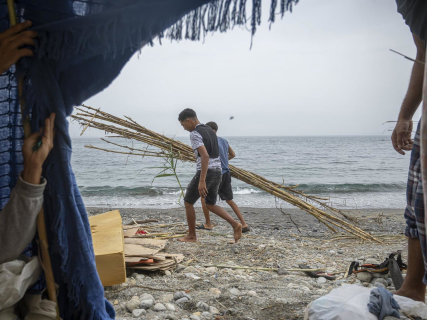

The management of the migration crisis in Ceuta leaves a strong weariness for the Government and a practically widespread perception of Morocco's responsibility. 89% of Spaniards attribute "much" or "quite a lot" of responsibility to the Moroccan Government for the massive entry of migrants on July 30 and 31, according to a 40dB survey for EL PAÍS and Cadena SER.
The attribution of responsibilities also reaches the Spanish Executive. 72% believe that the Government of Spain had "much" or "quite a lot" of responsibility in what happened, while 75% point to the mafias and networks of irregular immigration, 74% to the dissemination on social networks of false information, and 73% to the individuals who decided to cross the border.
Sánchez receives a strong failing grade for his management
The assessment of the actions of the President of the Government is mostly negative. 62.7% believe that Pedro Sánchez managed the crisis "badly" or "very badly": 12.8% choose the first response and 49.9%, the second. In contrast, only 14.2% rate his performance as "good" or "very good".
The speed of the response appears as one of the main weak points. Two out of three respondents rate negatively the speed with which the Executive reacted: 18.6% consider it "bad" and 47.7%, "very bad".
Negative assessments also prevail when asked about the cohesion, transparency, and effectiveness of the Government during the crisis. Discontent, according to 40dB data, even reaches a part of the socialist electorate, where more people rate the Executive poorly in effectiveness and speed than those who approve of it.
More supporters of hardening the relationship with Morocco
The results also reflect the impact of the crisis on the perception of bilateral relations. 45.7% believe that Spain should harden its relationship with Morocco and reduce cooperation, compared to 36.8% who advocate strengthening it because they consider Rabat's collaboration essential to control the border.
8.2% opt to maintain relations in their current situation and 9.3% do not know what position to adopt.
The results contrast with the line defended so far by the Government, which has emphasized Moroccan cooperation in returns and maintains that there is no conclusive evidence that allows attributing to the Moroccan Government the planning of the massive entry.
Vox, the party considered most capable of managing immigration
The scenario drawn by the survey especially benefits Vox. 27% points to Santiago Abascal's party as the most capable of managing immigration, ahead of the PSOE, with 18.4%, and the PP, with 13.9%.
The data also reveals a significant leak in the perception of the popular electorate: about 23% of those intending to vote for the PP believe that Vox would manage immigration better, while only 2.4% of potential Vox voters choose the PP.
However, there is a data point that nuances the result: 23% of the population does not consider any of the parties the most qualified to manage immigration, practically as many as those who choose Vox.
The general assessment of the migratory phenomenon also yields a negative balance. 53.6% considers that immigration is "rather negative" for Spain, compared to 33.1% who perceive it as "rather positive".
64% reject questioning the sovereignty of Ceuta and Melilla
The survey also addresses the debate about the future of the two autonomous cities. 63.6% believes that Spain should not question Spanish sovereignty over Ceuta and Melilla, while 16.8% would be willing to talk with Morocco about their future.
Another 15.7% believes that it should primarily be the inhabitants of Ceuta and Melilla who decide, while only 3.9% thinks that Spain should consider ceding the cities to Morocco to improve bilateral relations.
The defense of sovereignty remains when asked about the consequences that citizens would be willing to assume. 63.8% would support the participation of the Army in a war in the event of an external aggression against Ceuta or Melilla and 53.9% would assume economic consequences arising from sanctions against Morocco.
Support decreases in other scenarios: 44.6% would be willing to pay more taxes to increase defense spending and 41% states that they would personally participate in the defense of Ceuta and Melilla if called to do so.
The crisis remains, moreover, very present among Spaniards. More than 83% claim to have closely followed the events and 72.2% believe that episodes like the one that occurred at the end of July will happen "regularly" in the future. Concern is the predominant feeling, cited by 53.2% of respondents.