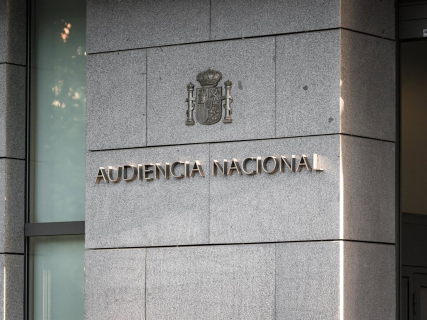

After the summer break, judicial activity will return strongly in the National Court, where the "Leire Díez" and "Plus Ultra" cases will be reactivated with new statements from those investigated. At the same time, the Supreme Court and the Constitutional Court will face key issues such as the possible adaptation of precautionary measures linked to the so-called "grandchildren's law" and the appeals related to the amnesty law.
The magistrate of the National Court Santiago Pedraz will resume the "Leire Díez case" on September 9, with the appearances as investigated of the manager of the PSOE, Ana María Fuentes, and Ismael Oliver, former lawyer of the former ministerial advisor Koldo García. An investigation is underway into an alleged scheme aimed at neutralizing judicial cases that would affect the Government and the PSOE, which would have been led by former socialist leader Santos Cerdán and coordinated by former member Leire Díez.
Pedraz took over the entire procedure after the first instructor, Arturo Zamarriego, referred his part of the investigation to him. In his resolutions, the judge pointed to an indicatory responsibility of the manager of the PSOE, at least as a presumed accomplice and, in any case, as a possible author of a crime of falsification in commercial documents for the issuance of allegedly false invoices.
According to a report from the Central Operational Unit (UCO) of the Civil Guard, Fuentes, in her capacity as party manager, "would have been the person in charge, with the mediation of Díez and under the directives of Cerdán, of falsifying two professional engagement notes": one with the law firm linked to Oliver and another with Cerdán's lawyer, Jacobo Teijelo.
Statement from the former director general of the Civil Guard
The UCO also suspects that the PSOE would have resorted to companies of Ismael Oliver and former Andalusian leader Gaspar Zarrías to pay 43,225 euros to Díez, using various companies "to channel funds to Leire originating from the party".
On September 10, the former director general of the Civil Guard, Leonardo Marcos, is summoned to testify within the case that analyzes whether commanders of the body may have received pressure to "stay on the sidelines" in the judicial investigation regarding David Sánchez, brother of the President of the Government, for possible irregularities in his hiring at the Badajoz Provincial Council.
The judge has not yet set a date for the interrogation as investigated of Juan Manuel Serrano, former president of Correos and former chief of staff of Pedro Sánchez in the PSOE. The instructor is awaiting a new report from the UCO based on the data extracted from Serrano's mobile phone. This same week, the National Court proceeded to clone the device for the second time, after the defense attempted to annul the first diligence, carried out without the presence of a lawyer for the former chief of staff.
The Plus Ultra case and the summons to the airline's leadership
In parallel, the judge of the National Court José Luis Calama, responsible for the "Plus Ultra case," has summoned the president of the airline, Julio Martínez Sola, and the CEO, Roberto Roselli, to testify as investigated on September 7 and 8, respectively.
In this procedure, the magistrate is investigating Zapatero as the alleged leader of a network of influence peddling that would have obtained economic benefits in exchange for his mediation in the rescue of 53 million euros that the Government granted to the company during the pandemic.
In two documents of identical content, both executives stated that the airline paid "large amounts of money" to businessman Julio Martínez Martínez, partner of former Prime Minister José Luis Rodríguez Zapatero, for the alleged mediation of the former socialist leader in the granting of the rescue of 53 million euros that the Executive awarded to the airline in 2020.
Judge Calama still has to specify the date of the summons as investigated of Zapatero's daughters, Alba and Laura Rodríguez, as well as of the secretary of the former socialist president, Gertrudis Alcázar.
In addition, the National Court is still pending the rulings of two of the most relevant processes of the year, which were submitted for judgment before the August break: the "Operation Kitchen," related to the alleged espionage to obtain documentation from the former treasurer of the PP Luis Bárcenas, and the alleged illicit enrichment of the Pujol family.
Supreme, Constitutional, and the start of the judicial year
In the Supreme Court, the first key date will be September 7, with an oral and public hearing to study the precautionary measures requested by Iustitia Europa and Vox. Both parties requested the provisional suspension of the registrations in the Electoral Census of Absent Residents (CERA) associated with the "grandchildren's law," which grants Spanish nationality to descendants of exiles, due to its "electoral effects."
The Constitutional Court, for its part, will begin on September 22 the analysis of the amparo appeals presented by leaders of the "procés" against the Supreme Court's refusal to apply the amnesty law to them, after the endorsement of the Court of Justice of the European Union (CJEU) to said measure of grace.
The high court of guarantees will start with the amparo appeal of the general secretary of Junts, Jordi Turull, and will address in subsequent plenary sessions the challenges of former Catalan vice president Oriol Junqueras and former councilors Raül Romeva and Dolors Bassa.
On September 10, King Felipe VI will preside over the opening ceremony of the judicial year at the Supreme Court, in which the president of the General Council of the Judiciary (CGPJ), Isabel Perelló, and the Attorney General of the State, Teresa Peramato, will intervene.
This will be the first opening act of the judicial year for Peramato as the highest responsible for the Attorney General's Office, a position she assumed in December 2025 after the resignation of her predecessor, Álvaro García Ortiz, who was sentenced to two years of disqualification for leaking data of Alberto González Amador, partner of the president of the Community of Madrid, Isabel Díaz Ayuso.