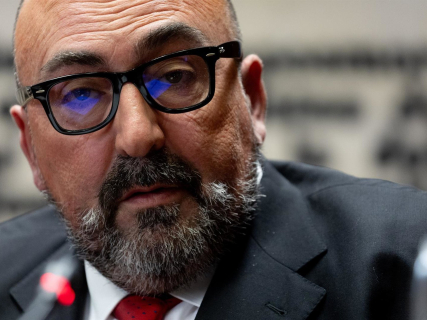
Koldo García’s lawyer resigns from her defense after revealing the payments of Okdiario

Leticia de la Hoz communicates her decision to the National Court for "professional reasons" that she does not detail as they are protected by professional secrecy

fotonoticia 20260605130418 1920

fotonoticia 20260605130418 1920

Add DEMÓCRATA to Google

Ask FREN

Published

Last updated

1 minute

Most read

Elecciones 29N · Encuestas

La media de las encuestas

Media a 10 de noviembre de 2026 · 15 institutos

  • PP31,5 %
  • PSOE26,8 %
  • Vox19,1 %
  • Frente Amplio6,2 %
  • ERC2,5 %
01020304050ene 2024jul 2024ene 2025jul 2025ene 2026jul 2026

Media del último estudio de cada instituto en 30 días y su evolución semanal desde el 23J. Partidos con al menos un 2 %.

Todas las encuestas

Elecciones generales del 29 de noviembre · Demócrata

The lawyer Leticia de la Hoz has resigned from continuing to exercise the defense of Koldo García, a former adviser to the former minister José Luis Ábalos and investigated in the Koldo case. The attorney has communicated her decision to the Audiencia Nacional in a brief in which she alleges "professional reasons", without offering any further explanations about the motives for her departure.

In the document, advanced by El País, De la Hoz specifies that the circumstances that led her to resign are covered "by professional secrecy" and assures that she informed her client in advance so that he could organize his legal representation.

"The resignation has been communicated to my client beforehand, with sufficient notice so that he can provide for his defense", the lawyer states in the brief sent to the court.

The resignation comes after the payments by Okdiario became known

The decision comes after the attorney herself revealed that the publishing company of Okdiario had paid 242,000 euros to cover fees and other expenses related to the defense of Koldo García.

The information about these payments was known on October 29 and added a new element of controversy to the judicial proceedings affecting the former adviser of Ábalos.

For his part, Koldo García has assured that the Partido Popular offered him to assume the costs of his defense and give him one million euros in exchange for providing information that could politically harm the President of the Government, Pedro Sánchez.

This is an accusation made by the person under investigation himself, whose veracity has not been demonstrated with the information available.

For the moment, De la Hoz has not expressly linked her resignation to the payments that became known or to the statements of her client until now. The lawyer has limited herself to invoking professional reasons protected by the duty of confidentiality.

More key points, information and questions with FREN

AI-GENERATED CONTENT

What steps must the National Court follow to formally accept the resignation of a defense lawyer in a criminal case?

The National Court must record the resignation, decide on its procedural effects, and ensure the continuity of the defense before allowing the change of lawyer to harm the investigated or accused party. Submitting the letter does not authorize the lawyer to immediately abandon the proceedings. No specific internal rule of the National Court has been found that establishes a procedure different from the general framework of criminal proceedings.

1. Incorporate the resignation into the proceedings

The lawyer must formally communicate it to the body handling the case: the investigating body or the corresponding Chamber. It is appropriate to submit a signed letter identifying the procedure, the defended party, and the unequivocal intention to cease. They must also inform the client of the decision, trying to prove that communication and respecting professional secrecy: it is not necessary to reveal confidential conversations to explain the professional break.

A private communication to the client, without informing the judicial body, is not enough to order the procedural substitution.

2. Verify the circumstances and decide

The body must verify whether the lawyer is private or court-appointed, whether the defended party knows about the resignation, and if there are upcoming statements, appearances, appeals, or a trial. It must also determine if a substitute is already available.

There must be an express procedural act that acknowledges the resignation and orders how to guarantee the defense. However, this should not be confused with stating that a separate acceptance order is always mandatory: the form of the resolution will depend on the content and significance of the decision. If a dispute about rights or the continuity of an essential proceeding is resolved, the decision must be reasoned.

3. Request a new appointment or activate the duty roster

If there is no substitute, the situation must be communicated to the investigated or accused person and given the opportunity to appoint another lawyer, with a deadline appropriate to the circumstances and a warning about the consequences of not doing so. There is no single deadline applicable to all resignations.

When defense is mandatory and there is no effective appointment, the body must request the competent Bar Association to appoint a lawyer ex officio. If there is urgency, it should not wait for a series of requests that leave a necessary proceeding unattended.

The ex officio appointment does not automatically imply recognition of legal aid. The STC 216/1988 distinguishes the need to appoint a defender in criminal proceedings from the economic situation of the accused.

4. Ensure an effective substitution

The new lawyer must be able to review the proceedings, communicate with their client, and prepare the intervention. It is not enough for a name to appear: the assistance must be real and effective.

If a statement, appearance, or trial cannot be held with these guarantees, the body must decide on its postponement or suspension. The resignation does not automatically suspend the procedure or deadlines: a decision is needed that considers the specific proceeding and the risk of lack of defense. If the person is deprived of liberty, the substitution requires special urgency.

5. Document and notify the agreed measures

The resignation letter, communications to the defended party, the resolution on its effects, the request for a new appointment, and the incorporation of the substitute must be included. If the duty roster intervenes, the request to the Bar Association and the response with the appointment must also be recorded.

The decision must be notified to the outgoing lawyer and the defended party through the appropriate channel; also to the new defender and other parties when it affects common proceedings or hearings. The Bar Association must receive the necessary communications when involved in the substitution.

In summary: formalize, decide, substitute, and document, without leaving a defense gap.

What are the competencies and functions of a ministerial advisor in the Government of Spain?

A ministerial advisor provides political, technical, or strategic support to the minister and their team. Their main function is to help prepare decisions, analyze matters, and coordinate information; the advisor position alone does not grant powers to issue resolutions, approve expenses, or direct the ministry's administrative bodies.

To specify their powers, it is necessary to distinguish between an advisor integrated into a cabinet as trusted personnel and a public employee who performs advisory tasks from an administrative unit. Although both can prepare recommendations, their position, responsibilities, and powers are not necessarily the same.

Common functions

  • Analysis and advice. Study problems within the ministry's scope, compare alternatives, and prepare reports, notes, or recommendations. The work may address legal, economic, social, technical, or political issues, depending on specialization.
  • Decision preparation. Summarize background, detect risks, and anticipate the consequences of different options. The advisor proposes and argues; the decision corresponds to the competent body.
  • Support for institutional activity. Prepare documentation for meetings, visits, public interventions, and encounters with other administrations, business organizations, unions, or social entities.
  • Parliamentary monitoring. Help prepare appearances and debates, analyze initiatives, and gather information for the department's responses. This support does not replace the functions of units responsible for relations with the Parliament.
  • Coordination and monitoring. Facilitate information exchange between the cabinet and ministry units, follow priority projects, and warn about delays, conflicts, or coordination needs with other departments.
  • Communication. Collaborate on speeches, argumentaries, and institutional messages, in coordination with communication managers. Not all advisors perform this function or act as spokespersons.

Competencies an advisor does not have

The fundamental distinction is between influencing a decision and having authority to adopt it. Access to the minister or participation in relevant meetings does not make the advisor a hierarchical superior of officials nor allow them to exercise the powers of a general director.

Therefore, it should not be understood that they can award contracts, grant subsidies, impose sanctions, appoint personnel, or sign provisions merely by advising. Any intervention with legal effects requires valid competence or authorization linked to the position actually held. Nor does an informal indication from the cabinet replace the required procedures, reports, and controls.

Dependence and scope of action

The specific content of the work depends on the level they support, the cabinet's organization, and the tasks assigned. A specialized advisor may focus on a sectoral policy; another may handle institutional agenda, parliamentary relations, or strategic analysis.

Trust and advisory functions must be distinguished from ordinary administrative management. It is also advisable to distinguish the advisor from the cabinet director: collaborating with the latter does not automatically imply assuming their organizational or coordination responsibilities.

Obligations and responsibilities

The advisor must act respecting legality, confidentiality, and the obligations corresponding to their link and position. Access to sensitive information requires proper use and does not authorize using it for personal interests. Likewise, applicable rules on incompatibilities and conflicts of interest must be observed.

Ultimately, it is a position of support, not substitution of the competent authority. To evaluate a specific case, what matters is not the informal title of "advisor," but their appointment, assignment, and functions effectively attributed.

What legal requirements exist for a political party to finance the legal defense of a person under investigation in a judicial case?

In Spain, a political party can, in principle, pay for the legal defense of a person under investigation: the laws consulted do not establish a general prohibition merely because the person is under investigation. But they also do not grant unlimited authorization: the payment must respect the party's internal rules, the origin and purpose of the funds, and accounting and control obligations.

1. Internal decision and justification of the expense

The main framework is Organic Law 6/2002, whose article 13 refers to financing legislation, and Organic Law 8/2007, amended by Organic Law 3/2015.

The decision must fit within the statutes, the powers of those authorizing expenses, and internal contracting instructions. It is advisable to document who approves the payment, its amount, the judicial procedure, and the reason why the party assumes a personal defense. That documentation allows justifying the operation; it does not by itself make any expense lawful.

It is also important to distinguish between defending the party itself and paying the lawyer of another person. Being a member or official of the party does not automatically generate a legal right for the party to cover the defense.

2. Origin and destination of the money
  • Private resources: may come from fees, contributions, assets, or other sources admitted by law. Being private does not eliminate authorization, justification, and accounting obligations.
  • Public subsidies: their purpose must be respected. The law differentiates electoral subsidies, operating subsidies, and other public contributions. It is not enough that the party has the money: it must justify that the expense is compatible with the purpose of the aid. The examined texts do not contain specific authorization to charge any individual defense to operating subsidies.
  • Donations: article 5 prohibits anonymous, earmarked, or revocable donations, those from legal entities, and, with the legally provided real estate exception, those exceeding 50,000 euros annually per donor. Therefore, receiving a donation conditioned on paying the defense of a specific person raises the prohibition of earmarked donations.

Additionally, donations exceeding 25,000 euros and all real estate donations must be notified to the Court of Auditors within three months of acceptance.

3. Accounting, contracting, and control

The legislation requires detailed books that allow knowing the financial situation and compliance with legal obligations, identifying income and expense categories. Lawyer payments must be recorded and have supporting documentation of the service, its amount, and payment.

The party must respect its contracting instructions, apply internal controls, and report to the Court of Auditors. Accounting for the payment does not remedy an improper use of funds. Also, accountability should not be confused with a general obligation to publish all details of the defense strategy.

4. Corruption, conviction, and reimbursement

The examined provisions do not establish an automatic prohibition on financing the defense due to an investigation related to corruption. That does not exempt justifying the expense or respecting the purpose of the funds. Special attention must be paid to possible conflicts between the interests of the investigated person and those of the party.

There is also no general rule requiring the beneficiary to repay fees if convicted. To avoid uncertainties, it is advisable to agree in writing whether the payment is final, an advance, or aid subject to reimbursement and under what circumstances. That contractual provision should be distinguished from liabilities that may arise from irregular use of funds.

Play

Test your knowledge with FREN!

How much do you know about this topic? Answer the following 3 questions.

Who was Koldo García before being investigated in the Koldo case?

Question 1 of 3

How much money did the publishing company of Okdiario pay to cover the fees and expenses of Koldo García's defense?

Question 2 of 3

What argument has lawyer Leticia de la Hoz used to justify her resignation?

Question 3 of 3