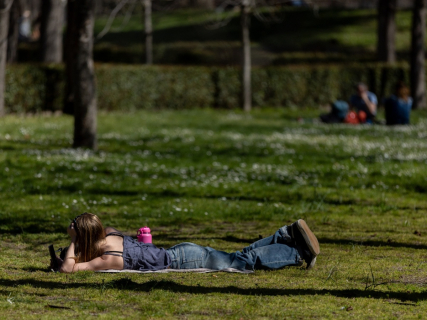
El Retiro and five other historic parks in Madrid will close from 18:00 due to the storm.

Madrid closes El Retiro and five other historic parks from 18:00 due to forecasted wind gusts of up to 71 km/h.

1 minute

retiro foto 1200x900

retiro foto 1200x900

Add DEMÓCRATA to Google

Ask FREN

Published

Last updated

1 minute

Most read

The Madrid City Council has announced that the El Retiro park, along with five other historic gardens in the capital, will remain closed starting at 18:00 hours this Friday due to forecasts of adverse weather conditions provided by the State Meteorological Agency (Aemet).

The closure measure will be applied in the Capricho park, the Rosaleda of the Parque del Oeste, the Quinta de Fuente del Berro, the Quinta de los Molinos, and the Quinta Torre Arias, which thus join the preventive device activated in El Retiro.

According to the latest report issued by Aemet for the city of Madrid, gusts of wind are expected to reach up to 71 km/h from 18:00 hours. The reopening of all these green spaces will take place once any possible damage to the trees has been reviewed and corrected, something that is expected to be completed throughout tomorrow.

The City Council will communicate any updates on the status of the parks through its usual public information channels, including the 22 information panels installed at the entrances of El Retiro.

More key points, information and questions with FREN

AI-GENERATED CONTENT

What procedures must the Madrid City Council follow to reopen historic parks after a preventive closure due to weather conditions?

Since 2026, the Madrid City Council has specific protocols to manage the closure and reopening of historic parks during adverse weather episodes (wind, heavy rain, or snow). These protocols apply to El Retiro and other historic parks that may be closed —El Capricho, Fuente del Berro, Quinta de Torre Arias, Quinta de los Molinos, and the Rose Garden of Parque del Oeste— and establish both the closure thresholds and the conditions for their safe reopening.

1. Activation of the protocol and preventive closure

The starting point is information from the State Meteorological Agency (AEMET), which determines the alert level:

  • Green alert: no significant risk.
  • Yellow alert: some probability of incidents, without widespread danger.
  • Orange alert: significant risk, which may involve partial evacuations and marking of zones.
  • Red alert: high risk that requires park closure.

With the so-called “Retiro 2026 protocol”, definitively approved in June 2026, new wind thresholds to activate these alerts have been set. The orange alert is activated with gusts between 45 and 60 km/h, and the red alert from 60 km/h onwards, which entails the closure of El Retiro and the other historic parks following this same model.

Municipal press releases about wind closures explicitly state that these parks “will remain closed until municipal staff verify the safety of the trees” and that the closure is adopted following this meteorological alert protocol.

2. Technical review prior to reopening

Once the weather episode passes (wind gusts weaken, heavy rain or snowfall ceases), the City Council does not automatically reopen the parks, but:

  • The technical services of the Directorate General of Green Areas and Water Management and the Green Evaluation and Review Service (SERVER) carry out an inspection of the trees and the most sensitive areas.
  • Specifically checked are large trees, potentially unstable branches, slopes, and passage areas, to prevent later falls once the park is open.
  • If incidents have occurred (falling branches or trees, damage to paths, playgrounds, or other elements), priority is given to removal of debris, pruning of affected trees, and basic repairs before authorizing public access.

Only when these teams certify that the risk level is acceptable again is the full closure lifted. This approach is based on accumulated experience: the City Council itself has indicated that, between 2020 and 2025, El Retiro was only closed due to red alert about 1% of the time, but during that period a very high percentage of tree and branch falls occurred, reinforcing the need for this prior inspection.

3. Total or partial reopening and marking

The protocol foresees that reopening may be:

  • Total, when the technical review indicates no areas with significant risk remain.
  • Partial, maintaining marked or cordoned-off areas while review or pruning work is completed in specific points.

This partial reopening has been applied in practice: in orange alert situations, “various cordoned-off areas” have been maintained in El Retiro and other historic parks until a certain time, while the rest of the park remained accessible. In case of red alert, first the full closure is maintained and, once the episode is over, it may move to an intermediate phase of open parks with marked zones before full normalization.

4. Communication to the public

The reopening decision is communicated through the official channels of the City Council:

  • Press releases and notices on the municipal website (Madrid City Council).
  • Messages on corporate social media.
  • Informative panels at the entrances of El Retiro and other parks with protocols, announcing both closure and reopening.

In episodes of exceptional rain or wind, the City Council has expressly stated that it “will inform through its usual channels […] about the reopening of the parks,” emphasizing that lifting the closure depends on the results of technical inspections.

5. Operational summary

In summary, after a preventive closure due to weather in Madrid’s historic parks, the City Council must: (1) wait for the conditions that caused the red alert or preventive closure to improve; (2) carry out a thorough technical inspection of the trees and sensitive areas; (3) decide, based on that evaluation, whether a total reopening is appropriate or to maintain cordoned-off areas; and (4) clearly and publicly communicate the timing and conditions of the reopening. All this is governed by the park protocols in force since June 2026, which seek to balance citizen enjoyment with safety against wind, heavy rain, or snow.

What are the competencies of the Madrid City Council in the management and closure of public parks according to current legislation?

The competencies of the Madrid City Council regarding the management and closure of public parks are supported by a body of basic state, regional, and special legislation for the capital, supplemented by municipal protocols and ordinances.

Basic state framework: LRBRL (Law 7/1985)

Law 7/1985, Regulating the Bases of Local Regime assigns to all municipalities, as their own competencies, urban environment, "in particular, public parks and gardens," as well as protection against noise, light, and atmospheric pollution. Additionally:

  • It obliges municipalities with more than 5,000 inhabitants to provide a public park as a minimum service.
  • Recognizes municipal competencies in local police, civil protection, fire prevention and extinction, relevant for preventive closure due to safety reasons.
  • Empowers municipalities to provide any public services necessary to meet residents' needs, including managing, conserving, and regulating the use of parks and gardens.

Regional development: Community of Madrid

Law 2/2003, on Local Administration of the Community of Madrid develops the local regime in the region and confirms that:

  • The municipality is the basic local entity and may promote all kinds of activities and services within its competence.
  • Municipal own competencies are specified through state and regional sectoral laws (for example, in urban environment, green areas, health protection, or civil protection).
  • Regional cooperation is foreseen through funds and support instruments for the maintenance of municipal infrastructures, equipment, and green areas, reinforcing the municipal nature of park management.

Law 8/2005, on the protection and promotion of urban trees in the Community of Madrid emphasizes the obligation of municipalities to inventory and maintain urban trees and grants them the capacity to process sanctioning proceedings and damage repair regarding this green heritage. Although focused on trees, in practice it strengthens municipal competence over conservation and safety in parks and gardens.

Special regime of Madrid capital

Law 22/2006, on Capitality and Special Regime of Madrid specifies additional powers of the Madrid City Council, relevant for the use and closure of public spaces:

  • Recognizes that the City Council exercises its competencies in urban planning, security and local police, civil protection, public health, environment, and mobility even when participating in the management of state infrastructures located in the city.
  • Expressly empowers the City Council to regulate the uses of urban streets and public spaces and order their use (circulation, stay, sports or recreational uses), with the capacity to typify infractions and sanctions in its ordinances.
  • Foresees that the City Council may limit circulation or close streets and urban spaces when necessary to preserve safety, environment, or heritage.

In practice, these provisions legally support Madrid in issuing specific rules and protocols on when and how its public parks are temporarily closed.

Municipal regulatory power and ordinances

Based on the LRBRL, Law 2/2003, and Law 22/2006, the Madrid City Council has regulatory power to approve ordinances regulating:

  • Opening and closing hours of parks and gardens.
  • Access and use conditions (prohibition of certain behaviors, restricted areas, incompatible uses, etc.).
  • Preventive closures for safety reasons (falling branches, storms, works, mass events).
  • A graduated sanctioning regime (minor, serious, and very serious infractions) for damage to furniture, trees, improper occupation of green areas, or non-compliance with access rules.

Municipal press releases show how, under this power, specific park protocols have been approved and modified (for example, the “Retiro 2026 Protocol” and the protocol for Juan Carlos I, Juan Pablo II, and the Manzanares Linear Park), which set wind and adverse weather thresholds and determine when to proceed with total closure, partial evacuation, or simple marking of risk zones.

Closure due to adverse weather and safety

The combination of competencies in urban environment, civil protection, and local police allows the City Council to:

  • Establish alert levels (green, yellow, orange, red) based on AEMET data and tree risk models.
  • Order the complete closure of fenced historic parks (such as El Retiro or El Capricho) when red alert is activated, or marking of specific areas in other parks.
  • Coordinate these decisions through its technical services (Water Management and Green Areas), Municipal Police, and civil protection devices.

Municipal notes on closures of El Retiro and other parks due to wind or storms make clear that the basis of these decisions is visitor safety, and that opening and closing are communicated as an exercise of own municipal competencies, not delegated ones.

Summary

In short, according to current legislation, the Madrid City Council has its own competence to:

  • Plan, conserve, and manage the city’s public parks and gardens.
  • Establish opening hours and usage conditions through ordinances.
  • Approve technical protocols for closure and evacuation due to safety or adverse weather.
  • Exercise police, civil protection, and sanctioning functions against behaviors that damage green heritage or endanger people.

All this must be done respecting the limits of state and regional legislation, but with a broad margin of own configuration recognized by the LRBRL, Law 2/2003, and, more strongly, by Law 22/2006 on capitality.

Can you detail exactly what articles 25 and 26 of Law 7/1985 say about public parks and gardens? What are the main characteristics of the Retiro and Juan Carlos I–Juan Pablo II–Manzanares Linear Park protocols? What types of infractions and sanctions do Madrid’s municipal ordinances usually include regarding the use of parks and green areas?

What regulations govern municipal actions in response to weather alerts in public spaces in the city of Madrid?

In the city of Madrid, municipal actions in response to weather alerts in public spaces are supported by a layered regulatory framework: state civil protection and safety laws, regional laws of the Community of Madrid, and the municipal civil protection planning and public space use regulations.

1. Basic state framework

  • Law 17/2015, of July 9, on the National Civil Protection System (text in BOE). Defines civil protection as a public service to protect people and property against emergencies, including adverse weather phenomena. It establishes:
    • The National Civil Protection System and coordination among State, autonomous communities, and local entities.
    • Planning instruments (territorial, special, and municipal plans) and their minimum content.
    • The duty of all administrations, including city councils, to plan responses to risks such as floods, snowfalls, wind, etc.
  • Royal Decree 524/2023, of June 20, approving the Basic Civil Protection Standard (text in BOE). Develops Law 17/2015 and sets:
    • The risks that must be subject to civil protection planning, including adverse weather phenomena and floods.
    • General criteria and minimum content of territorial, special, and municipal plans.
    • The obligation of coordination among plans at different levels, which conditions how Madrid integrates its own municipal protocols within the regional and state framework.
  • Law 7/1985, of April 2, Regulating the Bases of Local Regime (text in BOE). Establishes municipal competencies in areas such as civil protection, management and regulation of public spaces, parks and gardens, and local police, which form the legal basis for measures like park closures, restrictions on public space use, or support for evacuation in case of risk.
  • Organic Law 4/2015, of March 30, on the protection of citizen security (text in BOE). Regulates, among other things, the powers of authorities and Security Forces to adopt extraordinary measures in emergency situations, such as evacuation of premises, prohibition of passage, or evacuation of buildings, which can be activated in severe meteorological emergencies in coordination with civil protection.

2. Community of Madrid regulations

  • Law 5/2023, of March 22, on the Creation of the Integrated Civil Protection and Emergency System of the Community of Madrid (text in BOE). Creates the regional system and integrates international, national, regional, and local levels. Identifies among the most relevant risks the adverse weather phenomena and establishes the competence and coordination framework in which Madrid’s municipal plans must be inserted.
  • Territorial Civil Protection Plan of the Community of Madrid (PLATERCAM), approved by Agreement of April 30, 2019 of the Government Council (BOCM 14.05.2019). It is the general instrument that:
    • Defines the response organization for situations of serious risk, catastrophe, or public calamity.
    • Foresees coordination with municipal plans and support to them.
    • Integrates the various risks present in the Community of Madrid, including meteorological ones.
  • Special Civil Protection Plan for Winter Inclement Weather in the Community of Madrid, approved by Agreement of October 5, 2022 (BOCM 14.10.2022). Specific for snow, ice, low temperatures, and other winter risks; sets alert mechanisms, coordination with municipalities, and possible measures on mobility and public services.
  • Special Civil Protection Plan for Flood Risk (INUNCAM), approved by Agreement of December 9, 2020 (BOCM 16.12.2020), and other special plans (for example, the Civil Protection Action Plan for Pandemics, Agreement of 10.14.2020: BOCM 16.10.2020), which also foresee coordination with local entities.

3. Municipal scope: Madrid City Council

Based on this state and regional framework, the Madrid City Council must approve its municipal civil protection and emergency plans (municipal plan, self-protection plans, action protocols in parks and green areas, etc.), which specify:

  • Alert levels and criteria to close parks, gardens, and tree areas in case of strong wind, snow, ice, or risk of falling branches.
  • Suspension or limitation of activities in public spaces (outdoor events, markets, sports activities) based on weather warnings.
  • Coordination among municipal services (Emergencies Madrid, Municipal Police, Parks and Gardens, Works and Services, etc.) and with the 112 emergency number of the Community of Madrid.

These municipal instruments are supported, on one hand, by Law 7/1985, which assigns municipalities competencies in civil protection and public space regulation, and, on the other hand, by Law 17/2015, the Basic Civil Protection Standard, and Law 5/2023, which require local planning integrated into the regional and national system. Additionally, specific decisions (for example, a temporary park closure due to a red alert from AEMET) can be implemented through mayoral decrees, resolutions from competent areas, or public notices, supported by this general framework.

In summary, the actions of the Madrid City Council in response to weather alerts in public spaces do not depend on a single regulation but on a layered system of civil protection and safety where state legislation sets the bases, the Community of Madrid develops territorial and special planning (PLATERCAM, winter inclement weather and flood plans), and the City Council specifies, through its own plans and provisions, the specific protocols for parks, trees, and activities in public spaces.

Play

Test your knowledge with FREN!

How much do you know about this topic? Answer the following 3 questions.

Why has the Madrid City Council decided to close El Retiro and five other historic parks?

Question 1 of 3

What is the maximum speed of the wind gusts forecasted by Aemet in Madrid?

Question 2 of 3

How will the Madrid City Council communicate updates about the status of the closed parks?

Question 3 of 3

Hola, soy Fren. ¿Cómo te ayudo?