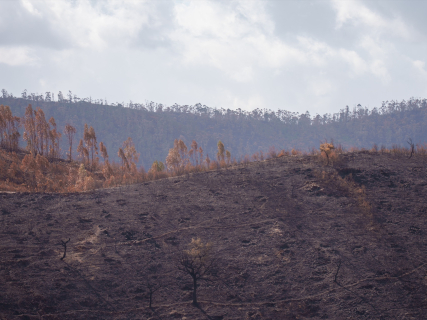
Fires in Spain today, Wednesday, August 26: Segorbe is under control and Collserola concentrates the main concern

The fire in the Sierra Calderona has been declared controlled after affecting 633 hectares, while the fire declared in Collserola during the afternoon of Tuesday remains stabilized after forcing evacuations and confinements.

3 minutes

incendios forestales 26 agosto

incendios forestales 26 agosto

Add DEMÓCRATA to Google

Ask FREN

Published

Last updated

3 minutes

Most read

The situation of the wildfires changes this Wednesday, August 26, with a new improvement in several of the major hotspots that have marked the last few days. The fire in Segorbe, in the Sierra Calderona, has been controlled after six days of work and after affecting 633 hectares, while the fire in Pinofranqueado, in Las Hurdes, remains controlled as well.

The main focus of attention is now in Collserola, in Barcelona. The fire declared during the afternoon of Tuesday forced the evacuation of residents of Torre Baró and confined several neighborhoods, although emergency services managed to stabilize it during the night. The favorable evolution allows for a reduction in the emergency, but the device continues to work on the ground.

Segorbe is controlled after six days of work

The wildfire declared on August 20 in Segorbe, caused by a lightning strike, has been controlled after six days of extinguishing work. The fire affected 633 hectares in the surroundings of the Natural Park of the Sierra Calderona, mainly in the terms of Segorbe and Gátova.

The improvement in weather conditions allowed for the stabilization of the fire over the weekend and subsequently continue with the consolidation and cooling work of the perimeter. The declaration of control represents a new step in the evolution of the fire, although the teams remain deployed and the fire has not yet been declared extinguished.

Collserola stabilizes after forcing evacuations and confinements in Barcelona

The fire declared on Tuesday in the surroundings of the Natural Park of the Sierra de Collserola has become the main episode of the last few hours. The fire affected a forested area near the Barcelona neighborhoods of Canyelles and Torre Baró and forced the preventive evacuation of several residents.

Emergency services also ordered confinements in nearby areas while a large ground and air device worked to stop the advance of the flames. During the night, the teams managed to stabilize the fire, although the affected area and the perimeter remain under evaluation while surveillance and control work of possible hot spots continues.

Pinofranqueado remains controlled in Las Hurdes

The fire in Pinofranqueado, in the Cáceres region of Las Hurdes, remains controlled after several days of emergency. The fire forced the evacuation of numerous hamlets and raised concerns due to its proximity to the province of Salamanca, although subsequent developments allowed for the gradual lifting of restrictions.

The latest known estimate places the affected area at about 3,765 hectares. The operation continues to carry out surveillance and monitoring tasks over the affected area, while the emergency has transitioned to a new phase focused on the recovery of the affected nuclei and territory.

The Peñas de Riglos fire remains controlled while extinction work continues

The fire in Las Peñas de Riglos, in Huesca, remains controlled, according to updated information from the INFOAR operation. The fire was one of the most serious in August and still requires work on the perimeter to eliminate smoke and other hot spots.

The current situation is very different from that recorded during the first days of the emergency, when the flames forced the evacuation of several population centers. Teams are now continuing with manual and surveillance work to move towards definitive extinction and prevent possible re-ignitions.

Biscarrués and Aliaga maintain a favorable evolution

The fires declared during the past weekend in Biscarrués, in Huesca, and Aliaga, in Teruel, continue to show a favorable evolution. The former was stabilized shortly after its detection and the latter was declared controlled during the same day.

The Aragonese operation continues to monitor both fires while necessary tasks to complete their extinction are ongoing. The rapid intervention of resources prevented these fires from spreading further or generating a similar emergency situation to that experienced weeks ago in Las Peñas de Riglos.

More key points, information and questions with FREN

AI-GENERATED CONTENT

What are the legal and administrative procedures to officially declare a forest fire extinguished in Spain?

In Spain, there is no single regulation that details, step by step, how a forest fire is declared extinguished, but there is a common framework derived from the basic state regulations (Forestry Law, National Civil Protection System Law, Basic Directive and State Plan for forest fires) and from the specific regional plans (such as the Andalusian INFOCA Plan or the special fire plans of each autonomous community).

1. Key concepts: controlled, stabilized, and extinguished

The Basic Directive for Civil Protection Emergency Planning for Forest Fires, approved by Royal Decree 893/2013, and the State Civil Protection Plan for Forest Fire Emergencies (Resolution of October 31, 2014, BOE-A-2014-11493) establish definitions that are then reproduced by the regional plans:

  • Controlled forest fire: one in which the fire's advance and spread have been isolated and stopped within control lines.
  • Stabilized forest fire: a fire that, without being controlled, evolves within the established control lines according to forecasts and extinguishing efforts.
  • Extinguished forest fire: a situation in which there are no longer any ignited materials in or within the fire perimeter and its reproduction is neither possible nor foreseeable.

These concepts are commonly used throughout the territory because the Basic Directive and the State Plan act as a minimum reference framework for the regional plans.

2. Who declares each phase and the competence framework

The Law 43/2003, on Forests, in its regulation on fires, establishes that the responsibility for organizing defense against forest fires lies with the autonomous communities and the General State Administration, with collaboration from local entities. Each community approves its special forest fire plan, which specifies:

  • The plan's management structure.
  • The severity levels of the fire.
  • Who is the Technical Extinguishing Direction and what decisions correspond to it.

For example, the Andalusian Forest Fire Emergency Plan (Decree 371/2010) provides that the Technical Extinguishing Direction, from the Advanced Command Post, is the one who “declares the fire controlled” and “declares the fire extinguished”, communicating it to the Operations Center. This is a pattern repeated, with nuances, in other regional plans.

For civil protection purposes, Law 17/2015, of the National Civil Protection System, and the Basic Civil Protection Standard (Royal Decree 524/2023) establish that:

  • Ordinary management corresponds to the competent autonomous community.
  • The State assumes direction only if the emergency is declared of national interest.

3. Technical criteria and documentation

The decision to declare a fire extinguished is technical and falls on the Technical Extinguishing Direction, which evaluates, among others, these elements:

  • Absence of hot spots on the surface and in depth within the perimeter.
  • Meteorological and fuel conditions that make reproduction not foreseeable.
  • Final reconnaissance of the entire perimeter by teams (on foot, with vehicles, or aerial means).

The State Forest Fire Plan foresees the preparation of a “end of fire bulletin”, with a final summary of its evolution and consequences, prepared by the Government Delegations/Subdelegations based on information sent by the autonomous community. Regional plans usually require:

  • End of intervention report from the Technical Extinguishing Direction.
  • Record of affected surface, damages to people, goods, and infrastructures.
  • Formal communication to the civil protection body of the community and, if applicable, to the state CECOPI.

4. Legal effects of the extinction declaration

The official extinction has several effects:

  • Closure of the emergency phase due to forest fire and transition to the recovery and damage repair phase, under Law 17/2015.
  • Demobilization of extinguishing and civil protection resources, although surveillance and security tasks may be maintained.
  • Activation of damage assessment mechanisms that may lead to the declaration of a zone severely affected by a civil protection emergency and to measures of aid, subsidies, or social and tax benefits.
  • In the forestry field, the Forestry Law and regional regulations foresee consequences on the future use of the burned land and its registration in burned land registries, with limitations on land use changes and restoration obligations.

However, the extinction declaration does not close the investigation and liability process:

  • Cause investigation work (by forest/environmental agents, security forces) continues regardless of when the fire is declared extinguished.
  • Criminal and administrative liabilities (forest fire crimes, fire use infractions, negligence, etc.) are processed according to the Penal Code and administrative sanction legislation even if the fire is already extinguished.
  • For insurance and other coverages, the official date and time of extinction, recorded in the end of fire report or bulletin, serve as a temporal milestone to delimit the claim, but do not affect the existence of coverage itself, which is governed by the policy.

In summary, the official extinction declaration is a technical-formal act, adopted by the Extinguishing Direction within the regional and state regulatory framework, which marks the end of the operational emergency but not the end of the fire's legal cycle, which continues with investigation, liability resolution, and restoration of the affected environment.

What competencies and functions do the regional and state emergency services have in forest fire management?

In Spain, forest fire management relies on a division of competencies in which the autonomous communities play the central role in prevention and extinguishing, while the State provides general coordination and strategic reinforcement resources (aerial means, specialized brigades, armed forces, and state civil protection). All this is articulated through special emergency plans for forest fires and formal coordination mechanisms between administrations.

General division of competencies

The autonomous communities are, as a general rule, responsible for the management of forest territory and for the prevention and extinguishing of fires within their scope. This includes regional forestry regulation, prevention devices (cleanings, firebreaks, use of fire in rural areas), and fire and forest agent services.

The State mainly has functions of:

  • General coordination and basic planning in civil protection and environmental matters.
  • Provision of national support resources: large capacity aircraft, forest reinforcement brigades, and in severe situations, the Military Emergency Unit (UME).
  • Management of emergencies of national interest, when the magnitude or territorial impact justifies it.

Functions of regional emergency services

In practice, in most forest fires, command is held by the autonomous community through its own devices:

  • Regional or consortium firefighters: intervene in direct extinguishing, protection of population centers, infrastructures, and assets, and in securing tasks once the fire is controlled.
  • Forest services and agents: play a key role in surveillance, early detection, cause investigation, support to extinguishing direction, and, outside the campaign, in prevention and silvicultural management.
  • Specialized regional devices (INFOCA in Andalusia, INFOCAT in Catalonia, INFOPA in Asturias, etc.): integrate ground resources, helitransported units, command technicians (extinguishing director, sector chiefs), coordination centers, and communication and analysis systems (cartography, meteorology, fuel).
  • Regional Civil Protection: coordinates the population protection dimension (evacuations, confinements, shelters, public information) and activates special emergency plans for forest fires at their different levels.

These devices develop and manage their special forest fire plans, which regulate organization, emergency levels, aid request procedures, and coordination with other services (health, security, volunteers, etc.).

Functions of state resources (BRIF, UME, aerial means)

State resources do not replace the regional device but act as reinforcement when requested by the community or when the emergency acquires national dimension:

  • State aerial means (amphibious planes, heavy helicopters) are deployed to support extinguishing in fires of high complexity, simultaneity, or when regional means are insufficient. Their missions are coordinated from regional command centers through established protocols.
  • BRIF (forest fire reinforcement brigades) are highly specialized helitransported units, integrated into the fire device under regional extinguishing direction, although they depend organizationally on the General State Administration.
  • The UME intervenes in large or high-risk fires for people and assets, when requested by the autonomous community or when the emergency is declared of national interest. It provides massive attack, logistics, and command capacity in very complex situations.

In all cases, the principle applies that the technical command of extinguishing lies with the authority designated by the autonomous community (usually the extinguishing director), while state resources are integrated into the operational structure defined by the regional plan.

Civil protection and special plans

The state Civil Protection develops basic planning and common criteria, maintains alert systems, and coordinates, if necessary, emergencies that exceed regional capacity. Through state plans, mechanisms for aid requests, use of national resources, and coordination between communities are established.

The regional special plans (such as INFOCAT, INFOPA, etc.) define risk zones, emergency levels, command structure, integration of resources from other administrations, and population protection measures. When the situation requires, higher phases can be activated that involve mobilization of state resources and, if necessary, assumption of general coordination by the State, always in close collaboration with the affected community.

What requirements must affected communities meet to receive state aid or European funds after a forest fire?

After a forest fire, autonomous communities and local entities do not receive state or European aid automatically. A series of material requirements (severity of damages) and procedural requirements (formal declarations, economic estimates, applications, and documentation) must be met to activate both State aid and European Union funds.

Below is a summary of the main requirements and steps, distinguishing between state aid linked to the declaration of a zone severely affected by a civil protection emergency and European aid, especially from the EU Solidarity Fund (EUSF).

1. Requirements to activate state aid

1.1. Declaration of severely affected zone

Law 17/2015 of the National Civil Protection System, developed by Council of Ministers agreements and Royal Decree 307/2005, requires the Government to formally declare the zone as a “zone severely affected by a civil protection emergency” (formerly “catastrophic zone”). This declaration:

  • Is approved by the Council of Ministers, at the proposal of Interior and Treasury.
  • Expressly delimits the municipalities and territories included.
  • Must be justified by:
    • Personal or material damages of special severity.
    • Severe alteration of living conditions of the population.
    • Paralysis of one or more essential public services.
    • A clearly determined geographical impact.

Communities and municipalities can request this declaration, but the final decision is state. Additionally, they must have communicated the emergency to the National Emergency Center (CENEM) and the elevation of the civil protection plan to operational levels 1 or 2; in fact, Interior has had to open extraordinary channels to include fires not communicated at the time and avoid affected parties being excluded from the aid package (Interior note 08/28/2025).

1.2. Requirements for aid to individuals, companies, and administrations

The declaration opens the door to a “menu” of measures (not all are always activated). For neighbors, companies, or administrations to receive aid, it is usually required:

  • Being within the territorial scope indicated in the Council of Ministers agreement or subsequent orders.
  • Proving damages with technical reports, photographs, budgets, and ownership or usage documentation (for example, for primary residences, agricultural holdings, or businesses), according to the scheme of Royal Decree 307/2005 and specific regulations.
  • Meeting economic or size requirements, such as:
    • Staff and activity limits for aid to small industrial, commercial, or service establishments.
    • Income requirements of the family unit for certain housing and belongings aid.
  • Submitting the application on time to Government Delegations/Subdelegations or electronic offices. The general regime sets one month from the end of the causative events, except for extensions or special regimes announced in the BOE.
  • Compatibility and accumulation: the sum of public aid and insurance cannot exceed the real value of the damage; calls usually require declaring other aids and compensations.

In parallel, municipalities and provincial councils must submit repair projects for infrastructures and justify urgent expenses (evacuations, accommodations, cleaning, service replacement) to access state subsidies often financed with the Contingency Fund, as various Treasury notes indicate (06/10/2025, 07/30/2024).

2. Requirements to receive European funds after fires

2.1. European Union Solidarity Fund (EUSF)

The EUSF finances part of the public emergency and reconstruction costs after major disasters. Recent information about the 2025 fires shows the usual scheme:

  • The Member State (Spain) must submit an application to the European Commission, including:
    • Detailed estimate of direct damages (in 2025 valued at over 4.3 billion euros, according to Demócrata).
    • Description of eligible actions: repair of infrastructures and essential public services, cleaning of damaged areas, temporary accommodation, rescue services, etc. (Demócrata article; Treasury note 06/11/2026).
  • The Commission evaluates whether it is a major natural disaster according to the Fund's regulation thresholds and proposes an amount.
  • The European Parliament and the Council must approve the credit mobilization; only then are the advance (when applicable) and final payment made.
  • The money is destined to public expenditure of States and territorial entities, not to direct individual payments; therefore, recipient communities and municipalities must:
    • Include actions in approved programs and budgets.
    • Justify expenses before the State and, through it, before the EU.
    • Comply with European contracting, state aid, and financial control rules.
2.2. Other European instruments

Besides the EUSF, the following can be mobilized:

  • The agricultural reserve of the CAP or specific measures for damaged agricultural and livestock holdings, for which the Ministry of Agriculture and autonomous communities must justify losses and compliance with European regulations.
  • The EU Civil Protection Mechanism, activated during the emergency for extinguishing means, but also entails information and coordination obligations that can facilitate later access to funds (explanation in Demócrata).

In summary, for an affected community to fully benefit from state and European aid after a forest fire, it is key: that the emergency is correctly declared and documented, that damages are rigorously quantified, that the requirements of each aid line are met, and that applications are processed timely and properly.

Play

Test your knowledge with FREN!

How much do you know about this topic? Answer the following 3 questions.

Which fire is currently considered the main focus of concern according to the news?

Question 1 of 3

How many hectares were affected by the Pinofranqueado fire in Las Hurdes?

Question 2 of 3

What measure was taken in the Barcelona neighborhoods of Canyelles and Torre Baró due to the fire in Collserola?

Question 3 of 3

Hola, soy Fren. ¿Cómo te ayudo?