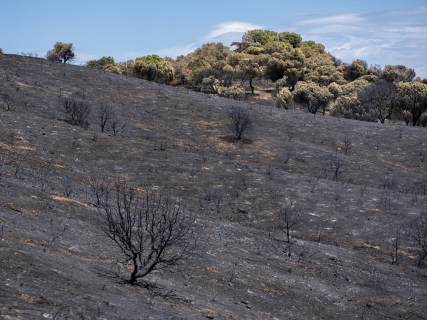
Fires today in Spain: confinement in Castellón and emergency due to the fire in Niebla

Spain wakes up this Saturday, August 8, with several active wildfires. The most concerning situation is concentrated in Niebla, in Huelva, where the UME is working after the evacuation of 66 people, and in Castellón, where an Es-Alert ordered the confinement of Sierra Engarcerán due to smoke while other hotspots remain active in Culla and Tirig.

1 minute

incendios forestales

incendios forestales

Add DEMÓCRATA to Google

Ask FREN

Published

Last updated

1 minute

Most read

On Saturday, two major focal points on the fire map begin: Huelva and Castellón.

In Andalusia, the fire in Niebla continues in operational situation 2 after a particularly complicated day due to wind changes.

In the Valencian Community, Emergencies issued an Es-Alert during the night directed at the residents of Sierra Engarcerán due to a fire that started in Vall d'Alba and advanced towards that area.

Sierra Engarcerán: confinement order

The emergency message asked residents to stay inside their homes, close doors and windows, stop ventilation systems, and turn off air conditioning units and extractors.

Preventive evacuations were also ordered in some farmhouses, and situation 2 of the Special Plan Against the Risk of Forest Fires was established.

The UME was also mobilized towards the fire in Castellón.

During the early morning, 11 units of forest firefighters from the Generalitat were working, ten fire trucks, personnel from the Provincial Consortium, volunteers, health services, Generalitat Police, and Civil Guard.

Lightning behind several fires in Castellón

Aemet Valencian Community reported numerous electrical discharges over the province.

The lightning affected points where fires were later detected in Sierra Engarcerán, Culla, and Tirig.

In addition to the main fire, firefighters are working on declared fires in these other two localities.

Niebla remains in operational situation 2

In Huelva, the fire that started in the area of Raboconejo has one of the most important devices of the day deployed.

There are 66 people evacuated, and the roads HU-3106 and A-493 remained closed in the latest available update.

The provisional estimate places the burned area at about 380 hectares.

The Junta requested the incorporation of the Military Emergency Unit after successive wind changes seriously hindered firefighting efforts.

More than 150 professionals work in Niebla

During Friday, 24 aerial resources operated, along with around 150 ground personnel and heavy machinery.

Weather conditions forced the withdrawal or redistribution of aerial resources at times for safety.

The fire in Villablanca, also in Huelva, was extinguished on Friday.

More key points, information and questions with FREN

AI-GENERATED CONTENT

What is the process and requirements for declaring situation 2 of the Special Plan against the Risk of Forest Fires in the Valencian Community?

In the Special Plan against the Risk of Forest Fires of the Valencian Community (PEIF), the declaration of pre-emergency levels corresponds to the plan's management, which is based on the forest fire hazard index from AEMET and other risk factors. In the consulted regulations and in the recent joint resolution of August 5, 2026, only the level 3 pre-emergency and the “risk situation due to unforeseen circumstances” are expressly developed, but the specific procedure or technical thresholds for the so-called “situation 2” are not detailed. Therefore, the general framework of competencies and criteria can be described, but it is not possible to precisely reconstruct, from the available sources, all the specific requirements for that situation 2 of the PEIF.

General regulatory framework of the PEIF

The resolution published in the DOGV on August 7, 2026 clearly places the PEIF within the regional civil protection and emergency management system. It is supported, among others, by:

  • Law 4/2017, establishing the Valencian Agency for Security and Emergency Response (AVSRE), which assigns this body the management of emergencies, including forest fires.
  • Law 3/1993, Forest Law of the Valencian Community, which allows limiting access to forests (art. 59 bis), suspending social and recreational uses due to fire risk (art. 61.2), and prohibits the use of fire at certain pre-emergency levels.
  • Decree 91/2023, Regulation of Law 3/1993, which develops:
    • Art. 130, on the declaration of “risk situation of forest fire due to unforeseen circumstances.”
    • Art. 139, linking the level 3 pre-emergency of the PEIF with very broad fire prohibitions and possible transit restrictions.

The resolution text itself indicates that “the Special Plan against the risk of forest fires of the Valencian Community (hereinafter PEIF) establishes that the plan management is responsible for declaring the pre-emergency level.” That is, the entire system of levels (1, 2, 3…) is formally integrated into the PEIF, although only level 3 is expressly developed in the consulted documentation.

Competent body to declare levels and situations

From the resolution and references to Decree 91/2023, the following distribution of competencies emerges:

  • PEIF management: declares “the pre-emergency level” using information from AEMET's forest fire hazard index, along with sociocultural factors and other circumstances affecting risk.
  • Directorate general with competencies in forest fire prevention and directorate general competent in emergencies and civil protection: according to art. 130 of Decree 91/2023, they can declare the “risk situation of forest fire due to unforeseen circumstances” (extreme heat waves, strong wind, extreme drought, accumulation of people, etc.).
  • In practice, the August 5, 2026 resolution is signed by the regional secretary of Emergencies and Interior (director of AVSRE) and the regional secretary of Environment and Territory, reflecting a joint declaration of pre-emergency level and extraordinary restrictions.

General criteria for declaration (applicable to any level, including situation 2)

Although the available text does not literally mention “situation 2,” it does specify the general criteria the PEIF uses to set pre-emergency levels and activate restrictions:

  • AEMET fire hazard index: objective meteorological basis (temperature, humidity, wind, etc.).
  • Sociocultural factors: forecast of people influx to forest areas or protected natural spaces (for example, the resolution mentions the “solar eclipse” as a cause of crowds increasing risk).
  • Other unforeseen circumstances included in art. 130 of Decree 91/2023:
    • Significant temperature increases.
    • High sustained wind speed.
    • Extreme drought or other extraordinary natural risks.
    • Accumulation of people or other circumstances increasing ignition probability.

With these elements, the plan management assesses the risk and declares the corresponding level (1, 2, 3…), and simultaneously, if the circumstances of art. 130 concur, a “risk situation due to unforeseen circumstances” can be declared, enabling additional restrictions on access, fire use, or activities in the forest.

Limitations of information on “situation 2”

In the resolution published in the DOGV (resolution of August 5, 2026) and in the consulted normative extracts, there is no explicit definition of “situation 2” of the PEIF, nor an article detailing its technical requirements (specific risk index thresholds, affected area, operational intensity, etc.). Only the following is described:

  • The competence of the PEIF management to set pre-emergency levels in general.
  • The legal regime of level 3 (general fire prohibition, suspension of permitted uses, possibility to restrict transit, etc., according to art. 139 of Decree 91/2023).
  • The figure of the “risk situation of fire due to unforeseen circumstances” (art. 130 of Decree 91/2023) declared by the competent directorates general.

Therefore, based on the available sources, only the general framework (who decides, with what type of information and legal instruments) can be explained, but not a closed and exact list of specific requirements for the “situation 2” of the PEIF. No further information is available in the consulted sources.

Practical advice

If it is necessary to apply or invoke “situation 2” in an operational context (municipality, company, third sector entity), it is advisable to request the full and updated text of the PEIF from the Valencian Agency for Security and Emergency Response or the competent department in emergencies and civil protection, where the following should appear:

  • The exact definition of each situation (0, 1, 2, 3, etc.).
  • Objective thresholds (risk index, AEMET forecasts, etc.).
  • Operational consequences and use limitations for each level.
What specific measures does the PEIF differentiate between situation 1 and situation 2 of forest fire emergency? How does the Generalitat coordinate with municipalities when a high pre-emergency level of the PEIF is declared? What is the relationship between the PEIF and Law 3/1993 Forest Law of the Valencian Community and how is it applied in practice during a heat wave?

What competencies and functions does the Military Emergency Unit have in forest fire management according to Spanish law?

The Military Emergency Unit (UME) has, under Spanish regulations, the mission to intervene in serious emergencies, including expressly forest fires, with functions focused on protecting people, property, and the environment, acting as an extraordinary state support resource for autonomous communities. Its competencies are framed within civil protection policy (Law 17/2015), the Intervention Protocol approved by Royal Decree 1097/2011, and the ministerial order regulating its internal organization. Additionally, the State Civil Protection Plan for Forest Fire Emergencies defines the UME as an extraordinary state resource and integrates it into the command and coordination structure of large fires.

General framework and creation of the UME

The UME was created by Agreement of the Council of Ministers on October 7, 2005, published by the resolution of January 19, 2006. That agreement sets its generic mission: to intervene anywhere in the national territory, when decided by the President of the Government or the delegated minister, to contribute to safety and welfare in cases of serious risk, catastrophe, calamity, or other public needs. Its military nature, placement under the Ministry of Defense, and the possibility of using all Armed Forces means are emphasized.

The Law 17/2015, of the National Civil Protection System integrates the UME into the state civil protection system, reiterating the participation of the Armed Forces and the UME in civil protection actions and highlighting that the law includes the “essential rules governing the intervention of the Military Emergency Unit,” consolidated as an effective instrument against emergencies.

Intervention protocol and specific mention of forest fires

The operational framework against fires is established in the UME Intervention Protocol. The first protocol was approved by Royal Decree 399/2007, which was annulled by the Supreme Court for formal reasons and replaced by Royal Decree 1097/2011, which currently governs.

In the annex of Royal Decree 1097/2011, among the emergency situations in which UME intervention may be ordered, the following are expressly listed:

  • “b) Forest fires” as one of the serious emergencies justifying UME activation.

The protocol itself establishes that, once intervention is ordered, UME's operational actions focus on adopting measures to safeguard, protect, or assist the life and integrity of people, their property, the environment, natural spaces, and their resources. In forest fires, this translates into tasks of extinguishing, supporting evacuations, protecting urban-forest interface nuclei, and defending critical infrastructures.

Royal Decree 1097/2011 also regulates aerial firefighting resources, organically assigning the Ministry of Defense the means of the 43rd Air Force Group and functionally to the then Ministry of Environment, but foreseeing that when the UME participates in a national interest emergency it may require and direct those aerial means in the extinction operation.

Organization and scope of its actions

The Order DEF/160/2019 regulates the organization and functioning of the UME. It reiterates that:

  • Its operational actions are governed by Royal Decree 1097/2011 and are aimed at protecting people, property, environment, natural spaces, and heritage.
  • The UME only performs necessary prevention tasks to face a declared emergency, although it may act in alert or pre-emergency situations to minimize the severity of a fire before its formal declaration.
  • In extreme need situations, the UME Chief may order the intervention of its units, reporting to the Defense minister.
  • The UME may use personnel and means of the Armed Forces when necessary, and its members have authority agent status in the exercise of their functions.

Role in the forest fire system and coordination

In the sectoral scope of forest fires, the State Civil Protection Plan for Forest Fire Emergencies, approved by resolution of October 31, 2014, defines the UME as part of the “extraordinary state resources”. The plan foresees that these resources—including the UME—are mobilized when the autonomous community requests it or when the emergency has interregional scope or requires additional state resources.

The plan creates coordination figures such as the Integrated Operational Command, which integrates UME commanders alongside other action groups, and distinguishes the Single Extinction Command for fires affecting several autonomous communities and requiring state resources. Thus, legally the UME:

  • Does not assume ordinary extinction competence (which is regional),
  • But acts as an extraordinary reinforcement, under coordinated command schemes, when the State Plan is activated or a national interest emergency is declared.

Complementary regulations

To complete the framework, the following also impact the UME's role against fires:

In summary, the UME has a functional competence to intervene in serious forest fires as a military state resource, activated by the Government or at the request of Interior within civil protection, with functions focused on extinction and protection of people, property, and environment, always in coordination with the regional authorities competent in ordinary extinction.

[link] [link] [link] [link] [link] [link] [link] [link] [link] [link] [link] [link] [link] [link] [link] [link] [link] [link] [link] [link] [link] [link] [link] [link] [link] [link] [link] [link] [link] [link] [link] In what specific cases is a national interest emergency declared in a forest fire for the UME to assume a central role? How is the UME's action legally coordinated with the regional forest fire extinction services? What differences does the regulation establish between the UME's intervention in forest fires and in other types of emergencies such as floods or heavy snowfalls?

How many forest fires have required UME intervention in Spain in the last year?

The question about how many forest fires have required UME intervention in Spain in the last year does not currently have an official global figure published for the period August 2025–August 2026. What does exist is a consolidated figure for the 2025 summer fire campaign: the Military Emergency Unit participated in 48 interventions in 9 autonomous communities, acting in up to 14 simultaneous fires, according to the Ministry of Defense. For 2026, Interior's notes and media coverage indicate a very strong increase in large fires and numerous UME activations, but without a closed numerical balance of interventions. Therefore, only that minimum of 48 interventions in summer 2025 can be stated precisely, knowing that the real figure in the last twelve months will be higher but has not yet been published in aggregate form.

The only closed data: the 2025 summer fire campaign

The Ministry of Defense provided a specific balance of the 2025 summer campaign in the press release “Robles, to the forces deployed in the fires: ‘Thank you for always being there’”. That document details that:

  • The UME participated in 48 interventions against fires.
  • It acted in 9 autonomous communities.
  • On the most critical days (August 14, 15, and 16) it was deployed in 14 fires simultaneously.
  • More than 6,500 military personnel and over 2,000 resources participated in that “wave” of fires.

This same volume of 48 actions is reiterated in political and media information. The proposal debated and supported in the Defense Commission of Congress, covered by the newspaper Demócrata in “Parliament supports the UME for its action in fires…” and in another parliamentary report, also speaks of 48 actions in nine communities, with interventions lasting almost 15 consecutive days.

Why there is no clear figure for the “last year”

The “last year” (August 2025–August 2026) covers two different realities:

  • The 2025 campaign, very well quantified in terms of number of fires, burned area, and UME role.
  • The 2026 campaign, still ongoing with provisional data, where official sources prioritize affected area and number of large fires but do not yet offer a complete breakdown of UME activations.

Interior, for example, has provided balances on the worsening of fires in both 2025 and 2026, in notes such as “Interior extends the forest fire campaign until October 31”, indicating that 2025 was the worst year of the decade, with 6,697 fires and outbreaks and more than 348,000 hectares burned, or in the 2026 update recalling that the previous year had 63 large fires, according to this other Interior note and its version in La Moncloa [link]. But neither in these balances nor in Defense's is there, so far, an annualized total of “number of fires with UME intervention” for 2025 plus early 2026.

Indirect indicators: increase in large fires and UME deployments

Until an updated official balance is available, the best quantitative indicator remains that minimum of 48 UME interventions in 2025. Added to this are several relevant clues:

  • Defense and Ecological Transition announced a structural reinforcement of the UME device for fires, with 1,400 military personnel directly deployed and nearly 3,000 people involved in total, according to joint 2025 notes from Defense ([link]) and Ecological Transition at La Moncloa ([link]).
  • The Xunta de Galicia documents in multiple notes (for example, 8/5/2025, another on 8/5/2025, also on 8/5/2025, 8/6/2025, 8/7/2025, 8/7/2025, 8/24/2025, 8/24/2025 (afternoon) and 8/25/2025) the presence of the UME in several specific fire sites, confirming that a significant part of the major emergencies in Galicia have also required military support.

In parallel, the newspaper Demócrata has portrayed the political and operational dimension of these interventions: from the PSOE proposal to honor the UME (“PSOE requests recognition in Congress for UME's effort against fires” and the Commission debate), to the monitoring of the large 2026 deployments in Madrid, Ávila, Andalusia, Catalonia, or Aragon (national emergency in Madrid and Ávila, 65,000 people evacuated, Los Gallardos fire, [link], Murcia fire, Cinco Villas, Soneja–Azuébar, active fires July 8, balance July 14, July 9, UME contained in Madrid and Ávila, 152,678 hectares burned, 194,122 hectares, political controversy about UME's role, Marlaska's statements, [link], [link], exchange with Bendodo, 20 years of the UME, praise from Margarita Robles and explanatory piece on who mobilizes the UME).

Conclusion

With the available information, the only closed and official figure is that the UME intervened in 48 forest fires during the 2025 summer campaign in nine autonomous communities. It is reasonable to assume that, adding the actions from late 2025 and the very intense 2026 campaign, the total number of fires requiring the UME in the last twelve months is higher, but so far there is no published global data to specify that annual figure without speculation.

Is there any place where annual statistics of UME interventions in forest fires are systematically published? Which autonomous communities have most frequently requested UME intervention in the 2026 summer fires? How is the UME activation legally decided and what legal framework regulates its participation in forest fires?

Play

Test your knowledge with FREN!

How much do you know about this topic? Answer the following 3 questions.

Which town in Castellón received a lockdown order due to a fire?

Question 1 of 3

How many people were evacuated in Niebla (Huelva) due to the fire?

Question 2 of 3

What meteorological phenomenon was identified as the cause of several fire outbreaks in Castellón?

Question 3 of 3

Hola, soy Fren. ¿Cómo te ayudo?