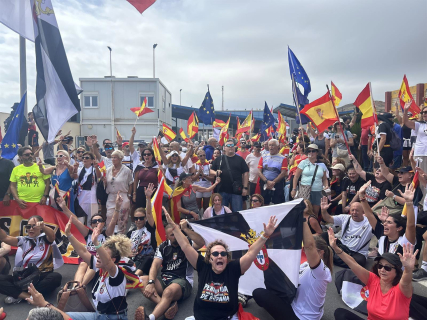

Women from Ceuta have organized a mobilization in Madrid for this Sunday with the aim of demanding measures that allow the autonomous city to recover the "normality" prior to July 30, the date on which the massive entry of 80,000 people from Morocco occurred. During the march, they will demand a reinforcement of border control, the return of migrants, and the reform of the Immigration Law.
Starting at 11:00 a.m., Ceuta families will depart from the Atocha roundabout heading to the Congress of Deputies, in the Plaza de las Cortes, where the reading of a manifesto is planned that will set a time limit for their demands: thirty days for the requested changes to be implemented.
"We have not seen any solution in these three months. Ceuta needs an immediate return of immigrants and a reinforcement of the borders with more human, material, and technological resources," defends Maxi Lacasa, local police in the autonomous city and member of "Muejeres Caballas," in conversation with Europa Press.
The platform Mujeres Caballas will also demand at the concentration an urgent reform of the Immigration Law so that "it is adapted to the situation of Ceuta and Melilla," insists Lacasa, in addition to the approval of a specific decree law with measures for the city. "Why is there not the same urgency as with housing?" questions the local police.
The organizers point out that there are already around ten full buses with Ceuta families that will travel to the capital. Several local entrepreneurs have covered the cost of these vehicles to facilitate the attendance of residents at the demonstration, in which the Ceuta leader, Juan Jesús Vivas, will also participate.
In addition, they emphasize that buses have been chartered from other points in Spain such as Alicante, Granada, Seville, Málaga, or Talavera de la Reina (Toledo). "It is countless, in all the places where they could, a bus will come out," expresses Elisabeth Muñoz, nurse and member of Mujeres Caballas.
In this line, Mujeres Caballas encourages Madrilenians and citizens from different provinces to join the protest. "For us, the presence of people from different places is a hug to our cause," expresses Lacasa. The organization also asks to attend wearing white or black t-shirts, in reference to the colors of the Ceuta flag.
MOTHERS AT THE HEAD OF THE PROTEST
The platform Mujeres Caballas emerged spontaneously and is made up of "heads of families" from various professional fields who demand the support of all Spanish society. "We are lawyers, police officers, healthcare workers, teachers... Who at the school gates, in everyday conversations were the first to step forward to claim that Ceuta has to return to normal," explains Maxi Lacasa.
The concern for safety is one of the axes that has driven the 'caballas' to move to Madrid to demand changes. "We see daily brawls that require healthcare assistance. There have been more than 400 sexual assaults that occur especially among the migrants themselves because we are confining ourselves," explains the local police.
Lacasa also emphasizes the importance of guaranteeing protection for migrant women. "They are human beings. Why are there no violet points for them?" he insists. And he concludes: "Our Ceuta has never been like this. We just want to return to normal."
For her part, Muñoz describes the healthcare situation as "dantesque." "Nothing has been reinforced at all. We are abandoned to our fate. The Ministry of Health provides statistical data that is unrelated to the reality we live," denounces the nurse and general secretary of the Satse union in the autonomous city.
In her opinion, the "care pressure" has not been taken into account at any time, which has resulted in "neither Ceutans nor migrants who need it can be properly attended to."