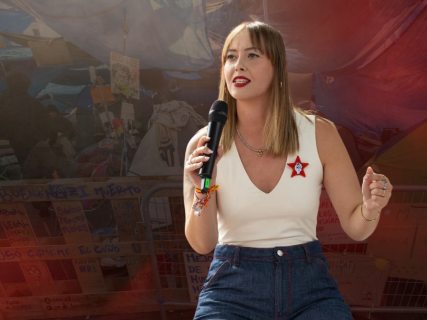
Aránzazu Figueroa, the face of the Ferraz quarry to attract the young vote

Ferraz gives a starting position (the eight for Madrid) to the leader of the Socialist Youth, considered “a diamond” with a speech crossed by municipalism, housing, and the living conditions of “my generation”

ILUSTRACIONES TEMAS (36)

ILUSTRACIONES TEMAS (36)

Add DEMÓCRATA to Google

Ask FREN

Published

3 minutes

Most read

Elecciones 29N · Encuestas

La media de las encuestas

Media a 21 de octubre de 2026 · 15 institutos

  • PP31,6 %
  • PSOE26,9 %
  • Vox18,7 %
  • Sumar6,3 %
  • Podemos3,1 %
  • ERC2,2 %
010203040ene 2024jul 2024ene 2025jul 2025ene 2026jul 2026

Media del último estudio de cada instituto en 30 días y su evolución semanal desde el 23J. Partidos con al menos un 2 %.

Todas las encuestas

Elecciones generales del 29 de noviembre · Demócrata

In the PSOE lists for Madrid for the general elections of 29N, among the President of the Government, Pedro Sánchez, ministers like Margarita Robles or Félix Bolaños, and seasoned faces like Rafael Simancas, emerges a name somewhat unknown to the common mortals who do not belong to the socialist ranks or do not follow daily activity: Aránzazu Figueroa, a young woman whom the leadership holds in the highest esteem and is called to be one of the most relevant profiles during the campaign.

Not in vain, Figueroa was one of the masters of ceremony of the rally held after the Federal Committee last Saturday. She took the floor alongside key figures like the Minister of Digital Transformation and Public Function and candidate for the Community of Madrid, Óscar López, the mayor of Fuenlabrada (socialist stronghold) Javier Ayala, and Sánchez himself.

During her speech, fiercely applauded by the attendees gathered there, she outlined some of the messages that make up her usual discourse. With a municipalist soul, she expressed her support for the striking Madrid teachers for dignified working conditions; backed the encampment at Puerta del Sol and throughout the Spanish geography for “decent housing”; and defended policies for “my generation.”

A “diamond” with present and much future

“You already heard her speak and, those of us who know her, are aware of her worth. We have a diamond,” sources from Ferraz point out to DEMÓCRATA; which is why she has been bet on and included in the starting positions for Congress. She occupies number eight and the PSOE hopes to maintain the ten that it currently holds.

In the party, they highlight the energy she transmits and her ability to permeate the younger electorate on issues like housing, one of the main axes of debate during the campaign due to the context in which the advance was called and the social situation, with encampments spread throughout the territory and a general strike for housing on November 11.

In the party, they highlight the energy she transmits and her ability to permeate the younger electorate on issues like housing

Who she is and where she comes from

Born in 1999, she is 27 years old, is a resident of Colmenar de Oreja, graduated in the double degree of Law and Economics, and has professional experience in legal advice and business management.

Since the age of 18, she has been a member of the Socialist Youth of Spain (JSE). She joined as a grassroots member in Aranjuez, in the absence of a socialist youth group in her region. In 2020, with the establishment of the Socialist Youth of the Las Vegas region, she assumed the General Secretariat of the organization. Subsequently, she also held the Secretariat of Organization of the Socialist Youth of Madrid (2023-2026) and is the current leader of the JSE at the national level.

Curriculum and trajectory aside, those in Ferraz value her organic commitment, her closeness to the membership, and her strong municipalist vocation. “Her commitment to municipalism and the pride of doing politics from rural Madrid constitute two of the most representative traits of her political identity,” they assert.

The card for the young and feminist vote

The PSOE hopes to capitalize on the young vote with profiles like that of Aránzazu Figueroa. Ferraz emphasizes that her way of doing politics connects with the real concerns of youth. Already in the campaign to lead the JSE, she defended the improvement of the material living conditions of her generation and the need to humanize politics and build a more accessible organization, open to citizens and connected with social and youth movements.

She is the first woman at the helm of the Socialist Youth of Spain, “a milestone that reinforces her feminist commitment and her will to pave the way for the women of her generation and those to come,” they affirm in Ferraz. In addition, she is part of the Advisory Council on Equality Policies of the PSOE, from where she “contributes to promoting a more egalitarian society and breaking the glass ceilings that still persist.”

She does not shy away from close combat, claims her roots as a banner, and uses clear, close, combative, and direct language to connect with the electorate.

In short, “Aránzazu represents a new generation of socialist political leaders who advocate for a politics that is close, rooted in the territory, and focused on improving people's lives. A way of understanding public commitment through listening, presence on the street, defense of social rights, and the conviction that politics must offer concrete answers,” conclude the sources consulted by this medium.

More key points, information and questions with FREN

AI-GENERATED CONTENT

At what stage of parliamentary processing is the PSOE candidacy for Madrid for the general elections on November 29?

The PSOE candidacy for Madrid for the general elections on November 29, 2026, does not have parliamentary processing but electoral processing. As of October 23, it has already completed its internal approval by the party, and the period for submitting candidacies to the electoral boards is open. The consulted sources do not show documentary confirmation of its specific submission nor an official proclamation of the Madrid list.

What phase has been completed

The internal process of preparing the socialist candidacies culminated with the ratification by the Federal Committee on October 17. It is important to distinguish three moments because the party's approval and the proclamation by the electoral administration are different decisions:

  • On October 14, the PSOE Regional Committee of Madrid approved its proposal of candidacies for the Congress and the Senate. The proposal for Congress included 38 candidates and was headed by Pedro Sánchez, followed by Margarita Robles and Félix Bolaños. (Demócrata, October 14).
  • On October 16, the Federal List Commission endorsed the candidacies for Congress and Senate before submitting them to the Federal Committee. (Demócrata, October 16).
  • On October 17, the Federal Committee ratified the lists and proclaimed Sánchez as the party's candidate for the Presidency of the Government, closing the organic approval procedure. This internal proclamation does not replace the electoral proclamation of the candidacy. (Demócrata, October 17).
At what point is the electoral procedure

The published calendar places the submission of candidacies between October 21 and 26. Therefore, October 23 corresponds to the period enabled to submit lists to the provincial electoral boards, not to a phase of debate, amendments, or voting in Congress or the Senate. (Demócrata electoral calendar).

The important clarification is that an open period does not prove that a specific candidacy has already been submitted. The consulted information confirms that the PSOE has ratified its list but does not allow assigning a submission date before the Madrid Provincial Electoral Board. Nor should the dissemination of its members be confused with its official proclamation: Demócrata's candidacy search engine explicitly distinguishes between names announced or ratified by parties and proclaimed lists. (Candidacy search engine).

What are the next milestones

According to the published electoral calendar, the next steps are:

  • October 26: deadline for submitting candidacies ends.
  • October 28: submitted candidacies are published.
  • November 2: proclamation by the electoral boards is scheduled.
  • November 3: proclaimed candidacies are published.

Between submission and proclamation, requirements are reviewed and possible defects can be corrected. Therefore, the initial publication of a submitted list does not equate to its later proclamation. (Submission and review of candidacies).

In conclusion, the precise description is: candidacy internally ratified by the PSOE, with the electoral submission period open and without official proclamation accredited in the consulted sources. It is not pending parliamentary approval: the next relevant milestone corresponds to the electoral administration.

What are the competencies and functions of the leader of the Socialist Youth of Spain according to the organization's statutes?

The leadership of the Socialist Youth of Spain (JSE) corresponds to the General Secretariat. According to the consulted Federal Statutes, its responsibilities include the political representation of the organization, the direction of its executive, setting its agenda, and administrative and financial management. To specify its scope, it is useful to distinguish between statutory competencies and the attributions detailed in the development regulations.

Competencies included in the Federal Statutes

Article 33 of the consulted Federal Statutes places the General Secretariat at the head of JSE's political direction and assigns it these functions:

  • Highest political representation. Represents the Socialist Youth both inside and outside the organization and, especially, before the PSOE. It is, therefore, the main political interlocutor figure of JSE in its relationship with the party.
  • Direction of the Federal Executive Commission. Leads the work of the CEF, the organization's federal executive team. This attribution refers to conducting its activity, not only to the public representation of the position.
  • Determination of the executive's composition. Intervenes in the configuration of the CEF within the competencies attributed by the Congress and the Federal Committee. This must be read with that limit: it does not equate to an unlimited faculty to configure the bodies outside the decisions that correspond to these.
  • Setting the political agenda. Establishes the organization's political priorities, that is, the issues on which JSE focuses its activity and public intervention.
  • International representation. Represents JSE before the international entities of which it is a member. The competence thus includes an external dimension besides political interlocution in Spain.
  • Administrative and financial management. Assumes the direction of the organization's administrative and economic management, in addition to its strictly political responsibilities.

These competencies appear in the consulted Federal Statutes and in the text of the 26th Congress. The latter also establishes that no person may hold the General Secretariat for more than two terms.

Functions specified by the regulations

The Development Regulation details other attributions of the position. Although they are part of the organizational regulations, it is important not to present them all as if they were literally enumerated in article 33:

  • Public representation and communication. Exercises JSE's representation before the PSOE and the media. May delegate it to executive members when compatible with applicable rules.
  • Casting vote. Has a casting vote in the Federal Executive Commission when there is a tie.
  • Territorial participation. May participate in lower JSE bodies with voice but without vote. This allows intervention in deliberations without voting due to that condition.
  • Editorial direction. Directs the editorial line of JSE's press.
  • Relations with youth entities. Maintains relations with other youth organizations and with the Youth Council of Spain.

In summary, the General Secretariat combines political leadership, representation, and organizational direction, but its attributions are exercised within the organization's distribution of competencies. There is a relevant temporal caution: the examined texts correspond to the 26th Congress; the 27th Congress opening in May 2026 is known, but no later statutory text allowing identification of possible modifications appears in the consulted sources.

How many seats did the PSOE obtain for Madrid in the last general elections and what is the current composition of Congress for that constituency?

The PSOE obtained 10 seats for Madrid in the last general elections, held on July 23, 2023. The constituency elected 37 deputies, distributed among PP, PSOE, Sumar, and Vox. To answer the second part of your question, it is necessary to distinguish that electoral result from the subsequent nominal composition: the consulted sources allow confirming the distribution from the polls but do not provide a complete and updated list of its members as of October 23, 2026.

The seat distribution for Madrid

The resulting distribution from the July 23 elections was as follows, according to the results collected by Demócrata:

  • People's Party: 16 deputies. It was the candidacy that obtained the most seats in the constituency.
  • Spanish Socialist Workers' Party: 10 deputies. It was the second candidacy by number of representatives.
  • Sumar: 6 deputies. It was the third candidacy by representation.
  • Vox: 5 deputies. Completed the distribution of the 37 seats.

Therefore, the ten socialist deputies represented approximately 27% of the Madrid seats: ten out of thirty-seven. This proportion refers to the representation obtained, not the percentage of votes. The distribution can also be consulted in the RTVE results.

What can be said about the subsequent composition

The above distribution precisely answers how many seats each candidacy obtained. However, it does not by itself identify who occupies each seat later nor certify the parliamentary affiliation of all representatives on a specific date. The consulted documentation shows personal changes during the legislature that should be kept in mind.

  • The replacement of Íñigo Errejón. Demócrata explained on October 29, 2024, that after his resignation, the seat corresponded to Alda Recas Martín, number seven on the Sumar candidacy for Madrid and belonging to Más Madrid. The information indicated that this replacement maintained Sumar's representation. It can be seen in their information about the group.
  • The resignation of Noelia Núñez. A Demócrata report from August 19, 2025, noted that the PP deputy for Madrid had left her seat. At that time, the news did not confirm who would replace her. That data describes the situation then but does not confirm that the vacancy remained afterward. This is noted in the parliamentary departures balance.
The answer to use

If you need to cite the result of the last elections, the formulation is unequivocal: "The PSOE obtained ten of the thirty-seven seats elected by Madrid; the distribution was PP 16, PSOE 10, Sumar 6, and Vox 5."

If you need the current composition by names and groups, no complete and updated list appears in the consulted sources. It would not be correct to automatically present the 2023 candidacies as a current nominal list, nor to deduce changes in party distribution solely from the mentioned resignations.

In short: ten seats for the PSOE is the accredited electoral answer. The 16–10–6–5 distribution identifies the representation resulting from July 23 but should be cited with that date and not as certification of the current nominal composition.

Play

Test your knowledge with FREN!

How much do you know about this topic? Answer the following 3 questions.

What is Aránzazu Figueroa's current responsibility within the PSOE?

Question 1 of 3

What topic did Aránzazu Figueroa highlight in her speech after the Federal Committee?

Question 2 of 3

How old is Aránzazu Figueroa according to the news?

Question 3 of 3