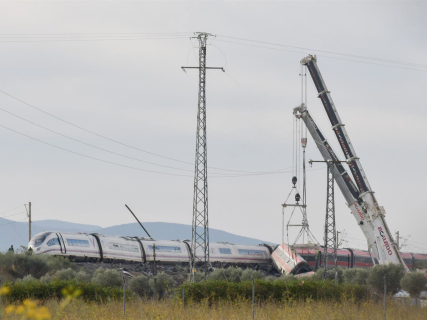

The Government plans to approve this Tuesday, November 3, a royal decree with financial aid intended for the victims and family members affected by the Urda (Toledo) railway accident. The measure will be addressed at the first meeting of the Council of Ministers since the tragedy of last October 28, which has caused 69 deaths, according to the balance reported by the EFE Agency.
Sources from the Executive have confirmed to EFE that the Council will also receive a report from the Minister of Transport and Sustainable Mobility, Óscar Puente, on the circumstances of the accident. The plan is for the minister himself to later appear at a press conference from the Palacio de la Moncloa to explain the content of the measures and offer new details about the actions undertaken.
The announcement comes after Pedro Sánchez announced last Thursday, during a statement in Toledo, that the General State Administration would mobilize resources to assist those affected. The president assured that the Government would maintain its efforts both in assisting the victims and in clarifying the causes of the accident and restoring railway safety.
The aid for the victims of Urda: amounts still pending to be specified
The Government has still not detailed how much money each family will receive or what amounts will correspond to the passengers who have suffered injuries. These issues must be defined in the regulation that the Council of Ministers plans to approve on Tuesday.
The objective is to establish a mechanism of economic support that will allow those affected to face the immediate consequences of the tragedy, without relying exclusively on the usual timeframes of insurers or on the judicial proceedings that may be opened.
The Executive has a recent precedent: the extraordinary aid approved last January 27 for the victims of the railway accidents in Adamuz (Córdoba) and Gelida (Barcelona).
On that occasion, the Government approved a package of 20 million euros, distributed between direct aid and advances on the compensation corresponding to insurance. The measures aimed to speed up the arrival of economic resources to those affected and prevent families from having to wait for the resolution of civil liability proceedings.
However, the amounts approved for Adamuz cannot be taken as confirmed for Urda. The new regulation must specify the amounts, the access requirements, the beneficiaries and the application procedures.
The Adamuz precedent: up to 216,000 euros per deceased person
The railway accident in Adamuz, which occurred on 18 January 2026, led the Executive to approve nine days later an extraordinary compensation system for the victims and their families.
The amounts contemplated then could exceed 216,000 euros per deceased person, taking into account immediate public aid, civil liability advances and the coverage of compulsory insurance.
Specifically, the scheme included just over 72,000 euros as direct non-repayable aid, an equivalent amount as an advance on the civil liability insurance compensation and another 72,000 euros corresponding to the compulsory travel insurance.
The purpose of this model was to provide liquidity immediately to those who had suffered the consequences of the accident, without having to wait months or years for the completion of the ordinary procedures.
In the case of the injured, direct aid was set according to the severity of the injuries, with amounts starting at just over 2,400 euros and exceeding 84,000 euros in the most serious cases. The advances on the compensation were also adjusted to these criteria.
The Ministry of Transport explained then that the extraordinary aid would be compatible with the compensation provided for by insurance and would be exempt from taxation, in accordance with the regime established for those accidents.
The Government must clarify on Tuesday whether it will reproduce that system for Urda or introduce modifications, both in the amounts and in the procedures for accessing the compensation.
Óscar Puente will present a report on the accident before the Council of Ministers
In addition to approving the aid, the Council of Ministers will analyze a report by Óscar Puente on what happened in Urda. The document will presumably include part of the explanations offered by the minister last Friday during his appearance before the media.
Puente has advanced that his department is working on a package of measures to reduce the possibility of technical failures and strengthen the safety of the railway network. The minister maintains that these actions should help restore citizens’ confidence in train transport.
The head of Transport has also ruled out, for the moment, tendering his resignation, despite the criticisms and demands for political accountability that arose after the accident.
For its part, Pedro Sánchez acknowledged last Friday that the confidence of Spaniards in the railway system is "broken" after the Adamuz and Urda tragedies, which occurred barely nine months apart.
The presentation of the report constitutes one of the Ministry of Transport’s main immediate commitments, while investigations continue to determine the causes of the accident and establish the corresponding responsibilities.
Puente will appear on Tuesday at 17:00 hours in the Congress
Tuesday’s day will also be marked by the parliamentary appearance of Óscar Puente. The minister will go at 17:00 hours to the Permanent Deputation of the Congress of Deputies to report on the Urda railway accident and answer questions from the political groups.
The intervention will take place hours after the meeting of the Council of Ministers and the press conference scheduled at Moncloa.
The Permanent Deputation is the parliamentary body that maintains the essential functions of Congress during the period of dissolution of the Cortes, after the calling of the general elections of November 29.
Puente requested to appear at his own request, although previously Sumar, ERC and Podemos had demanded that he go to the Lower House to offer explanations. For its part, the Popular Party has also requested the urgent appearance of the President of the Government, Pedro Sánchez, considering it insufficient for the parliamentary explanations to fall exclusively on the head of Transport.
The appearance will make it possible to know what information the Ministry currently has, what security measures it plans to implement and how the Executive intends to respond to the consequences of the tragedy.
A package of aid while the judicial investigation continues
The approval of the economic compensations will be one of the first decisions of the Council of Ministers after the Urda accident, although it will not by itself resolve the pending questions about the operation of the railway systems and the responsibilities arising from the disaster.
The experience of Adamuz shows that the Government can approve extraordinary aid without needing to wait for the technical and judicial investigations to conclude. The immediate compensations are intended to address the economic needs of those affected, while the determination of responsibilities follows its own procedure.
In fact, the existence of public aid does not necessarily replace the right of the victims to claim the compensation to which they are legally entitled.
For now, the main unknowns center on the total budget of the aid, the individual amounts, the compatibility with insurance, and the application and payment deadlines.
These details must be known after the meeting of the Council of Ministers on Tuesday, November 3, when the Executive presents the definitive content of the regulation.
The decision will come six days after the Urda railway tragedy and amid a growing demand for explanations about the safety of the Spanish railway. That same day, Óscar Puente must account for the actions of his department before the media and the Congress of Deputies.