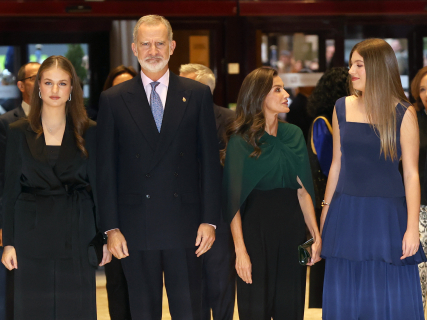
The Kings, Leonor and Sofía receive the affection of the public at the exit of the concert of the Princess of Asturias Awards

The Royal Family has concluded its first day in Oviedo amidst applause and displays of affection from the citizens gathered at the doors of the auditorium. This Friday it will preside over the award ceremony at the Campoamor Theatre.

EuropaPress 7862525 don felipe vi dona letizia princesa leonor infanta sofia llegan auditorio

EuropaPress 7862525 don felipe vi dona letizia princesa leonor infanta sofia llegan auditorio

Add DEMÓCRATA to Google

Ask FREN

Published

Last updated

2 minutes

Most read

Elecciones 29N · Encuestas

La media de las encuestas

Media a 21 de octubre de 2026 · 15 institutos

  • PP31,6 %
  • PSOE26,9 %
  • Vox18,7 %
  • Sumar6,3 %
  • Podemos3,1 %
  • ERC2,2 %
010203040ene 2024jul 2024ene 2025jul 2025ene 2026jul 2026

Media del último estudio de cada instituto en 30 días y su evolución semanal desde el 23J. Partidos con al menos un 2 %.

Todas las encuestas

Elecciones generales del 29 de noviembre · Demócrata

The Kings Felipe VI and Letizia, accompanied by Princess Leonor and Infanta Sofía, have concluded this Thursday their first day in Oviedo on the occasion of the Princess of Asturias Awards 2026. The Royal Family attended the traditional concert prior to the award ceremony and, upon their exit, received applause and displays of affection from the citizens gathered at the doors of the Príncipe Felipe Auditorium.

The joint appearance of Felipe VI, Letizia, Leonor, and Sofía has been one of the highlights of this first day, which paves the way for the institutional events scheduled for this Friday at the Campoamor Theatre.

A night of music before the award ceremony

The XXXIV Princess of Asturias Awards Concert, which began at 19:00 hours, was dedicated to the German composer Felix Mendelssohn and featured the participation of the Symphony Orchestra of the Principality of Asturias and the Choir of the Princess of Asturias Foundation, under the direction of Nuno Coelho.

The musical program included a selection from the composer's second symphony, Lobgesang (Song of Praise), with the participation of sopranos Sylvia Schwartz and Pilar Alva-Martín and tenor Santiago Ballerini.

The event is one of the traditions that accompany the awards each year and precedes the official ceremony, which will bring together this Friday the Royal Family, the awardees, and representatives from different fields of culture, science, and society.

Leonor will receive the awardees for the first time alone

The agenda will continue this Friday, October 23, with one of the most significant moments for the heir to the throne. Princess Leonor will receive for the first time alone the awardees of the Princess of Asturias Awards, in an audience scheduled for 12:30 hours at the Hotel de la Reconquista in Oviedo.

During the morning, other institutional receptions will also be held before the award ceremony, which will begin at 18:30 hours at the Campoamor Theatre.

The Kings, Leonor, and Sofía will preside over the central act of this edition, in which the speeches of the Princess of Asturias and Felipe VI are scheduled.

The visit of the Royal Family to the Principality will conclude on Saturday with the delivery of the Award for Exemplary People of Asturias 2026 in Llanes, the last appointment of a three-event agenda.

More key points, information and questions with FREN

AI-GENERATED CONTENT

What institutional functions correspond to Princess Leonor as heir to the throne according to the Spanish Constitution?

The Spanish Constitution recognizes the figure of the heir to the Crown, but attributes very few own institutional functions to them. Most of the constitutional powers are concentrated in the reigning King or Queen; the heir mainly has a role of succession, guarantee of continuity and certain potential functions (regency and guardianship) if certain circumstances arise.

1. Constitutional position of the heir

The heir to the Crown is regulated in Article 57 of the Constitution, which establishes the order of succession. It does not detail active functions for the heir, but defines who will be the next Head of State. In the current case, Princess Leonor is listed as heir to the throne by virtue of that succession regulation, but:

  • She is not yet Head of State, so she does not exercise the functions of the King (Articles 62 and 63 CE).
  • Her role is mainly to guarantee the continuity of the institution and be prepared to exercise the Headship of State when appropriate.
2. Oath of the heir of legal age (Art. 61.2 CE)

The only clear and express function that the Constitution imposes on the heir while the King lives is the oath before the Cortes Generales upon reaching the age of majority. Article 61.2 CE establishes that the heir Prince (today heir Princess) must:

  • Take an oath to faithfully perform their duties.
  • Uphold and ensure the Constitution and the laws are upheld.
  • Respect the rights of citizens and Autonomous Communities.
  • Swear fidelity to the King.

This oath, solemn and public before the Cortes, is a constitutionally regulated act that marks the formal assumption of her duties as heir and her commitment to the constitutional order.

3. Role in the succession to the Crown

Although not an “active” function in the strict sense, Leonor’s role as heir is at the core of the succession mechanism designed by the Constitution:

  • In case of death, abdication, or permanent incapacity of the King, the Crown automatically passes to the heir (Art. 57 CE).
  • This ensures the immediate continuity of the Headship of State, without power vacuums.

From an institutional point of view, the mere existence of a clear and constitutionally recognized heir is itself a guarantee of stability and predictability of the system.

4. Role as possible Regent (Art. 59 CE)

Where the Constitution does foresee material functions for the heir is in the regency, that is, in cases where the King cannot personally exercise his functions:

  • If the King becomes incapacitated to exercise his functions and the incapacity is recognized by the Cortes Generales, the heir of legal age assumes the Regency (Art. 59.2 CE).
  • If the King dies and the successor is underage, the Regency corresponds to the father or mother of the minor King; if none exist, to the closest adult relative in the succession (Art. 59.1 CE). In certain scenarios, this could also fall to the heir.

The Regent exercises all the functions of the King, although in his name. Therefore, in these exceptional cases, Princess Leonor could effectively exercise the Headship of State as Regent, even before formally becoming Queen.

5. Role in the guardianship of the minor King (Art. 60 CE)

Article 60 CE regulates the guardianship of the minor King. The Constitution clearly distinguishes between:

  • Regency, which exercises the political functions of the King.
  • Guardianship, which refers to the personal and patrimonial care of the minor King.

The heir could be involved in this guardianship structure if so provided by law or a will of the King, although the Constitution does not reserve an exclusive or automatic role for her in this matter.

6. Representative functions by constitutional practice

Beyond the constitutional text, Princess Leonor assumes, by political and monarchical practice, functions of:

  • Symbolic representation of the Crown in certain official acts.
  • Institutional and military training, intended for the future exercise of the Headship of State.
  • Progressive participation in State acts alongside the King.

These functions, however, are not defined in the Constitution, but depend on political decisions and the Royal Household itself.

In summary, according to the Spanish Constitution Princess Leonor, as heir, has few own functions: the constitutional oath upon reaching majority and the potential role as Regent or participant in the guardianship of the minor King in exceptional situations. The rest of her activity is mainly preparation and representation, in view of her future condition as Queen.

What have been the results of the latest regional elections in the Principality of Asturias?

The latest regional elections held in the Principality of Asturias were on May 28, 2023. The PSOE won with 19 seats, followed by the PP with 17, in a General Junta composed of 45 deputies. No candidacy reached an absolute majority alone, which is set at 23 seats.

Results by candidacy

Six candidacies obtained parliamentary representation. The distribution of votes and seats recorded in the electoral information from El País was as follows:

  • PSOE: 190,392 votes, 36.50% and 19 seats. It was the most voted candidacy and the one that obtained the most representatives in the General Junta.
  • People's Party (PP): 170,331 votes, 32.65% and 17 seats. It occupied second position, two deputies behind PSOE.
  • Vox: 52,546 votes, 10.07% and 4 seats. It was the third force both by votes and representation.
  • Convocatoria por Asturies, IU-Más País-IAS: 39,715 votes, 7.61% and 3 seats. It was the fourth candidacy with the most electoral support.
  • Podemos: 20,349 votes, 3.90% and 1 seat. It obtained its own representation in the regional Parliament.
  • Foro Asturias: 19,313 votes, 3.70% and 1 seat. It completed the set of candidacies that entered the Chamber.

The distribution of the 45 seats also appears in the coverage by El Comercio. It is important to distinguish this electoral result from subsequent parliamentary agreements or changes: the above figures describe what came out of the ballot boxes in May 2023.

Candidacies without representation

Among the candidacies that did not obtain seats were the following, according to the published results:

  • SOS Occidente: 5,713 votes and 1.09%.
  • Ciudadanos: 4,774 votes and 0.91%.
  • Verdes Equo: 1,574 votes and 0.30%.

Other minor candidacies also did not obtain representatives. Therefore, the support received by these lists did not translate into presence in the General Junta, whose distribution was entirely among the six candidacies mentioned above.

Key points of the result

The first key was the narrow gap between PSOE and PP: they were separated by 20,061 votes, 3.85 percentage points, and two seats. Although PSOE retained first position, its result was not enough to reach the 23 deputies of the absolute majority alone. Both figures come from the published electoral count.

The second was the concentration of representation in the two most voted candidacies. PSOE and PP summed 36 of the 45 seats, that is, 80% of the Chamber. The remaining nine corresponded to Vox, Convocatoria por Asturies, Podemos, and Foro Asturias, according to the parliamentary distribution.

The third key was the arithmetic to reach a majority: the 19 deputies of PSOE, the three of Convocatoria por Asturies, and the one of Podemos summed exactly 23. On the other hand, the 17 of PP, the four of Vox, and the one of Foro Asturias summed 22. These sums describe only the numerical possibilities of the result, they do not by themselves prove subsequent political agreements.

In short, the elections left a General Junta with six represented candidacies, a PSOE victory, and absence of an absolute majority by a single party. That is the regional result that should be taken as reference, without confusing it with general, municipal, or European elections.

What requirements must candidates meet to apply for the Princess of Asturias Awards?

To apply for the Princess of Asturias Awards, candidates must demonstrate an extraordinary and exemplary contribution, with international projection, in one of the fields recognized by the awards. Additionally, they cannot nominate themselves: the candidacy must come from an authorized person or institution and comply with the conditions of the official regulations.

Who can be a candidate and what merits are required

Candidates can be individuals, institutions, organizations, and groups of people or institutions. The fundamental thing is that their scientific, technical, cultural, social, or humanitarian work has contributed in an extraordinary and exemplary way to progress and social welfare, and that their contributions have international reach or recognition.

The proposal must fit into one of the eight categories: Arts, Communication and Humanities, Social Sciences, Scientific and Technical Research, Letters, International Cooperation, Sports, and Concord. Each values the merits specific to its field; for example, Sports recognizes careers that exemplify the benefits of sports practice for society. The Foundation explains the general scope of the awards in its frequently asked questions.

Who must submit the proposal

The candidacy needs an authorized proposer. According to the regulations, proposals can be made by:

  • Previous awardees.
  • Members of the eight juries of the edition, except for the award whose jury they are part of.
  • Spanish diplomatic representations abroad and foreign ones in Spain.
  • Persons and institutions of recognized prestige.
  • Other persons or institutions expressly invited by the Foundation.

Therefore, it is not enough to have merits: it is also necessary that the proposal comes through one of these channels. The prohibition of self-nomination applies both to those who request the award for themselves and to those who request it for the institution they represent.

Which candidacies are excluded

The regulations establish several grounds for inadmissibility. Candidacies are not accepted:

  • Posthumously.
  • From heads of State or Government, Spanish or foreign, nor from persons holding positions with that status.
  • From the high institutions of the Spanish State, their members, and senior officials of the Spanish Government.
  • From trustees of the Foundation who are so at the time of submitting the proposal or who have been so during the three immediately preceding editions.
  • From members of the juries who are so at the time of submitting the proposal or who have belonged to any during the three previous editions.
  • Submitted by the interested parties themselves for themselves or for the institution they represent.

Documentation and deadline

The proposal must use the official form, clearly identify the candidate and category, and present their merits. It can be accompanied by documentation, bibliography, audiovisual materials, supports, and endorsements that allow accrediting them. To use the electronic platform, prior registration is necessary.

The Foundation contemplates submission via electronic platform, email, or postal mail. Instructions are on its candidacy submission page and in the 2026 call.

For that edition, the general deadline ended on March 5, 2026, at 23:59, peninsular Spanish time. The regulations provide a later exception for proposals from previous awardees and jury members, within established limits. In short, three elements must concur: sufficient merits, an authorized proposer, and a valid submission, without grounds for exclusion.

Play

Test your knowledge with FREN!

How much do you know about this topic? Answer the following 3 questions.

Who attended the traditional concert prior to the 2026 Princess of Asturias Awards ceremony?

Question 1 of 3

To which composer was the XXXIV Princess of Asturias Awards Concert dedicated?

Question 2 of 3

Where will the Princess of Asturias Awards ceremony be held?

Question 3 of 3