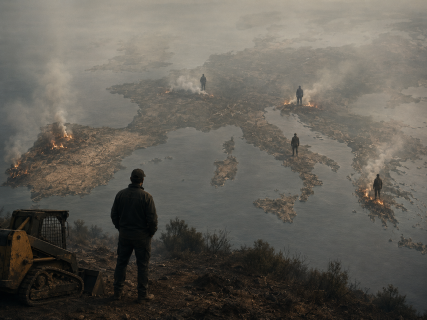

The case of 'El Perejil', the owner of the excavator investigated for the fire in Burgohondo, allows observing a reality that repeats in the large European fires: locating the point where the fire started does not necessarily equate to identifying its criminal responsible. (((Check here live the status of the fires)))
The Civil Guard is investigating whether the fire that has affected more than 50,000 hectares in Ávila originated from the use of heavy machinery during a day when its use was prohibited due to extreme risk. The owner of the excavator was arrested and later released, while the operator remains under investigation.
It remains to determine who decided to carry out the work, who operated the machine, whether it actually produced the spark, and how far the responsibility of each involved reaches. For now, none of them has been judged and both fully retain the presumption of innocence.
The European precedents advise caution. Some of the most serious fires in recent decades began with individual conduct, but ended up revealing much broader failures in prevention, evacuation, or forest management. In other cases, Justice could not attribute responsibilities despite seating numerous people in the dock.
Mati: an imprudence and 104 dead
The most dramatic example is found in Greece. The fire in Mati, declared on July 23, 2018, near Athens, caused 104 deaths and left dozens of serious injuries. It remains the deadliest wildfire in the recent history of the country.
The investigation placed the origin in a private property. Its owner was convicted of having negligently caused the fire. The first-instance ruling imposed three years in prison, although the sentence was suspended due to his age and health condition.
However, the case was not limited to the man who started the fire. Greek Justice also examined how a localized fire could turn into a human catastrophe. The process reached those responsible for the firefighters and Civil Protection for the coordination failures, the absence of an effective evacuation, and the decisions made during the emergency.
In 2025, the appeals court declared 10 people guilty. Four former high-ranking officials received cumulative sentences of up to 340 years, although Greek legislation limited the effective period of compliance to five years. In May 2026, the Supreme Court definitively confirmed the guilt of four operational leaders, although it ordered a review of a specific issue related to mitigating factors and sentences. The resolution made the main sentences for the Mati fire final.
The Greek lesson is relevant to the Spanish case. Responsibility for starting a fire does not necessarily exhaust the investigation into a disaster. Justice can differentiate between those who cause the ignition and those who, by action or omission, contribute to making the consequences much greater.
Pedrógão Grande: eleven accused and no convictions
Portugal offers the opposite outcome. The Pedrógão Grande fire in June 2017 left 65 dead and devastated more than 30,000 hectares. Many of the victims were trapped in their vehicles when trying to escape on roads surrounded by flames.
For years, even the origin of the fire was debated. The first explanations pointed to a dry storm, while subsequent technical reports analyzed the possible interaction between vegetation and a power line, in addition to deficiencies in land clearing.
The criminal process brought eleven people to the dock. Among them were the commander of the firefighters of Pedrógão Grande, workers from the former EDP Distribuição, employees of the road concessionaire Ascendi, municipal officials, and personnel linked to forest management.
The Prosecutor's Office attributed possible charges of homicide and injury due to negligence. However, all were acquitted in September 2022. In June 2025, the Coimbra Court of Appeal confirmed the eleven acquittals and closed the case against the responsible parties sitting in the dock. The resolution fully upheld the acquittal ruling.
Pedrógão demonstrates the difficulty of transforming administrative, forestry, or operational failures into individual criminal responsibilities. There was a tragedy, documented deficiencies, and a long investigation, but no "Perejil" condemned to attribute the disaster to.
Landiras: arrested and then dismissed
France provides a third scenario. The fire in Landiras, one of the major fires in Gironde during the summer of 2022, burned approximately 13,600 hectares of forest and forced the evacuation of thousands of people.
The police arrested a 39-year-old neighbor after the testimony of a person who claimed to have seen a vehicle leaving the place where the flames began. The suspect had already been investigated years earlier for another fire, although that procedure was archived due to lack of evidence.
For a few hours, France seemed to have found the person responsible for the large fire. But the expert reports, the analysis of the collected elements, and the interrogations ultimately ruled him out. The Bordeaux Prosecutor's Office ordered his release and expressly acknowledged that the proceedings excluded him from the case, despite maintaining the hypothesis of a criminal origin. The fire continued to be under investigation after the detainee was exonerated.
The French precedent serves as a warning against the hasty construction of culprits. An arrest, a known nickname in the area, or a police record do not replace the expert evidence capable of linking a person to the ignition.
Sardinia: when the cameras do allow a conviction
Italy offers examples where authorship has been able to be accredited. In June 2024, a court in Oristano sentenced a neighbor from Ghilarza to four years in prison for intentionally causing a fire that occurred in Sardinia in July 2021.
The fire burned about 130 hectares and threatened homes, roads, and agricultural operations. More than 120 people, five helicopters, and three Canadair planes participated in its extinction.
In this case, investigators located the exact point where the flames had started and used surveillance footage to reconstruct the movements of the accused. The man opted for a summary procedure and received a four-year sentence for willful forest fire. The sentence considered the authorship of the Ghilarza fire to be accredited.
The spark does not always explain the catastrophe
The "Perejiles" in Europe offer, therefore, three possible endings: a conviction for starting the fire, an acquittal due to lack of sufficient evidence, or the emergence of additional responsibilities for the failures committed during the emergency.
In Burgohondo, the investigation must determine if the excavator was really the origin of the fire and what degree of knowledge each involved party had about the prohibition of working with machinery. But two issues must also be separated: who could have caused the first spark and why that fire exceeded 50,000 hectares.
The heat, the wind, and the dryness explain part of the propagation. The continuity of the vegetation, the management of the mountain, the speed of the response, and the availability of resources must also be analyzed. The fire may have started at a specific point, but a disaster of this magnitude rarely has a single cause.