The upcoming eclipses that will be seen from Spain: 2027 and 2028 will complete a historic trio.

After the total eclipse of August 12, 2026, Spain will experience two major solar phenomena in less than two years: another total eclipse in August 2027 and an annular one in January 2028.

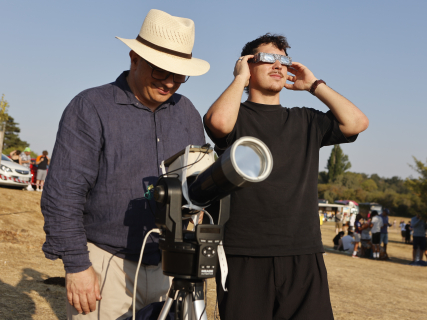
EuropaPress 7711552 varias personas eclipse solar total 2026 12 agosto 2026 soria castilla leon

EuropaPress 7711552 varias personas eclipse solar total 2026 12 agosto 2026 soria castilla leon

Add DEMÓCRATA to Google

Ask FREN

Published

Last updated

2 minutes

Most read

España vota · Congreso y Senado

Elecciones generales 29 de noviembre de 2026

Se eligen 350 diputados y los senadores de elección directa. Encuestas, calendario, candidaturas, programas y todo lo que necesitas saber para votar.

Faltan 42 días y 11 horas para que abran los colegios electorales.Hasta que abran los colegios, el domingo 29 a las 09:00 (hora peninsular).
Entra en el especial

Próximas fechas

  1. Presentación de candidaturas al Congreso y al Senado21–26 oct · Fecha prevista
  2. Voto desde el extranjero (CERA): envío de la documentación24–30 oct · Fecha prevista
  3. Publicación de las candidaturas presentadasFecha prevista
  4. Proclamación de candidaturasFecha prevista
Calendario completo

The historic total solar eclipse of this Wednesday, August 12, will not be an isolated event. Spain will once again become one of the great global stages for observing eclipses in 2027 and 2028, completing an exceptional succession of three solar phenomena in just a year and a half.

The date in 2026 opens the so-called Trio of Eclipses 2026-2027-2028, a sequence that will allow two total eclipses and one annular eclipse to be observed from Spanish territory.

August 2, 2027: another total solar eclipse

The next major event will arrive on August 2, 2027, less than a year after the eclipse this Wednesday.

Spain will once again be within the path of a total solar eclipse, although this time the strip from which totality can be observed will shift southward.

The phenomenon will be especially visible from areas in the south of the Peninsula, as well as Ceuta and Melilla, and will be marked by a duration of totality longer than that recorded on August 12, 2026.

It will therefore be the next opportunity to see how the Moon completely covers the solar disk and allows the Sun's corona to be observed for a few minutes.

January 26, 2028: an annular eclipse

The third event will arrive just six months later. On January 26, 2028, Spain will be able to observe an annular solar eclipse.

Unlike a total eclipse, in this case, the Moon will not completely cover the Sun. This happens because the satellite appears smaller in the sky, so a luminous circle known popularly as "ring of fire" remains visible around it.

The phenomenon will cross a large part of the Peninsula and will occur late in the afternoon, very close to sunset, a factor that will condition the points from which it can be observed under the best conditions.

Three eclipses in less than a year and a half

The exceptionality lies precisely in the temporal concentration. Between August 12, 2026, and January 26, 2028, Spain will have experienced three major solar eclipses:

  • August 12, 2026: total solar eclipse.
  • August 2, 2027: total solar eclipse.
  • January 26, 2028: annular solar eclipse.

The eclipse this Wednesday has therefore been the beginning and not the end of an exceptional stage for astronomical observation in Spain.

The images of the Moon's shadow crossing the country in 2026 will remain as the first chapter of a sequence that will still have two other major events before the end of January 2028.

More key points, information and questions with FREN

AI-GENERATED CONTENT

What requirements must be met to organize a public solar eclipse observation event in Spain?

To organize a public solar eclipse observation event in Spain in a public space (square, park, public road) with large attendance, state, regional, and municipal requirements are combined. At a basic level, you will need authorization to use the local public domain, compliance of the event with regional public entertainment regulations, and a security and civil protection device appropriate to the expected capacity. Additionally, you must comply with occupational risk prevention for the staff, usually have civil liability insurance, and respect specific regulations regarding minors, schedules, and alcohol consumption. In practice, the entry point is almost always the city council, which coordinates with the autonomous community and, if applicable, with the Government Delegation.

1. Basic state framework

Several state frameworks condition this type of event:

  • Civil protection and emergencies: the Law 17/2015 of the National Civil Protection System configures civil protection as a public service and relies on instruments such as the Basic Self-Protection Standard (Royal Decree 393/2007, cited in its preamble). For events with large attendance, a self-protection plan and coordination with regional and municipal emergency services may be required.
  • Citizen security: the Organic Law 4/2015 on the protection of citizen security frames the actions of the Police and Civil Guard, as well as certain obligations of organizers of activities affecting public order. It may involve communications or authorizations when there are large gatherings in public spaces.
  • Private security: if security personnel are hired, Law 5/2014 on Private Security applies, which requires licensed companies and guards and conditions their functions within the venue.
  • Occupational risk prevention: for workers and hired personnel, Law 31/1995 on Occupational Risk Prevention applies, reinforced by the 2003 reform. The promoter must assess risks (crowds, falls, handling optical material, etc.) and adopt preventive measures, training, and information.
  • Insurance: Law 20/2015 on the regulation, supervision, and solvency of insurance entities regulates the sector, but the specific content of the civil liability insurance is mainly imposed by regional entertainment regulations and by the conditions set by the city council in the authorization.

2. Regional public entertainment regulations

The direct regulation of the event as a show or recreational activity is regional. Each community has its own entertainment law, which usually requires:

  • Authorization or prior communication for extraordinary outdoor events.
  • Calculation and respect of the maximum capacity.
  • Security measures, exits and evacuation routes, signage, and, if applicable, medical services.
  • Civil liability insurance with minimum coverage and sometimes a bond.
  • Limitations on noise, schedules, and presence of minors.

Examples of this regional framework include the Law 13/1999 on Public Shows and Recreational Activities of Andalusia, the Law 11/2009 on public shows and recreational activities of Catalonia, successive reforms of the Madrid entertainment law (for example, the Law 5/2015 of the Community of Madrid), or the Law 14/2010 on public shows of the Valencian Community. All contemplate figures of “extraordinary or occasional show or activity” applicable to a one-time eclipse observation event.

3. Role of the city council and use of public domain

In practice, the first requirement is authorization to use the street or public land by the city council (occupation of square, park, street closure, installation of tents or telescopes). Municipal ordinances usually require:

  • Application with a descriptive report (date, schedule, estimated capacity, layout sketch, sound/lighting equipment, etc.).
  • Proof of compliance with the regional entertainment law and, if applicable, attach specific license or responsible declaration.
  • Civil liability insurance and, if applicable, a self-protection plan or at least a security and emergency plan.
  • Commitment to cleaning and restoration of the space, and payment of fees for occupation of the public domain.

4. Security, minors, and optical material

Since it is an astronomical observation event, besides general security regulations, administrations may require specific measures related to the use of optical material (queue organization, supervision of its use, risk information, etc.). In family events, it is common for regional entertainment regulations to impose reinforced conditions for the presence of minors (schedules, separation of alcohol consumption areas, warning messages).

In summary, to organize a public eclipse observation event in Spain you must: process the occupation of public space before the city council, fit the activity into the regional category of extraordinary show or recreational act (with its license or responsible declaration), develop and apply a security/self-protection plan proportional to the capacity, comply with occupational risk prevention regarding staff, and contract civil liability insurance under the terms set by regional and municipal regulations. From there, the specific conditions will depend on the autonomous community and the municipality where you want to hold it.

What practical differences exist between autonomous communities when authorizing a public eclipse observation event? What exactly must a self-protection plan include for a massive astronomical observation event? What specific obligations would I have if I organize the eclipse observation event in a school or university campus?

What regulations govern the safe observation of solar eclipses in Spanish educational centers?

Spanish regulations do not contain, according to the references found, a specific and detailed regulation on “solar eclipse observation” in educational centers, nor a unique state protocol for schools and institutes. Safety during an eclipse is framed within general risk prevention, product safety (glasses and filters), organization of educational centers, and protection of minors. No explicit regional instructions on eclipses appear in the reviewed searches beyond generic safety and school organization obligations. In practice, centers rely on this general regulation and on non-regulatory technical recommendations (scientific or health-related).

1. Absence of a specific state regulation on eclipses in centers

At the state level, no law, royal decree, ministerial order, or resolution has been found that directly and specifically regulates solar eclipse observation in schools, institutes, or universities, nor an official state guide aimed at educational centers for eclipses. There is regulation on science curricula (where astronomical phenomena are covered), such as Order ECD/686/2014 for Primary under the MEC scope (Primary curriculum) or its erratum for ESO and Baccalaureate (ESO and Baccalaureate erratum), but without normative content on safety procedures for eclipses.

2. General framework of risk prevention and protective equipment

Visual protection during sun observation is connected to occupational health and safety regulations, which require protecting workers (including educational staff) against foreseeable risks.

  • Personal protective equipment (PPE). The use of approved filters or glasses is framed within the general PPE regime, regulated by Royal Decree 773/1997 (not explicitly listed, but amended by Royal Decree 1076/2021) and by updated technical standards on PPE, such as the Resolution of May 27, 2002, on the marketing of personal protective equipment (PPE).
  • Artificial optical radiation. Royal Decree 486/2010 and its erratum (erratum RD 486/2010) regulate protection against artificial optical radiation (lasers, lamps, etc.), not direct solar radiation, but reinforce the general principle of ocular risk assessment and control at work.
  • Artificial UV radiation sources. Royal Decree 1002/2002 on tanning devices using ultraviolet radiation, although unrelated to eclipses, shows the regulatory approach to ocular and skin damage from radiation.

In parallel, UNE standards on eye safety are periodically updated (for example, the Resolution of February 14, 2012, publishing UNE standards approved by AENOR, UNE standards 2012), which serve as technical references for the quality of filters and glasses, including those used for sun observation.

3. Product safety (glasses, toys, etc.)

Eclipse glasses or filters may be subject to product safety regimes depending on their legal classification:

  • Toy safety. Royal Decree 1205/2011 on toy safety, which transposes European regulations, incorporates safety requirements for products intended for minors; it is complemented by technical references such as the Commission Decision on EN 71-1 standard (EN 71-1). If glasses are marketed as toys, they must comply with this framework.
  • Other products and machines. Standards such as Royal Decree 1644/2008 (machines) or various technical resolutions on work equipment (specification 2011-01-17, specification 2012-01-17, specification 2010-1-01) do not refer to eclipses but are part of the equipment safety ecosystem.

4. Organization of educational centers and protection of minors

In the educational field, student safety is articulated through organizational and operational regulations of centers, and the general responsibility for the protection of minors.

  • At the state level, various orders and resolutions regulate curricula and operation (for example, Order PRA/262/2017 on Physical and Sports Activities qualifications, PRA/262/2017, or student admission resolutions in Ceuta and Melilla, 2019/2020 school year, 2017/2018, 2016/2017), but without mention of eclipses.
  • At the regional level, general organizational norms have been found, such as Decree 252/2019 on the organization of ESO and Baccalaureate centers in the Valencian Community, the 2021 Andalusian Baccalaureate Order (Andalusia Baccalaureate curriculum), Decree 143/2007 of ESO in Catalonia (ESO organization Catalonia) or the Madrid Territorial Civil Protection Plan (PLATERCAM), without specific instructions on eclipse observation.

Other norms cited in the searches (for example, Andalusian Law 7/2007 on environmental quality, Law 7/2007; Valencian Law 16/2010, Law 16/2010; various regional decrees and orders on vocational training and image curricula: Andalusia FP Image, Decree 197/2015, Order EDU/186/2021, Order ENS/200/2017, Decree 126/2003, Decree 98/2012 Madrid, Decree 90/2012 Madrid, Decree 41/2017, Decree 185/2014, Decree 102/2008) also do not introduce specific rules on eclipses.

5. Practical conclusion

In the absence of a specific “eclipse regulation,” safe observation in Spanish educational centers is governed by:

  • The general obligation to guarantee the safety and health of students and staff (risk prevention and protection of minors framework).
  • The exclusive use of filters and glasses that comply with PPE and product safety regulations (relying on UNE technical standards and frameworks such as Royal Decree 1205/2011 and PPE regulations).
  • The center’s internal organizational decisions (whether to authorize direct observation activities, group control, supervision, etc.), based on these general obligations.

No further information is available in the consulted sources about specific state or regional guides or protocols for solar eclipses in educational centers.

What specific obligations does a public school principal have if they decide to organize an eclipse observation with students? Have any autonomous communities recently published circulars to schools regarding specific solar eclipses? What technical characteristics must eclipse glasses or filters meet to be considered safe according to applicable regulations?

How many total solar eclipses have been visible from Spain in the last century?

Due to the nature of your question, I cannot provide a reliable figure on how many total solar eclipses have been visible from Spain in the last century. My scope is specialized in politics, institutions, and sociopolitical current affairs in Spain, not in astronomical phenomena or history of science. Any number I might offer about eclipses would be a conjecture not supported by the sources I handle, and that would go against the rigor criterion I must follow.

Scope of this assistant

This assistant is specifically designed to work on political, institutional, and social information, with a main focus on Spain. This includes, among others:

  • Parliamentary activity: processing of bill and law proposals, royal decree-laws, motions, interpellations, investigative commissions, and votes both in the Congress of Deputies and the Senate.
  • Government action: decisions of the Council of Ministers, regulatory plans, public policies, government strategies and their regulatory development (public consultations, hearings and reports, agreements for submission to Parliament, etc.).
  • Political parties and actors: positions of the main parties (PSOE, Sumar, PP, Vox, and nationalist and regionalist forces), parliamentary agreements, investiture pacts, and governance dynamics.
  • Political and social current affairs: debates on major reforms (labor, pensions, housing, taxation, ecological transition, digitalization, etc.) and their social and economic impact.
  • Regulation and legislation: explanation of laws, royal decree-laws, royal decrees, and other provisions, their content, purpose, and processing status.

On the other hand, I am not prepared to accurately address matters of:

  • Astronomy, physics, or natural sciences (such as eclipses, comets, space weather).
  • Clinical health or medicine (diagnoses, detailed medical treatments).
  • Technology in technical depth (software development, specific hardware, advanced cryptography).
  • Purely historical or cultural content without direct political or institutional linkage.

Why I do not provide an approximate figure

Although I could try to rely on general prior knowledge about eclipses to offer an approximate number, doing so would imply:

  • Providing a non-verifiable datum with the sources I have assigned (focused on politics and regulation).
  • Introducing possible errors about dates, visibility, or geographic extent of the phenomenon.
  • Creating an appearance of precision in a field where, in this context, I do not have documentary support.

My operation is based on not inventing information or filling gaps with assumptions. Therefore, for topics outside the political and institutional framework, the correct response is to acknowledge that limitation rather than force an inaccurate answer.

What types of questions I can help you answer

If you are interested in linking the issue of eclipses with politics or public action, I could be useful. For example, I could analyze:

  • How public administration organizes security, mobility, and civil protection devices in large astronomical or tourist events.
  • Whether there have been parliamentary initiatives in Spain related to scientific dissemination, astronomy, or protection of observatories.
  • The role of public bodies (such as the CSIC or regional institutions) in policies promoting astronomical research, provided there is a trace in political or regulatory activity.

I can also help with any question close to:

  • How a law is approved in Spain and what differences exist between bill, law proposal, and royal decree-law.
  • What majority is needed to validate a royal decree-law in Congress and what happens if it is repealed.
  • What reforms have been approved in areas such as energy, climate change, education, or science, and their impact on society and the economy.

Suggestion to obtain the data you seek

To know exactly how many total solar eclipses have been visible from Spain in the last century, the most appropriate is to consult specialized astronomy sources, for example:

  • Official pages of space agencies (such as ESA or NASA), which usually have historical eclipse catalogs.
  • Spanish scientific organizations, such as the National Geographic Institute (IGN), which has information on eclipses visible from Spanish territory.
  • Astronomy associations or scientific dissemination groups that prepare chronologies and visibility maps of these phenomena.

Once you have that data, if you want to explore how a massive phenomenon like an eclipse can influence public organization, tourism, scientific education, or even institutional communication, I can help analyze it from a political and social perspective.

What competencies do the central government and autonomous communities have in scientific and astronomical research? Have there been recent parliamentary initiatives in Spain to strengthen funding for science and space research? How are civil protection and security devices coordinated in Spain for mass events, such as major astronomical or sports phenomena?

Play

Test your knowledge with FREN!

How much do you know about this topic? Answer the following 3 questions.

What type of solar eclipse will be visible in Spain on January 26, 2028?

Question 1 of 3

In which regions of Spain will the totality of the solar eclipse on August 2, 2027, be especially visible?

Question 2 of 3

What is the particularity of the 2026-2027-2028 Eclipse Trio in Spain?

Question 3 of 3