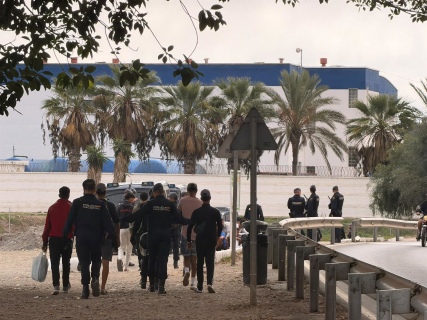

The National Police has developed a wide operation this Monday in different areas of Ceuta to identify migrant individuals likely to be returned to Morocco, including residents of the Temporary Stay Center for Immigrants (CETI) with asylum requests already rejected. In the framework of these actions, a dozen inmates from the center have been returned to the neighboring country, while the total number of voluntary returns and transfers to the Temporary Attention Center for Foreigners (CATE) for their registration is unknown.
The operation has extended through the CETI itself, the Trampolín beach, and neighborhoods such as Poblado Regulares, Los Rosales, and El Príncipe, in addition to other enclaves of the autonomous city. At the same time, the NGO Caminando Fronteras has reported that 16 people remain in a "limbo" between both countries since a similar operation carried out last Friday, and that the new transfers are generating "panic" among those sheltered in the center.
Forced exits at the CETI and transfers to the CATE
At the CETI, the initial objective was to execute the forced exit of about 70 people, although ultimately only around a dozen has materialized, as the rest would have previously left the facilities. In other parts of the city, more migrants have also been intercepted, and only at the Trampolín beach more than ten people have been detained and taken by the agents.
In addition to the intervention at the reception center, the Police has acted in Poblado Regulares, Los Rosales, and El Príncipe, where migrants sleeping on the street have been located. Some of them have been transferred to the CATE to complete identification procedures, while others have been taken directly to the Tarajal border on buses designated for voluntary returns to Morocco. However, no overall figures for the operation this Monday have been provided.
The majority of the individuals affected by the action at the CETI are of Moroccan nationality and arrived in Ceuta between July 30 and 31, remaining until now at the center. Organizations like Caminando Fronteras have warned that there are also migrants from other countries who are being prevented from crossing the border into Moroccan territory.
Reports of people trapped at the border
The NGO has focused on the situation of those who were blocked after the operation on Friday. "Since Friday, 16 people of different nationalities, including Togo, Niger, or Bangladesh, have been abandoned in an area on the border between Morocco and Ceuta. In principle, the Spanish authorities would be executing deportations, but Morocco is not accepting these people who come from third countries," expressed the aforementioned NGO led by Helena Maleno, who has described the situation of those transferred on Friday as "extreme vulnerability" due to "inhumane and degrading treatment" and the possibility of exposure of these people to a "risk of enforced disappearance."
In the same vein, Caminando Fronteras links the deployment of this Monday with that of last week and warns that there is "panic" among the residents of the CETI at the possibility of new expulsions. "This type of practice is once again using people as commodities in the bilateral relations that currently exist between Spain and Morocco, which are very tense, very conflictive, and expose these people to great risks due to the lack of collaboration between both countries," concluded the organization.
Special units and shielding of the CETI
In the operation of this Monday, agents from the Police Intervention Unit (UIP), members of the Prevention and Reaction Unit (UPR), and several buses designated for the transfer of intercepted individuals participated. Access to the CETI has remained heavily controlled during the operation, with a security perimeter to facilitate the work of the police forces.
These actions are part of the procedure applied to those who have already been identified and do not have a pending request for international protection awaiting a favorable resolution. In cases where asylum has been denied, the Police executes returns to the border, and similarly proceeds with those who have not requested protection and are considered susceptible to return.
The intervention this Monday adds to other recent deployments in various points of Ceuta, both in coastal settlements and in common spaces of different neighborhoods. The evictions on the beaches of Trampolín and Benítez, in the Tarajal polygon and in the Guano area have been accompanied by operations to locate people who spent the night in public spaces, garages, and other community facilities.
Balance of the operation on Friday and return data
The new deployment takes place three days after the police operation carried out on Friday in El Príncipe and its surroundings, which resulted in 295 people intercepted and 146 voluntary returns to Morocco, according to the Government Delegation. That operation began at 5:30 AM and mobilized 320 agents from the aforementioned units of the National Police.
The action on Friday extended across various points of the neighborhood and nearby areas, such as the old Legionary Settlement, San Daniel street, and El Sardinero. Among the migrants located were 60 minors and four women. The agents also accessed community garages and other places used for overnight stays, and a portion of the intercepted individuals was transported by buses to the CATE to formalize identification procedures.
The Minister of Territorial Policy and Democratic Memory, Ángel Víctor Torres, coordinator of the single command for managing the migratory situation in Ceuta, then defined the operation as "discreet and careful." Torres estimated that there had been 13,101 returns to Morocco since August 10. He added that the city had about 8,000 reception places, of which about 6,100 were occupied, and that more than 5,400 triages had been carried out on adults and 310 on minors.
The minister detailed that the processing of the files takes about 12 weeks, a period that would begin to be fulfilled on November 20 for the first individuals subjected to this procedure. Regarding unaccompanied foreign minors, he indicated that 3,434 had been identified and cared for by the protection system of the Autonomous City. Of them, 114 had been transferred to the peninsula for family reunification and another 181 relocated to different autonomous communities.