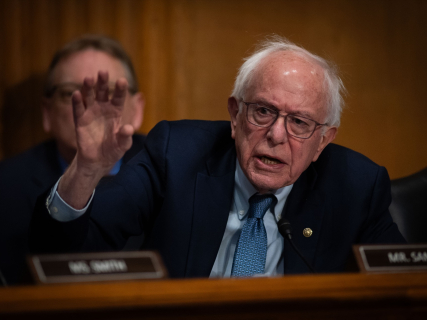
Bernie Sanders knocks JD Vance out of the top 10 of Digital Power ahead of the midterms: Trump is third

The senator from Vermont surpasses the Vice President of the United States by just two tenths in the international Digital Power ranking published by Demócrata, developed by Vinces. Narendra Modi leads the ranking, followed by Lula da Silva and Donald Trump, while Pedro Sánchez occupies eighth place less than a month before the general elections of 29N

EuropaPress 6458513 16 january 2025 us washington ussenator bernie sanders questions scott

EuropaPress 6458513 16 january 2025 us washington ussenator bernie sanders questions scott

Add DEMÓCRATA to Google

Ask FREN

Published

Last updated

8 minutes

Most read

Elecciones 29N · Encuestas

La media de las encuestas

Media a 27 de octubre de 2026 · 15 institutos

  • PP31,0 %
  • PSOE27,3 %
  • Vox18,9 %
  • Frente Amplio6,3 %
  • Podemos2,9 %
  • ERC2,3 %
010203040ene 2024jul 2024ene 2025jul 2025ene 2026jul 2026

Media del último estudio de cada instituto en 30 días y su evolución semanal desde el 23J. Partidos con al menos un 2 %.

Todas las encuestas

Elecciones generales del 29 de noviembre · Demócrata

The race for political influence on social networks registers new movements just a few days before the United States midterm elections next November 3. Democratic senator Bernie Sanders has managed to enter the international top 10 of Poder Digital, displacing the U.S. vice president, JD Vance, to eleventh place. Meanwhile, President Donald Trump remains among the leaders with the greatest digital presence in the world, although behind the Prime Minister of India, Narendra Modi, and the President of Brazil, Luiz Inácio Lula da Silva.

The latest update of the ranking, corresponding to October 28 at 18:50 hours, places Sanders at 68 points out of 100, compared with Vance's 67.8. The difference of just two-tenths has been enough to provoke an exchange of positions between both leaders: the senator from Vermont rises from eleventh to tenth place, while Trump's vice president makes the opposite journey.

The movement occurs in the final stretch of the U.S. midterms, a contest that will determine the balance of power in Congress and condition the Trump Administration's ability to develop its agenda during the second half of the term. The evolution also makes it possible to observe how digital influence is distributed among different international political figures, although the scores do not represent percentages of vote intention nor do they allow electoral results to be anticipated.

Bernie Sanders surpasses JD Vance and enters the top 10 of Poder Digital

The main change in the international ranking has as its protagonists Bernie Sanders and JD Vance, two U.S. leaders with very different political trajectories, institutional responsibilities, and ideological positions.

Sanders, independent senator for Vermont and one of the most recognized figures in the U.S. progressive space, reaches 68 points and is placed tenth in the international ranking. Vice President Vance, one of the main representatives of the political movement linked to Donald Trump, registers 67.8 points and falls to eleventh place.

The difference between the two is minimal, but enough to modify the order of the top ten positions. Sanders gains one position and Vance loses another, a movement that reflects that the institutional relevance of an office does not necessarily determine its position in the digital sphere.

In fact, occupying the vice presidency of the United States does not guarantee better results than a senator in a tool that measures activity on social networks, the ability to generate interactions, and the regularity of posts. The indicator does not establish a ranking of institutional political power, but rather a comparison of the presence and digital connection capacity of the profiles analyzed.

There is, moreover, an important nuance in the interpretation of the results. Sanders's rise does not mean that he has gained a point in his score, but rather that he has improved a position compared with the previous measurement. Likewise, Vance's setback corresponds to a place in the ranking, not necessarily to a loss of a point in the index.

The available data make it possible to confirm the exchange between both leaders, but not to determine how much each one's individual score has exactly varied with respect to the previous update.

Donald Trump occupies third place worldwide, behind Modi and Lula

Beyond Sanders's overtaking of Vance, Donald Trump continues among the three leaders with the highest score in the international Digital Power ranking. The U.S. president registers 80.1 points out of 100, a figure that places him behind Narendra Modi and Lula da Silva.

The Prime Minister of India leads the ranking with 87.6 points, which means a lead of 7.5 over the U.S. president. His position keeps him as the leader with the highest score among the international profiles analyzed.

In second position is Luiz Inácio Lula da Silva, with 80.9 points, just eight tenths above Trump. The distance between the two is considerably smaller than the one that separates them from first place, which reflects a greater closeness in the scores of the second and third positions.

After them appear the Italian prime minister, Giorgia Meloni, with 74.5 points, and the French president, Emmanuel Macron, with 73.6. Sixth place corresponds to the president of Indonesia, Prabowo Subianto, with 72.7 points, while the president of Turkey, Recep Tayyip Erdoğan, reaches 70.3.

The president of the Spanish Government, Pedro Sánchez, occupies eighth place with 70.2 points, just one tenth behind Erdoğan. The Colombian leader, Gustavo Petro, is ninth with 69.7, while Bernie Sanders closes the group of the top ten ranked with 68.

This is how the international top 10 of Poder Digital stands

Position Leader Score
1 Narendra Modi 87,6
2 Luiz Inácio Lula da Silva 80,9
3 Donald Trump 80,1
4 Giorgia Meloni 74,5
5 Emmanuel Macron 73,6
6 Prabowo Subianto 72,7
7 Recep Tayyip Erdoğan 70,3
8 Pedro Sánchez 70,2
9 Gustavo Petro 69,7
10 Bernie Sanders 68,0

The comparison shows important differences between the top positions. Modi maintains a wide advantage over his pursuers, while Lula and Trump present much closer results. At the end of the ranking, the distances are also small: only 2.5 points separate Erdoğan, seventh, from Sanders, tenth.

These differences make it possible to identify the leaders who obtain the highest scores in the indicator, but they do not constitute a ranking of electoral popularity or political support among citizens.

The November 3 midterms put Trump's control over Congress to the test

The update comes at a particularly relevant moment for American politics. The United States will hold its midterm elections on Tuesday, November 3, in which citizens will elect the 435 voting members of the House of Representatives and renew 35 Senate seats, including those corresponding to two special elections.

The results will determine the composition of Congress during the last two years of Donald Trump's term. Although the president and vice president do not directly stand for election in these contests, the result can significantly alter their ability to push laws, negotiate budgets, and secure approval for certain initiatives.

An eventual loss of the Republican majority in either chamber could increase the legislative difficulties of the Trump Administration and strengthen the Democrats' oversight powers. Conversely, maintaining both majorities would allow Republicans to retain a favorable parliamentary position to carry out much of their political agenda.

In this context, digital communication becomes a relevant instrument for spreading proposals, mobilizing supporters, and competing for public attention, even for leaders who are not candidates in the elections.

It is the case of Trump himself, of his vice president JD Vance and of Senator Bernie Sanders, whose messages can help shape the national political conversation without their positions being directly at stake in the November 3 polls.

However, the Power Digital photograph does not show a uniform behavior among American figures. Trump occupies third place worldwide, Sanders manages to enter among the top ten and Vance loses one position, despite the proximity of an electoral event of great importance for the three.

Pedro Sánchez, eighth in international digital influence before 29N

The presence of Pedro Sánchez among the top ten international positions also introduces a relevant element for Spanish politics. The President of the Government ranks eighth in the classification, with 70.2 points, when less than four weeks remain before the general elections of November 29.

His position allows him to be placed among the leaders included in the upper part of the international indicator, alongside heads of government such as Trump, Lula, Meloni, Macron or Erdoğan. However, the eighth place alone does not show that the Spanish pre-campaign has caused an increase in his digital activity or influence.

The tool collects data corresponding to a broader period than a specific day, so to establish an evolution it would be necessary to compare measurements made with the same methodology and within the same panel.

This distinction becomes especially important because Sánchez's 70.2 points in the international ranking do not match the 94.5 that he records in the Spanish electoral panel of Power Digital published by Demócrata.

Although both figures appear linked to the same tool, they belong to different classifications. Without a specific methodological explanation that would allow establishing their equivalence, it would not be correct to compare them directly or calculate a rise or a fall from their differences.

Consequently, the verifiable data of this update is that Sánchez occupies the eighth international position, but not that he has lost or gained influence with respect to his score in the Spanish classification.

What is Power Digital and how is the influence of political leaders calculated

Poder Digital is a technological tool developed by Vinces whose data Demócrata publishes within the framework of a strategic alliance. Its objective is to analyze and compare the capacity of political leaders, institutions and other public actors to generate conversation and connect with their communities on the main digital platforms.

The application uses an indicator of 0 to 100 points, developed from public information from four social networks: X, Instagram, LinkedIn and TikTok.

The methodology is based on the so-called RIO formula, which incorporates three fundamental components:

  • Regularity: analyzes the consistency with which a profile publishes content and maintains its active presence.

  • Interactions: measures the response generated by publications and user participation.

  • Originality: values original content, the contribution of information and the ability to open conversations.

The system studies up to 30 publications from the last 60 days and updates its ranking weekly. In this way, the score does not depend solely on a viral message or on the activity recorded during a day, but rather incorporates information about a broader period.

The methodology also contemplates adjustments to reduce the distortions that can be caused by occasional spikes in virality and considers the presence of the leaders on the different platforms analyzed.

Therefore, an account with millions of followers does not necessarily have to obtain a higher score than another with a smaller community, since the frequency of publication, interactions and production of original content also influence.

Why entering the top 10 of Poder Digital does not mean having more electoral support

The entry of Bernie Sanders among the top ten classified and the departure of JD Vance offer a concrete reference about his digital position before the U.S. elections. However, this movement does not allow us to conclude that Sanders has gained electoral popularity or that Vance has lost support among voters.

The interactions recorded by a publication can respond to different reasons. Some users may share a message because they agree with its content, while others may do so to criticize it, debate it or express opposing positions. The amount of activity generated does not necessarily determine the meaning of those reactions.

Likewise, the indicator scores also do not allow us to anticipate which party will obtain the majority in the United States Congress. To assess electoral preferences, it is necessary to resort to other instruments, such as representative polls and, ultimately, the official election results.

The temporal window of Poder Digital also requires interpreting the positions with perspective. The October 28 update incorporates activity from previous weeks, so not all the changes observed can be attributed to the latest events of the campaign.

The next ranking cutoff will make it possible to check whether Sanders maintains his position among the top ten leaders or whether Vance regains the place lost after the midterms. It will also make it possible to observe the evolution of Trump and the rest of the international leaders in a political context that could experience important changes after the elections.

For now, Poder Digital's international snapshot leaves three outstanding facts: Narendra Modi leads with 87.6 points, Donald Trump occupies third place with 80.1 and Bernie Sanders surpasses JD Vance by just two tenths, snatching the last position in the top 10 from him just days before the United States goes back to the polls.

More key points, information and questions with FREN

AI-GENERATED CONTENT

What are the next steps in the United States midterm election process following the November 3rd voting?

I cannot precisely detail the schedule or the specific “next steps” of the United States midterm elections because I specialize in Spanish politics and institutions, not the U.S. electoral system. My field is the Spanish Congress and Senate, regional parliaments, the Government, the Official State Gazette (BOE), regulations, and public and regulatory debate in Spain.

Still, and only very generally (not as a technical or exhaustive guide), after a voting day like November 3rd in U.S. midterm elections, these phases generally occur:

  • Counting and certification of results. After the polls close, the votes cast in person on election day are counted, added to early and mail-in votes. This initial count is refined with administrative reviews and may include automatic or requested recounts if the margin between candidates is very close, according to each state's regulations.
  • Resolution of incidents and appeals. In some districts or states, judicial or administrative appeals may be filed regarding the counting of certain votes (for example, mail ballots received at the deadline, signature issues, voting machine problems, etc.). Each state has its own rules and deadlines to process these disputes, which can affect when results are considered final there.
  • State certification of results. Once the count is complete and the most relevant incidents resolved, the competent authority in each state (usually the Secretary of State or a specific electoral body) certifies the official election results for each office elected: House seats, Senate seats up for election, and other state or local offices in those elections.
  • Final assignment of seats in Congress. With state certifications, the final composition of the House of Representatives and the Senate for the new federal legislature is consolidated. This allows knowing with certainty which party holds the majority in each chamber, whether control is maintained or changes, and what vote margins exist to pass legislation, appointments, budgets, etc.
  • Transition and internal organization of the new Congress. Between certification of results and swearing-in, parties in Congress hold internal meetings to elect their leaders (spokespersons, vote discipline managers, etc.), assign committee seats, and define legislative priorities. In this phase, decisions are made, for example, about who will be the Speaker of the House, who will chair key committees, and how chairmanships and spokesperson roles will be distributed.
  • Opening of the new legislature. The new Congress convenes on the date set by the Constitution and federal laws (usually the following January). New members take the oath of office, the leadership of the House and Senate is formally elected (or renewed), the internal rules applicable to the legislature are approved, and committees are launched. From there, the ordinary processing of legislative initiatives, appointments, and other functions of the federal legislative power can begin.

If you need the exact details of deadlines, competencies, and formal steps after specific midterms (for example, the deadline each state has to certify results or the exact date the new Congress convenes in a given year), it is best to consult specialized sources on the U.S. political system, such as the official U.S. Congress website, state electoral authorities, or comparative political analysis centers.

Where I can help you in depth is with Spanish electoral and parliamentary processes: dissolution of the Cortes, calling general or regional elections, counting, proclamation of elected officials, constitution of the Congress and Senate, investiture, functioning of the Permanent Deputation, etc. If you are interested in understanding or comparing those steps with the Spanish case, I can explain them to you in much more detail.

What powers and functions does the Vice President of the United States have according to the U.S. Constitution?

The office of the Vice President of the United States is a hybrid figure between the executive and legislative branches. Its basic powers are mainly defined in Article II of the Constitution, in Article I regarding the Senate, and in several later amendments (mainly the 12th, 20th, and 25th). Although in modern practice the Vice President has many political and governmental functions, legally the Constitution assigns a limited but very relevant number of formal powers.

1. Constitutional successor to the president

The core function of the Vice President is to be the first successor to the president. The Constitution provides that if the president dies, resigns, is removed by impeachment, or becomes incapacitated, the Vice President becomes president.

  • Article II, Section 1, establishes that the Vice President will assume the "powers and duties" of the president in case of vacancy or incapacity.
  • The 20th Amendment clarifies aspects of transition between presidencies (for example, what happens if the president-elect dies before taking office).
  • The 25th Amendment details the modern mechanism: if the presidency becomes vacant, the Vice President becomes president; if the president is temporarily incapacitated, the Vice President acts as "acting president" until the president can resume office.

This position in the line of succession makes the Vice President a kind of "institutional insurance" to guarantee the continuity of the executive power.

2. President of the Senate and tie-breaking vote

According to Article I, Section 3 of the Constitution, the Vice President is, by default, the President of the Senate:

  • Formally presides over Senate sessions when present.
  • Does not have a regular vote in Senate votes.
  • Does have the power to cast the tie-breaking vote when the vote results in a tie (tie-breaking vote).

In daily practice, the Senate is usually presided over by the president pro tempore or other senators, and the Vice President only attends at relevant moments or when very close votes are expected. However, the power to break ties can be decisive to pass laws, appointments, or resolutions.

3. Role in the election of the president and vice president

The 12th Amendment to the Constitution redefined the system for electing the president and vice president and assigned the Vice President a specific role in counting electoral votes:

  • The Vice President, as President of the Senate, presides over the joint session of both chambers of Congress in which the Electoral College certificates are opened and votes counted.
  • Formally oversees the counting process, although the content and validity of votes are determined by federal rules and by Congress itself.

Historically, this role has been understood as largely ceremonial and administrative: the Vice President leads the session but does not unilaterally decide which votes are valid.

4. Participation in the executive branch

Interestingly, the Constitution says very little about the Vice President's role within the Government beyond succession. It does not assign, for example, specific executive responsibilities or the headship of any department. However:

  • Being the immediate substitute for the president, the Vice President is part of the executive branch and is usually integrated into the Cabinet (although the Cabinet as such is not defined in the Constitution).
  • By political practice and custom, presidents often delegate to the Vice President tasks of international representation, political coordination, leadership of committees or councils (for example, certain security, space, pandemic councils, etc.).
  • None of these delegated functions are constitutionally mandatory: they depend on each presidency and do not formally alter the constitutional powers of the office.

5. Functions in the 25th Amendment (presidential incapacity)

The 25th Amendment grants the Vice President a key role in presidential incapacity mechanisms:

  • If the president declares that he cannot perform his duties, the Vice President becomes acting president until the president declares he is able again.
  • In cases of incapacity not voluntarily declared, the Vice President, together with the majority of the Cabinet, can declare to Congress that the president is incapacitated. At that moment, the Vice President assumes as acting president.
  • If the president disagrees, Congress decides, and meanwhile the Vice President may continue exercising as acting president.

This makes the Vice President a central actor in institutional crisis situations related to the president's health or capacity.

6. Limitations and characteristics of the office

The Constitution also establishes that:

  • The Vice President must meet the same requirements as the president: be a natural-born U.S. citizen, be at least 35 years old, and have resided in the United States for at least 14 years.
  • The term has the same duration as the president's (four years), and both are practically elected jointly.
  • The Vice President can be subjected to impeachment and removed under the same conditions as the president (for treason, bribery, or other serious crimes).

In sum, the Constitution configures the Vice President as a “second-in-command” with few direct powers but enormous potential relevance: guaranteeing the continuity of the presidency, potentially tipping decisive votes in the Senate, and playing a key role in certifying presidential elections and presidential incapacity mechanisms.

What was Bernie Sanders' political trajectory before becoming a senator for Vermont?

Bernie Sanders, born in 1941 in Brooklyn, New York, developed his political career long before becoming a senator for Vermont. Although internationally known for his recent presidential campaigns, his political roots lie in the social activism of the 1960s and a long career in local and federal politics, primarily as an independent.

In his youth, Sanders studied at Brooklyn College and later moved to the University of Chicago, where he earned a degree in Political Science. It was there that he became deeply involved in civil rights movements and against racial segregation. He participated in the Congress of Racial Equality (CORE) and the Student Nonviolent Coordinating Committee (SNCC), and was arrested in demonstrations against segregation in housing and Chicago schools. This stage shaped his ideological orientation toward social justice, economic egalitarianism, and fighting discrimination.

After graduating, Sanders moved to Vermont in the late 1960s, during the height of countercultural movements, and integrated into a political environment very different from the urban and industrial New York. For a time, he held various jobs, from documentarian to carpenter, while linking to small left-wing parties and articulating a critical discourse against the two major traditional U.S. parties.

His first significant political-party militancy occurred within the Liberty Union Party, a minor left-wing formation active in Vermont. In the early 1970s, Sanders ran several times as a candidate of this party for various state offices. With Liberty Union, he competed, for example, for Vermont governor and for the state's U.S. Senate seat, always with very modest vote results but gaining visibility as a figure clearly aligned with democratic socialism and pacifism during the Vietnam War. Those campaigns helped him project a consistent message against large corporations, in favor of more progressive taxation and a more active state in social protection.

By the late 1970s, disappointed with Liberty Union's limited prospects, Sanders distanced himself from the party and decided to reorient his career toward municipal politics, betting on building a solid local base. This bet materialized in 1981 when he decided to run for mayor of Burlington, Vermont's largest city. He ran as an independent against the traditional Democratic candidate, in a context where Republicans were not very relevant locally. Against all odds, he won by a very narrow margin.

Sanders' tenure as mayor of Burlington (1981-1989) was decisive in consolidating his political profile. From office, he promoted urban development controls to limit speculation, defended affordable housing, promoted cultural centers, and strengthened municipal public services. At the same time, he opened the city to international debates uncommon in U.S. local politics, speaking on issues such as U.S. foreign policy in Central America or the arms race. His management was well enough regarded to be reelected several times, facing both Democrats and Republicans and building his own local support coalition.

During these years, Sanders built a reputation as an independent politician, combative against big corporations and critical of Washington's political elites. His mayoralty became a laboratory for small-scale progressive policies and a platform to project his figure beyond the municipal sphere. By the late 1980s, when he decided not to run again for mayor, he was already a known figure throughout Vermont.

After leaving the mayor's office in 1989, Sanders prepared to jump to federal politics. After some failed attempts, he was elected to the U.S. House of Representatives in 1990, taking office in January 1991. He ran as an independent, although in practice he closely collaborated with the Democratic caucus in Congress. During his years as a representative (1991-2007), he consolidated his identity as an "independent" and "democratic socialist," became known for speeches against free trade agreements, defending Social Security and Medicare programs, and opposing major financial deregulations and various military interventions.

In summary, before becoming a senator for Vermont in 2007, Bernie Sanders went through three major stages: civil rights activist in Chicago, candidate of a small left-wing party in Vermont, and, above all, mayor of Burlington and then independent representative in the House. This trajectory, strongly anchored in social activism and local politics, explains both his ideological profile and the support base that allowed him to jump to the Senate and later to prominent national politics.

How did Bernie Sanders' years as mayor of Burlington influence his later work as a congressman and senator? What positions did Bernie Sanders defend in the House of Representatives before reaching the Senate, especially on economic and social matters? How does Bernie Sanders' early trajectory compare with that of other progressive politicians in the United States?

Play

Test your knowledge with FREN!

How much do you know about this topic? Answer the following 3 questions.

Which politician has displaced JD Vance from the international top 10 of Digital Power?

Question 1 of 3

Who holds the first global position in the international Digital Power ranking?

Question 2 of 3

What aspect does the Digital Power ranking measure among political leaders?

Question 3 of 3