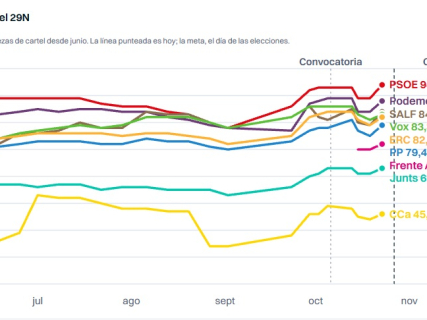

Pedro Sánchez remains at the top of the Digital Power ranking of candidates for the Presidency of the Government ahead of the 29N, with 94.2 points in the measurement published on October 23. Irene Montero occupies the second position, with 87.9, followed by Alvise Pérez, with 84.5; Santiago Abascal, with 83.3, and Gabriel Rufián, with 82.3.
The main variation among the six candidates from the state parties is that of Alberto Núñez Feijóo, who reaches 79.4 points after adding 2.4 compared to the previous measurement. Sánchez also advances, with an improvement of 2.2 points, while Abascal loses 2.7 and Alvise Pérez drops 1.5.
The ranking allows tracking the evolution of the digital presence of the candidates during the months leading up to the elections. The time series, which starts in June, shows the changes in scores throughout the period and indicates the phases of electoral call and campaign before the date of November 29.
Montero, Alvise, and Rufián are ahead of Feijóo
After Sánchez, Irene Montero records 87.9 points, with an increase of 0.9. Alvise Pérez obtains 84.5, although he retreats 1.5, and Abascal remains at 83.3 after losing 2.7. Gabriel Rufián reaches 82.3 points and improves three tenths.
Feijóo appears in sixth position, with 79.4 points and a rise of 2.4. Behind him are Ada Colau, with 72 points, and Míriam Nogueras, with 63.1. Cristina Valido closes the shown ranking, with 45.9 points, one tenth less than in the previous measurement.
The scores correspond to the tool of Digital Power of Demócrata. The individual profiles allow consulting the profile of each representative and expanding the available information about their activity.
What Digital Power measures
Digital Power assigns a score from 0 to 100 based on the activity of political profiles on social networks. Its methodology uses the RIO formula, based on three variables: regularity, interactions, and originality. The indicator takes into account aspects related to the audience, the impact of the messages, and recent activity.
The category of "head of the list" identifies the candidate of each party for the Presidency of the Government when the party has announced it. The ranking compares their digital performance but does not measure voting intention nor does it allow anticipating the election results.