National Lottery today, Thursday, August 13: prizes, schedule, and when the result comes out

The draw this Thursday distributes 30,000 euros per ticket for the first prize and takes place tonight.

2 minutes

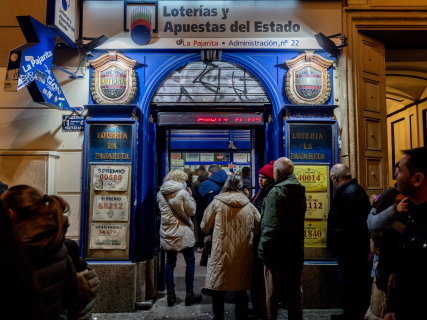
EuropaPress 7190192 gente comprando loteria sorteo extraordinario nino 29 diciembre 2029 madrid

EuropaPress 7190192 gente comprando loteria sorteo extraordinario nino 29 diciembre 2029 madrid

Add DEMÓCRATA to Google

Ask FREN

Published

Last updated

2 minutes

Most read

The National Lottery celebrates this Thursday, August 13, 2026, a new ordinary draw, with a first prize of 300,000 euros per series, equivalent to 30,000 euros per tenth. Players will be able to check tonight the first and second prizes, the refunds, and the rest of the extractions from the draw.

What time is the National Lottery today

The draw of the National Lottery this Thursday, August 13, is scheduled for 21:00 hours.

This is the draw number 65 of the National Lottery calendar for 2026. SELAE has scheduled for this Thursday an ordinary draw made up of six series of 100,000 tickets each. The issuance reaches 18 million euros and the price of the tenth is 3 euros.

The results can be consulted once the extractions are finished and officially published by Lotteries and Bets of the State.

Prizes of the National Lottery this Thursday

The main attraction of the Thursday draw is its first prize, endowed with 300,000 euros per series. As each ticket is divided into ten tenths, each tenth that matches the winning number receives 30,000 euros.

The second prize is endowed with 60,000 euros per series, which means 6,000 euros per winning tenth.

In addition to the two main prizes, the draw includes approximations to the winning numbers, prizes for the hundreds, endings, extractions of various figures, and refunds. The latter allow recovering the amount played when the tenth meets the conditions established in the result.

How much does a tenth of the National Lottery cost today

The price of each tenth for the draw this Thursday, August 13, is 3 euros.

SELAE has put into circulation six series of 100,000 tickets, with a total issuance of 18 million euros for this day.

The Thursday draw thus has a lower price than the ordinary draws on Saturdays, whose tenths usually cost 6 euros.

What you need to match to win the National Lottery

Each tenth of the National Lottery contains a number of five digits. The highest prize corresponds to those who have exactly the number drawn as the first prize.

There is also a second prize and different amounts for the numbers that match with approximations, hundreds, and certain endings of the winning numbers.

The refunds are determined by the corresponding digits announced during the draw itself.

How to check the National Lottery of Thursday, August 13

...

Once the draw is finished, players can check their ticket through the official channels of State Lotteries and Betting.

To know exactly if a number has been awarded, it is advisable to consult the complete list, since in addition to the first and second prizes there are numerous prizes associated with approximations, endings, hundreds, and refunds.

This same page will be updated tonight as soon as the official result of the National Lottery on Thursday, August 13, is known, incorporating at the top the first prize, the second prize, the refunds, and the rest of the extractions.

When the result of the National Lottery comes out today

The result will begin to be known after the draw scheduled for 21:00 hours this Thursday.

When State Lotteries and Betting publish the official extractions, this news will be updated with all the winning numbers. Subsequently, the locations where the main prizes have been sold may also be incorporated.

More key points, information and questions with FREN

AI-GENERATED CONTENT

What are the legal procedures and controls that the organization of a National Lottery draw in Spain must undergo?

The organization of a National Lottery draw, being a state-owned game, is heavily regulated and subject to public controls at all stages: legal and competency authorization, draw design, material execution, relationship with participants, and prize payment. The basic framework is set by the Constitution (exclusive State competence in “General Treasury”, art. 149.1.14 CE) and, sectorally, by Law 13/2011 on gambling regulation and its amendments. On this basis, the State Society for Lotteries and State Betting (SELAE) and the Directorate General for Gambling Regulation (DGOJ) operate, with the intervention of notaries and other public officials during the draw itself.

Basic constitutional and legal framework

The National Lottery is integrated into the state treasury under article 149.1.14 of the Constitution. The sectoral regime is established by Law 13/2011 on gambling regulation, which designs a system of planning, access, control, and sanction for state-level games, with special emphasis on the protection of minors, consumers, and the prevention of fraud and money laundering.

The preamble of Law 13/2011 emphasizes that, due to the economic volume and money laundering risks associated with lotteries, the exclusive reservation of state-level lotteries in favor of SELAE and ONCE is maintained. This law has been strengthened in terms of player protection by Law 23/2022, which modifies, among others, article 8 on safer gambling policies.

Law 13/2011 is further developed by regulations such as Royal Decree 1613/2011 (technical requirements for gambling activities) and Royal Decree 1614/2011 (licenses, authorizations, and registers), as well as prior rules on state-owned games like Royal Decree 208/2004.

Competences of SELAE and DGOJ

SELAE, a state public business entity, is the reserved operator of the National Lottery. Law 13/2011 and budgetary and administrative organization regulations subject it to enhanced public control, both financial and regarding game integrity, including the distribution of revenue and prizes in coordination with rules such as Royal Decree 419/1991 (cited in RD 208/2004 itself).

The DGOJ, integrated into the Ministry of Finance, assumes the regulatory, supervisory, and sanctioning functions provided in Law 13/2011: ensuring the integrity and transparency of operations, verifying technical systems (in coordination with RD 1613/2011), authorizing activities, and applying the sanctioning regime. After the 2022 reform, its role in evaluating responsible gambling policies and combating fraud is strengthened.

Internal procedures and prior controls of the draw

For each National Lottery draw, SELAE must approve rules or specific conditions (ticket price, prize structure, number of tickets and series, calendar), which are inserted within the applicable general regulatory framework. From there, several controls are deployed:

  • Product and prize design: must respect the minimum percentages of revenue allocated to prizes set by state gambling regulations (RD 208/2004 refers to the “General Lottery Instruction” and rules on revenue distribution).
  • Technical systems and security: verification of drums, balls, IT systems, and ticket traceability according to the requirements of RD 1613/2011 and technical provisions approved by the DGOJ.
  • Issuance and custody of tickets: ticket and ticket stub issuance is carried out under strict internal control, with numbering and registration, and distribution circuits to the network of agencies regulated also by agreements and labor resolutions (for example, the sector agreement published by Resolution of June 5, 2019, [link]).

Public faith controls during the draw

Royal Decree 208/2004 reformed the General Lottery Instruction to reinforce the presence of control bodies in draws. It establishes that, in any draw, there will be a control table formed at least by a president (usually the Director General of State Lotteries and Betting or their delegate) and a public notary or auditor, who record that all operations comply with current regulations and the draw program.

Additionally, the drawing and reading of balls are performed by persons or institutions designated by the Directorate General of Lotteries, adding a component of transparency and external control.

Advertising, responsible gambling, and participant protection

Regarding advertising and commercial communication, Law 13/2011 is complemented by Royal Decree 958/2020 (cited in Law 23/2022) to set limits and information obligations. SELAE must respect restrictions on schedules, messages, and the use of the game’s image, as well as include warnings about responsible gambling.

The law requires the application of active safer gambling policies, with self-exclusion mechanisms, attention to at-risk persons, and coordination with exclusion registers. The DGOJ evaluates the effectiveness of these measures and may impose sanctions if consumer rights are violated or minors are allowed access.

Subsequent controls: prize payment, taxation, and sanctions

After the draw, SELAE must validate winning bets through audited IT systems and pay prizes, respecting legally established prescription periods. Prizes are subject to a special tax on prizes from certain lotteries and bets, managed through forms 230 and 136 (approved by Order HAP/70/2013) and form 270 annual summary (Order HAP/2368/2013), updated by Order HFP/1286/2023.

Any relevant irregularity (manipulation, serious security failures, failure to meet information obligations) may lead to the infringements and sanctions regime of Law 13/2011, which provides for substantial fines, suspension of activities, and even revocation of authorizations in the most serious cases.

What legal and control differences exist between SELAE’s National Lottery and the lotteries managed by ONCE? How is the advertising of National Lottery draws specifically regulated and what limits does Royal Decree 958/2020 impose? What types of infringements and sanctions does Law 13/2011 foresee for SELAE in case of irregularities in a National Lottery draw?

What competences and functions does SELAE have in managing the National Lottery according to current legislation?

SELAE manages the National Lottery under a public monopoly regime as part of the set of state-owned games. Legally, its position is mainly defined by the creation of the state commercial company itself and the subrogation in “the exclusive management of state-owned games” previously exercised by the public entity LAE. This management includes organizing draws, economic exploitation, administration of the commercial network, and certain administrative powers over points of sale. The general state gambling framework is completed by Law 13/2011 on gambling regulation, which configures the sector and reserves certain games to the General State Administration, including the National Lottery.

1. Basic normative framework and legal status

The direct normative basis on SELAE is found in Royal Decree-law 13/2010, of December 3, and in Law 39/2010, on the General State Budgets for 2011, which essentially reproduce the same additional provision:

  • Creation of SELAE: “The State Society for Lotteries and State Betting is created, attached to the Ministry of Economy and Finance. The Council of Ministers [...] will approve its bylaws and appoint its governing body.”
  • Extinction of the public entity: the public business entity Lotteries and State Betting is extinguished upon SELAE’s registration in the Mercantile Registry, and the “branch of activity related to state-level games including all assets and liabilities, goods and rights, as well as enabling titles” is transferred to it.

Regarding the sectoral framework, Law 13/2011 on gambling regulation (Law 13/2011) acts as the general rule for the state-level gambling market and establishes the regime for games reserved to the State and authorized operators, a category in which SELAE is included for the National Lottery.

2. Management and exploitation powers of state games

The cited additional provision defines SELAE’s core competence in a key phrase:

The State Society for Lotteries and State Betting shall exercise all the powers previously attributed to the public business entity Lotteries and State Betting for the exclusive management of state-owned games, and shall also be subrogated in all rights and obligations derived from the transfer of said assets and liabilities, goods, and rights.”

From this formulation derive, in relation to the National Lottery (which is part of state-owned games):

  • Exclusive management: SELAE is the only entity authorized to organize and exploit the National Lottery as a reserved state game.
  • Organization of draws: SELAE is responsible for designing the draw offerings, setting calendars, prices, ticket types or stubs, prize structure, participation rules, etc., within the sectoral regulatory framework.
  • Economic exploitation: SELAE assumes commercialization of the National Lottery, collection, prize payment, and income management, including those subsequently allocated to public purposes as established by budgetary regulations.
  • Subrogation in rights and obligations: SELAE assumes all legal relationships previously held by the former public entity regarding the National Lottery (contracts, agreements with points of sale, obligations towards players and third parties, etc.).

3. Commercial network and administrative powers

The same additional provision expressly entrusts SELAE with the management of the commercial network inherited from the public entity:

  • Points of sale and commercial delegations: it is assigned “all rights and obligations related to points of sale and commercial delegations” which continued to be governed by administrative regulations.
  • Administrative powers over the network: “The State Society for Lotteries and State Betting is entrusted with exercising the administrative competences that may correspond regarding the points of sale of the commercial network [...] For these purposes, the Society’s personnel shall exercise [...] the necessary administrative powers concerning said points of sale, except for sanctioning powers...”

For the National Lottery, this means that SELAE:

  • Manages the registration, deregistration, modification, and supervision of lottery agencies and other points of sale that market the National Lottery.
  • Applies the specific legal regime of these points (operating conditions, sales obligations, schedules, corporate image, sales and prize control systems, etc.).
  • Collaborates with the competent administrative body when sanctioning powers come into play.

4. Relations with the General State Administration and control regime

SELAE is attached to the then Ministry of Economy and Finance, placing its actions under the supervision of the General State Administration. The additional provision also foresees:

  • Separation between management and regulation: regulatory functions of the state gambling market are attributed to the Ministry, while SELAE maintains the role of operator and manager of reserved games.
  • Specific patrimonial and tax regime: all transfers and corporate operations derived from SELAE’s creation and endowment benefit from certain exemption and tariff reduction regimes, reinforcing its character as an instrumental means of the State.
  • Transitional financial obligations: during 2011, it is entrusted with paying certain financial allocations to ONCE and other beneficiaries linked to state bets, before these obligations pass to the General State Administration itself.

No more specific information is available in the consulted sources that details, article by article, competences differentiated only for the National Lottery; the regulations attribute to SELAE as a whole the exclusive management of all state-owned games, including the National Lottery.

What exactly does Law 13/2011 say about the State reservation of the National Lottery and SELAE’s role? Which administrative body currently exercises the regulatory functions of the state gambling market differentiated from SELAE’s management? How is SELAE’s economic activity related to the National Lottery controlled by Parliament and through the State Audit Office?

What regulations govern the distribution of National Lottery prizes and how is their compliance audited?

The distribution of National Lottery prizes is governed by a set of specific regulations on state-owned games and by the general gambling law. In parallel, compliance is audited through administrative controls (licenses, guarantees to ensure prize payment, draw records) and tax controls (withholdings and specific forms on lottery prizes). The identified rules set minimum percentages that must go to prizes (except for the National Lottery, which has its own rules) and establish an inspection and sanction regime for operators.

Basic regulations on gambling and state lotteries

The general framework is Law 13/2011 on gambling regulation (Law 13/2011). This law:

  • Defines the concept of game, lotteries, and prizes, including that prizes may be monetary or in kind.
  • Reserves the activity of state-level lotteries to the State Society for Lotteries and State Betting (SELAE) and ONCE, subject to public control.
  • Establishes the regime of licenses, authorizations, and registers — developed by Royal Decree 1614/2011 — and a comprehensive system of infringements and sanctions, which acts as the main regulatory audit mechanism.
  • Provides for the constitution of guarantees related to the obligation to pay prizes and other operator obligations (guarantees are explicitly linked to prize payment in the located passages).

In the field of state games, Royal Decree 208/2004, on certain aspects related to state-owned games (Royal Decree 208/2004), sets key rules:

  • For all state-level games managed by Lotteries and State Betting, except the National Lottery, it requires allocating at least 55 % of revenue to prizes (50 % in certain Primitiva Lottery modalities), with the possibility of a refund fund.
  • Explicitly indicates that the National Lottery is governed by its specific rules.
  • Regulates the control table of draws (president and an auditor or public notary who record that the draw was conducted according to current regulations), directly linking to internal auditing of each draw.

These rules are complemented by the amendment of the 1956 General Lottery Instruction: Royal Decree 208/2004 updates article 25 so that the drawing and reading of balls are performed by charitable institutions or persons designated by Lotteries and State Betting, reinforcing draw transparency.

Specific rules on revenue and prizes

For the National Lottery and other games, the regulation of revenue and prizes relies on several sectoral administrative rules:

  • Royal Decree 419/1991, on distribution of revenue and prizes in state sports bets and other ONLAE games, has been amended by: Although article 2 of Royal Decree 208/2004 excludes the National Lottery from this general rule, these norms illustrate the state distribution scheme: a minimum percentage to prizes and the rest to other public destinations.
  • Order of October 17, 2001, which adapts the amounts of major National Lottery prizes to the euro and regulates aspects related to state games (Order 2001), constitutes the specific reference regarding prize amounts and structure for the National Lottery.
  • Resolution of November 27, 2001, of Lotteries and State Betting (Resolution 2001), develops management aspects of state-owned games, including operational rules on how prizes are calculated and paid.

Alongside these provisions, there is abundant technical and product regulation on Primitiva Lottery, Euromillions, horse betting, etc., such as Resolution of October 16, 2000, Resolution of July 23, 2002, or Resolution of February 6, 2004, which set specific rules for prediction contests and their prize categories and distribution.

Audit of prize payment

The audit of correct distribution and payment of National Lottery prizes relies on three levels:

  • Regulatory control of gambling: Law 13/2011 (Law 13/2011) assigns the gambling authority (National Gambling Commission/Directorate General for Gambling Regulation) functions of control, inspection, and sanction. Among serious infringements is failure to comply with control duties to guarantee game security and prize payment obligations; economic guarantees that operators must establish are explicitly linked to prize payment.
  • Internal control of each draw: according to Royal Decree 208/2004, a table with a president and an auditor or public notary is constituted at every state game draw, who record that operations were conducted according to regulations and the draw program. This record is the formal basis for subsequent prize distribution.
  • Tax control over prizes: Law 16/2012 (Law 16/2012) introduces a special tax on prizes from certain lotteries and bets, incorporated into both the IRPF (Law 35/2006) and the IRNR. This tax is withheld at the time of prize payment, obliging SELAE to correctly identify and declare paid prizes.

To channel this tax audit, specific forms are approved: forms 136 and 230 by Order HAP/70/2013, and form 270 (annual summary of the special tax), updated by Order HFP/1286/2023. Their correct submission allows the Tax Agency to verify that prizes have been paid and withheld according to law.

Additionally, SELAE, as a public business entity, is subject to the general controls of budgetary and tax regulations applicable to state entities; no more detailed information is available in the consulted sources about the specific intervention of other auditing bodies.

Other related texts

The regulatory block is completed with a large number of rules, many linked to other games or ONCE, but following the same logic of regulation and control of prize distribution, among others:

ONCE Coupon 2014, ONCE Weekend, ONCE Instant Lottery 2011, Instant Lottery 2010, Instant Lottery 2009, Euromillions Correction, ONCE Coupon Second Draw, Primitiva Lottery Correction, Primitiva Modification 2001, Order RD 419/1991, RD 1360/1985, ONCE 2012, ONCE 2011, ONCE 2010, ONCE 2009, ONCE Consolidated Text, ONCE Coupons 2023, Coupons 2022, Active Gambling ONCE 2012, Primitiva 2001, Instant Lottery 2023, Instant Lottery 2017, Active Gambling ONCE 2016, Royal Decree-law 13/2010, Euromillions 2009, Internet Order 2005, Horse Betting 2005, El Gordo Primitiva, Organic Law 6/2015, Quinigol 2006, Delegation Order 2001, Delegation of Competences 2000, Active Gambling ONCE 2023, General State Budgets 2011, Law 3/2013 CNMC, ONCE Instant Lottery 2023, RD 132/1981, RD 657/1980, Order 1972, National Tourism Prizes.

What exact percentage of National Lottery revenue is currently allocated to prizes and how has this varied historically? Which specific administrative body currently exercises control and inspection functions over SELAE and National Lottery draws? How are National Lottery prizes taxed in detail under the IRPF and what changes did Law 16/2012 introduce regarding the traditional exemption?

Play

Test your knowledge with FREN!

How much do you know about this topic? Answer the following 3 questions.

What is the first prize per series in the National Lottery draw on Thursday, August 13, 2026?

Question 1 of 3

What is the price of a tenth for this Thursday's National Lottery draw?

Question 2 of 3

Through which channels can the official draw results be checked?

Question 3 of 3

Hola, soy Fren. ¿Cómo te ayudo?