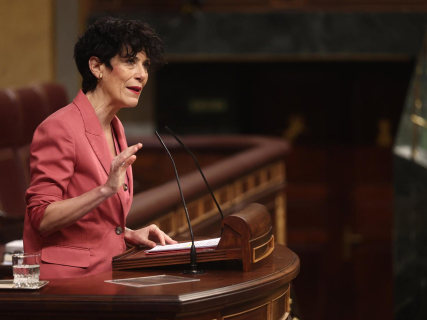

The 200 euros per month aid per child is back in the budget negotiation, this time with a more concrete step. The Minister of Youth and Childhood, Sira Rego, has formally sent a proposal to the Ministry of Finance to incorporate into the next General State Budgets a Universal Childcare Benefit of 200 euros per month for each child under 18 years old.
The measure has long been part of the demands of Sumar and the Ministry itself, but as of today there is no approved universal aid of 200 euros nor an open deadline to apply for it. The Council of Ministers included in February the progressive creation of a universal childcare benefit among the objectives of the 2030 Sustainable Development Strategy, but that inclusion sets a political orientation and does not in itself create the right to receive it.
Who could receive the 200 euros
If it is finally approved in the terms defended by Rego, the benefit would be aimed at all families with children under 18 years old, regardless of their income. The minister has explained that her preferred model is universal: having a minor would be the fundamental requirement and the redistribution among households with different incomes would be carried out later through the tax system.
This would mean 2,400 euros a year for each child. A family with two minors would receive 400 euros monthly, 4,800 euros a year, while with three minor children the amount would reach 600 euros monthly or 7,200 annually, as long as the final design maintained the 200 euros for each minor and did not introduce additional limits.
However, Youth and Childhood has opened the door for the rollout not to happen all at once. Rego has suggested that it could be introduced "gradually" by age brackets, so that certain minors could start benefiting earlier and coverage would later expand to include the entire population from 0 to 17 years old.
It is not the same aid that is already paid by Social Security
The proposal should also not be confused with the Child Aid Supplement (CAPI), which currently exists and is part of the Minimum Vital Income system. This supplement can be received even without receiving the full IMV, but it is conditioned to certain income, wealth, and family unit composition limits.
In 2026, the CAPI pays 115 euros monthly for each child under three years old, 80.50 euros between three and five years old, and 57.50 euros from six to 17 years old. The future benefit of 200 euros would be different precisely because the Ministry's approach is that it should have a universal character and not be reserved only for households that meet certain economic requirements.
What is needed for it to be collected
The main obstacle is now budgetary and political. Youth and Childhood has sent its proposal to the Treasury, but that does not mean that the Ministry led by María Jesús Montero has yet accepted to finance it under the requested terms. The measure would have to be incorporated into the budget project or find another funding route and, in addition, be legally specified: who would have the right, from what date, how it would be requested or recognized, which body would manage it, and how it would relate to existing aids and deductions.
It would then have to overcome the processing within the Government and, if included in the Budgets, obtain the necessary support in the Cortes Generales. Therefore, there is still no official date to start paying the 200 euros, nor a request form nor an enabled procedure.
The difficulty is not less due to the volume of resources needed. A study by ISEAK calculated that a completely universal benefit of 200 euros per month per child could reach a gross cost close to 19.276 billion euros annually, although that estimate corresponds to a specific model and the final cost would depend on how the measure is designed, its gradual implementation, and whether it replaces or coexists with existing tax benefits.
More than half a million children could be lifted out of poverty
The central argument of Youth and Childhood is to combat one of the highest child poverty rates in Europe. Rego argues that approximately one in three children and adolescents in Spain is at risk of poverty or social exclusion and argues that universal aids also reduce the access problems that benefits aimed exclusively at low-income households usually present.
A study presented by UNICEF estimates that a benefit of 200 euros per month could reduce child poverty by 7.1 percentage points and lift about 530,000 minors out of that situation. The organization has advocated for direct transfers to families as one of the most impactful tools to reduce child poverty.
The proposal also has prior political support within the Executive: the Sustainable Development Strategy incorporated in February the goal of advancing towards a benefit for 100% of families with dependent minors, with a progressive application. But there is still a fundamental difference between that commitment and an effective benefit: the 200 euro aid remains a proposal and not a right recognized in the BOE.
Thus, for now, no family must carry out procedures to request it. The next decisive step will be to verify whether the Treasury accepts to include it in the next Budgets, with what amount and schedule, and whether the Government then secures the necessary parliamentary support. Only then will it be known when payments would begin and whether the 200 euros will reach all minors from the start or will first be rolled out to certain age groups.