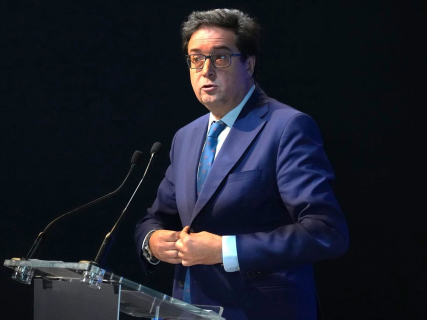

The Minister for Digital Transformation and Public Function, Óscar López, defended this Monday the need to promote a Public Administration more advanced to social demands, capable of using artificial intelligence to anticipate the processes that citizens need.
During his speech, López described a model of Administration that, relying on AI systems, detects in advance the needs of each person and completes by default most administrative procedures, so that the user only has to "complement or validate" the processes that are already prepared.
The head of Digital Transformation also emphasized that the new European regulatory framework on artificial intelligence does not constitute a brake on innovation. In his opinion, the experience of the automotive sector demonstrates the opposite and disproves the idea that Europe has fallen behind in the technological race for betting on regulation, since "the automotive sector has been regulated for 150 years and has not been contrary to innovation, but rather the opposite."
These reflections were shared at the closing event of the presentation of the Future Government Center of NTT DATA, held at Torre Bat, a forum that aspires to become a reference point for the transformation of public management, helping to close the gap between the pace of technological advancement and the capacity of institutions to direct and leverage it in favor of digitalization.
In this context, the minister criticized "the great lie" that is being spread about the supposed need not to regulate, insisting that "regulation is compatible with innovation." He cited as an example the effect of regulations in the motor industry, where, he pointed out, "regulation has made the car more sustainable, more secure," in contrast to what has happened in the realm of social networks, where the lack of clear rules has generated numerous problems.
A humanist and reliable artificial intelligence
López also rejected the narrative that presents global technological competition as a "stampede" without brakes and emphasized that "that artificial intelligence as a technology has to be humanist and has to be reliable."
He emphasized that the central objective should not be limited to speed or cost reduction, but to the reliability of the systems, stressing that "it is not enough for it to be something faster or cheaper, but it must be reliable."
According to the minister, that trust must become the hallmark of the technology developed in Europe. Therefore, he argued that "that has to be the seal of our artificial intelligence, of our technology" and rejected claims such as "Europe has lost the race because it regulates and that in that great race where others win, Europe has the problem that it regulates."
Future Government Center, he recalled, is an initiative of the Japanese multinational NTT DATA "conceived as a reference space for analysis, innovation, and collaboration around the future of public management."
In this line, López explained that this way of understanding administrative action has been applied for years in the tax field, with the Income Tax Declaration, where "the Tax Agency does your declaration, it is proactive, it is not you, it is done, you just have to go to complement or change it."
The minister reiterated that "with that same vision is how the Public Administration has to work," extending this approach to all procedures with institutions. He advocated for reversing the traditional scheme of relationship with citizens, arguing that "the Administration has to know what procedures we are doing with it so that it can handle them and the citizen only has to complement or validate later."
To achieve this model shift, López highlighted that "a lot of public-private collaboration has been decisive, there has been a lot of work for the administration," recognizing the joint role of companies and the public sector in incorporating these technologies into administrative services.
The person in charge also emphasized that one of the priorities of the European project is "to promote and present that European technology sector," linking "administrative modernization with the strengthening of the continent's technology industry."
In his speech, the minister again described the proposal for an Administration that, thanks to artificial intelligence, is capable of anticipating the needs of citizens and automating most procedures, reserving for people only the function of "complementing or validating" what has already been processed.
To close his speech, López has focused on the importance of sovereignty and digital rights as essential pillars of the ongoing technological transformation.