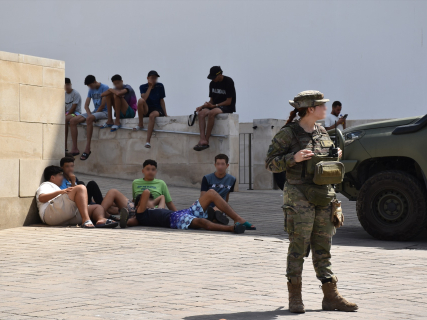

Meta and TikTok have agreed with the European Union to strengthen the verification of content related to border crossings into Spain after the massive influx recorded from Morocco to Ceuta and the spread of false messages encouraging potential migrants to attempt to reach Spanish territory.
The Executive Vice-President of the European Commission responsible for Technological Sovereignty, Security and Democracy, Henna Virkkunen, has explained that both platforms have activated their crisis protocols and established a "ad hoc mechanism for escalation and cooperation with verifiers". The aim is to detect and respond more quickly to false information that could be used by criminal networks to promote new attempts at entry.
A special mechanism between platforms and verifiers
The agreement is not simply about increasing ordinary moderation. Meta and TikTok have launched a specific crisis procedure so that certain content can escalate quickly to verification teams when there is a risk that misinformation could contribute to new dangerous migratory movements.
The European Commission has also explained that the platforms have committed to prohibiting content related to the illicit trafficking of people. Brussels specifies, however, that the decision to block or reduce the visibility of posts lies with the companies themselves: the Commission does not order them to remove specific content, but maintains a dialogue for them to act according to their responsibilities.
The community Executive and Europol maintain daily contacts with Meta and TikTok to monitor the evolution of the situation, according to the information provided by Virkkunen.
Brussels had already called for more oversight
The decision represents a further step regarding the discussions opened last week. On August 7, the European Commission already held a meeting with Meta and TikTok to demand a more intense response to misinformation linked to the Ceuta crisis and to strengthen collaboration with independent verifiers.
Brussels then focused on the use of the platforms to spread messages about supposed eases for crossing the border and on the risk that this type of content could favor new concentrations.
Coordination with the Spanish Government
Virkkunen has also held conversations with the minister for Digital Transformation and Public Function, Óscar López, about measures aimed at preventing new crossings encouraged by false information and reducing the risk of new victims.
The European concern is especially focused on preventing networks dedicated to human trafficking from using social media as a recruitment tool, spreading messages that present certain routes as safe or falsely assure that border controls have disappeared.
Reuters notes that some of the viral videos that preceded the crisis contributed to encouraging potential migrants to move towards Ceuta.