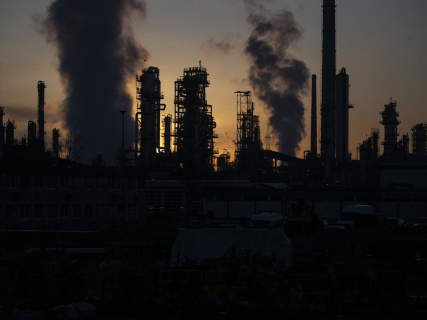
Oil surpasses 112 dollars and marks highs since May: why Brent is rising and how it affects Spain

The risks to supply in the Middle East drive up the price of crude oil. The market anticipates possible interruptions in exports and adds pressure on fuels.

fotonoticia 20260921170448 1920

fotonoticia 20260921170448 1920

Add DEMÓCRATA to Google

Ask FREN

Published

Last updated

2 minutes

Most read

Elecciones 29N · Encuestas

La media de las encuestas

Media a 21 de octubre de 2026 · 15 institutos

  • PP31,6 %
  • PSOE26,9 %
  • Vox18,7 %
  • Sumar6,3 %
  • Podemos3,1 %
  • ERC2,2 %
010203040ene 2024jul 2024ene 2025jul 2025ene 2026jul 2026

Media del último estudio de cada instituto en 30 días y su evolución semanal desde el 23J. Partidos con al menos un 2 %.

Todas las encuestas

Elecciones generales del 29 de noviembre · Demócrata

The price of oil rises again this Thursday with the Brent barrel, European reference, above 112 dollars during the session. The escalation places it at its highest levels since May, in a context of concern over the security of energy supply from the Middle East. 

At 14:25, Spanish peninsular time, Brent was trading at 111.92 dollars, with an increase of 2.84%, after reaching an intraday high of 112.68 dollars. These are data from a session that is still open.

Why the price of oil is rising

The trigger is the new attacks in Saudi Arabia and the fear that the regional escalation will harm production and exports. According to Reuters, Saudi Aramco has asked workers to leave its headquarters in Dhahran and work remotely, while the United States has ordered the departure of part of its diplomatic personnel and families. 

The price incorporates the risk that supply will become complicated in the coming days. Futures contracts reflect expectations about future deliveries: if the possibility of attacks on facilities or difficulties in transporting crude increases, buyers are willing to pay more to ensure their supply.

This uncertainty explains why oil can become more expensive even when exports improve. Crude flows from the region have recovered to levels prior to the conflict, but the fear of new interruptions continues to support prices. 

What role does the Strait of Hormuz play

The security of maritime transport is one of the keys. The Strait of Hormuz connects the Persian Gulf with the main export routes, so incidents in this passage add uncertainty about the arrival of shipments.

The continuity of attacks and difficulties in exporting certain refined products, such as diesel and aviation fuel, maintain pressure on the energy market.

Brent is at its highest since May, but remains below its historical record. The nominal reference is around 147.50 dollars per barrel reached in July 2008.

How it can affect gasoline and diesel in Spain

The increase in crude adds pressure on the manufacturing costs of gasoline and diesel. However, a 3% rise in Brent does not mean that fuels automatically increase by that same percentage.

The final price of the pump also depends on the quotes of refined products, the exchange rate between the euro and the dollar, taxes, and distribution margins. Therefore, the evolution of the barrel guides the trend, but it does not allow calculating by itself how much it will cost to fill the tank. 

More key points, information and questions with FREN

AI-GENERATED CONTENT

What is the current stage of processing of the European legislation on strategic oil reserves?

As of October 22, 2026, the European regime for strategic oil reserves is already approved and remains in force: its central rule is Directive 2009/119/EC. What is under review is its possible update; in the sources consulted, no formal legislative proposal for modification or replacement being negotiated by the Council and the European Parliament has been identified.

Therefore, it is advisable to separate two issues: the application of existing obligations and the preparation of a future reform. Recent decisions on coordination or release of reserves belong to the first, and do not by themselves mean that new legislation has been approved.

1. The current regulation is not pending approval

Directive 2009/119/EC obliges Member States to maintain minimum reserves of crude oil and petroleum products. It also establishes mechanisms for storage, information, and availability of those stocks in the event of a supply crisis.

The Commission continues to consider this directive one of the legal instruments of European material preparedness. This appears in the documentation of the European Reserves Strategy, presented in July 2025. Its review does not suspend current obligations nor replace them with the guidelines of that strategy.

2. The reform is in the preparatory phase

The main milestones identified are as follows:

  • Request from the European Parliament. On July 8, 2025, the Eurochamber approved a resolution on energy supply security that called for a review of Directive 2009/119/EC. The request responds to geopolitical changes and the needs for resilience and preparedness, including risks to fuel supply. It can be consulted in the approved resolution.
  • Work of the Commission. The reserves strategy documentation identifies the directive as a framework under review. This places the update within the scope of analysis and preparation of possible changes, according to the Commission document.
  • No formal legislative proposal located. No COM proposal directly modifying or repealing the directive has been identified, nor legislative positions of the Council and Parliament on a new oil reserves regime.

The parliamentary resolution corresponds to procedure 2025/2055(INI), of own initiative: it expresses a political position but does not amend legislation. The parliamentary report allows distinguishing that work from a binding legislative proposal.

3. The 2026 measures do not amount to a new directive

On April 22, 2026, the Commission presented the AccelerateEU package of measures. It includes coordination of exceptional reserve releases, attention to the availability of kerosene and diesel, and the announced creation of a Fuel Observatory to monitor production, trade, and stocks. The Commission communication outlines these actions but does not evidence the approval of a replacement regime.

The Regulation (EU) 2026/261, in force since February 3, 2026, must also be distinguished. It regulates the phased elimination of Russian gas imports and the preparation for Russian oil, with diversification plans and dependency monitoring; it does not establish a new general system of strategic reserves. Its text is published in the Official Journal of the EU.

In conclusion: the existing legislation is in application; its update is in preparation, without a formal legislative negotiation identified. The next relevant milestone would be the publication of a concrete proposal from the Commission, which would allow knowing its scope and timetable.

What are the competencies of the Ministry for the Ecological Transition regarding energy security?

The Ministry for the Ecological Transition and the Demographic Challenge (MITECO) has competencies to ensure energy supply, plan the system, and develop regulatory measures that protect supply continuity. It exercises these mainly through the Secretary of State for Energy, respecting the powers of the energy regulator and the autonomous communities. Its main organizational reference is Royal Decree 503/2024, especially its articles 2, 3, and 4.

1. Guarantee of supply and strategic autonomy

Article 2.1.a assigns to the Secretary of State the development of energy policy with explicit objectives of supply security, supply independence, and strategic autonomy. Article 2.1.l specifies its function: "the preparation and, where appropriate, application of measures aimed at ensuring energy supply".

This responsibility includes promoting flexibility through storage and demand management: having energy when needed and facilitating consumption adaptation to system conditions. It also includes saving, efficiency, and fuel substitution with lower-emission alternatives.

2. Infrastructure planning and electrical capacity

The Ministry develops energy planning and strategy, forecasts demand, and analyzes consumption, prices, and technological evolution. The Directorate General for Energy Policy and Mines participates in indicative and binding infrastructure planning and its monitoring, together with competent bodies.

  • Electricity: prepares proposals on system operation, non-peninsular systems, and capacity mechanisms, which allow remunerating resource availability to cover demand.
  • Networks and storage: promotes infrastructures, renewable integration, and solutions that provide flexibility.
  • Reliability: the Directorate General set parameters to evaluate electricity supply security through the Resolution of July 7, 2025.

3. Gas, oil, and security reserves

Its competencies cover hydrocarbon management, supply monitoring, and security obligations. Royal Decree 1716/2004 regulates minimum security stocks, diversification of gas supply, and the operation of the Strategic Petroleum Reserves Corporation (CORES).

Within this framework, the Ministry receives information on supplies and reserves and participates in their control, with CORES intervention and according to the territorial distribution of powers. The release of reserves should not be attributed exclusively to the Ministry: the agreements of April 29, 2025, and March 17, 2026, were adopted by the Council of Ministers and published through resolutions of the Secretary of State for Energy (2025 agreement and 2026 agreement).

4. Authorizations, inspection, and coordinated response

When it corresponds to the General State Administration, it processes authorizations, controls operators' obligations, and exercises inspection and sanctioning powers. These functions cover technical conditions, effective availability of electrical and gas installations, supply continuity, and service quality. It also formulates basic regulation on installation safety.

The Directorate General for Energy Planning and Coordination also concentrates strategic planning, efficiency, and nuclear management functions, including authorizations and monitoring of international commitments on physical protection of nuclear materials and installations.

5. Scope and limits

The Ministry coordinates energy policy with other departments and maintains international and European energy relations. However, leading energy security policy does not equate to daily operation of the networks: technical operation and regulatory supervision have differentiated responsible parties. Therefore, its competencies should be understood as a combination of planning, regulation, prevention, control, and coordination, not as an exclusive operational responsibility over any incident.

What legal requirements must Spain meet to guarantee the minimum supply of petroleum products according to European regulations?

Spain must permanently maintain reserves of crude oil and equivalent petroleum products, at least equal to the greater of two thresholds: 90 days of average daily net imports or 61 days of average daily internal consumption. Additionally, it must ensure that these reserves are physically accessible, verifiable, and usable in the event of a serious supply disruption. The European reference standard is Directive 2009/119/EC, not a regulation.

1. Maintain the minimum required volume

The two European thresholds are calculation alternatives: Spain must comply with the one that yields the higher quantity, expressed in oil equivalent and calculated over the corresponding reference period. Therefore, it is not correct to summarize the European obligation as 90 days of consumption, because that period refers to net imports.

Article 50.4 of the Hydrocarbons Sector Law expressly incorporates this requirement: to maintain a level equivalent to at least the greater of both amounts.

2. Apply Spanish storage obligations

Royal Decree 1716/2004, as amended, specifies the national system. As a general rule, obligated parties must maintain stocks equivalent to 92 days of their sales or consumption from the previous calendar year. During the first quarter, sales or consumption from the penultimate calendar year are taken as reference. For liquefied petroleum gases, there is a differentiated obligation of 20 days.

These 92 days constitute a national obligation with a calculation basis different from the European one; they should not be confused or directly compared as if measuring exactly the same thing.

  • Wholesale operators must maintain stocks corresponding to their national sales, with exclusions provided to avoid duplications.
  • Retail distributors and consumers are also obligated for the part of their sales or consumption not supplied by the legally established operators.
  • The system combines industry stocks and strategic reserves managed by CORES. The MITECO describes the ordinary distribution as 42 days managed by CORES and 50 by the industry.
3. Guarantee real availability and control

It is not enough to certify a quantity on paper. Article 50.3 requires that stocks be physically available and accessible to supply the national market and that they can be verified at any time. This requires adequate facilities and means for reception, storage, and transport, whose availability must be documented.

Obligated parties must provide information on purchases, sales, movements, and stock levels to authorities and CORES. Additionally, they must submit to this corporation, within the first five months of the year, an accounting statement of the previous year accompanied by an audit report, except for the substitution provided when there has been no activity. Non-compliance is subject to the sanctioning regime of the Hydrocarbons Law.

4. Provide for crisis response

The regulation allows mobilizing reserves in shortage situations. Article 49 of the Hydrocarbons Law empowers the Council of Ministers to intervene stocks, limit or allocate supplies, and adopt consumption restrictions.

Article 20 of the Directive contemplates temporary reserve reductions under the circumstances and conditions it regulates, including effective international mobilization decisions. The legal guarantee therefore combines quantity, accessibility, supervision, and response capacity; it does not consist solely of storing fuel.

Play

Test your knowledge with FREN!

How much do you know about this topic? Answer the following 3 questions.

What is the main reason for the recent increase in the price of Brent crude oil?

Question 1 of 3

What role does the Strait of Hormuz play in the energy market?

Question 2 of 3

What factors, besides the Brent price, influence the final price of gasoline and diesel in Spain?

Question 3 of 3