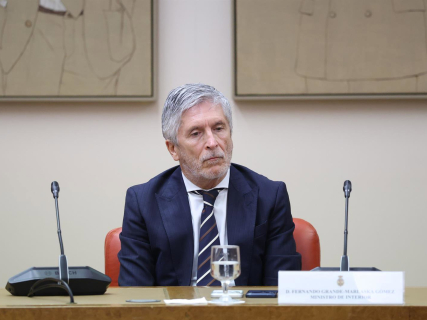
Police unions and civil guard associations are barricading themselves in the Interior to demand a "dignified retirement."

Representatives of three unions of the National Police and six associations of the Civil Guard denounce the lack of progress after almost a year of negotiations with the Secretary of State for Security and call on other agents to support the protest.

fotonoticia 20261026172142 1920

fotonoticia 20261026172142 1920

Add DEMÓCRATA to Google

Ask FREN

Published

Last updated

2 minutes

Most read

Elecciones 29N · Encuestas

La media de las encuestas

Media a 27 de octubre de 2026 · 15 institutos

  • PP31,0 %
  • PSOE27,3 %
  • Vox18,9 %
  • Sumar6,3 %
  • Podemos2,9 %
  • ERC2,3 %
010203040ene 2024jul 2024ene 2025jul 2025ene 2026jul 2026

Media del último estudio de cada instituto en 30 días y su evolución semanal desde el 23J. Partidos con al menos un 2 %.

Todas las encuestas

Elecciones generales del 29 de noviembre · Demócrata

Several unions of the National Police and professional associations of the Civil Guard have started this Tuesday a peaceful and indefinite sit-in at the Ministry of the Interior to demand improvements in their retirement conditions, after deeming the negotiations they have been maintaining for almost a year with the Secretary of State for Security a failure. The calling organizations assert that this is an unprecedented mobilization and demand from the department led by Fernando Grande-Marlaska concrete commitments to guarantee what they consider a "dignified retirement."

The protest includes the participation of the police unions SUP, Jupol, and UFP, as well as the associations of the Civil Guard AUGC, Jucil, AEGC, ASES-GC, IGC, and Unión de Cabos, who have decided to remain in the ministerial premises in the absence of an agreement with the Government.

"We have been in meetings and promises for almost a year; we need concrete commitments and solutions," the organizations have stated in a joint statement, in which they justify the sit-in due to the lack of results from the conversations held with the Interior officials.

Almost a year of negotiations without agreement with Interior

The union and professional organizations consider the negotiation route with the Secretary of State for Security exhausted after months of contacts in which, they claim, the necessary measures to improve the retirement conditions of the members of both bodies have not been specified.

The main reason for the mobilization is the demand for retirement conditions that the police and Civil Guard representatives consider insufficient, a claim that is part of the labor demands that both groups have been conveying to the Ministry of the Interior.

The organizers have chosen to maintain the sit-in without a planned end date, with the aim of obtaining a response from the ministerial department and verifiable commitments regarding their demands.

The decision represents a hardening of the protests after the meetings held in recent months, although the organizations insist on the peaceful nature of the initiative.

The organizers call on other agents to join the protest

The unions and associations have requested the support of other members of the State Security Forces and Corps stationed in Madrid, whom they have invited to come to the offices of the Secretary of State for Security to show their support.

In their call, the organizations emphasize that the mobilization must develop "peacefully and with absolute respect", with the intention of making their demands visible without altering the reivindicative nature of the concentration.

The representatives of both bodies have presented the sit-in as an exceptional measure in light of the lack of progress and have insisted on the need for the Ministry of the Interior to specify a solution.

For the moment, the organizations have not announced when they will end the protest, which they maintain indefinitely while waiting for a response from the Government.

More key points, information and questions with FREN

AI-GENERATED CONTENT

What is the parliamentary status of the reform of retirement conditions for police officers and civil guards?

As of October 27, 2026, the reform has not been approved and has not created a new general early retirement right for national police officers and civil guards. It is important to distinguish two different legislative initiatives and the negotiation with the Interior Ministry: the proposal from the Senate was stalled in amendments; another presented in the Congress faced a government budget veto. With the dissolution of the Cortes for the November 29 elections, the pending parliamentary process expired, while the governmental route remains unfinished.

The two legislative initiatives
  • Proposal from the Senate. Its purpose was to amend the General Social Security Law to include the National Police, Civil Guard, and Customs Surveillance among the groups with reducing coefficients: a mechanism that allows advancing the retirement age due to working conditions. It was sent to the Congress on June 7, 2024. There it remained in the amendment phase, with successive deadline extensions, without completing its legislative approval. Senate approval should not be confused with a law definitively approved by the Cortes. It can be consulted in the Congress file.
  • Another proposal presented in the Congress. It also aimed to include those three groups through a coefficient of 0.20 per full year of effective service, with access from age 60, or age 59 with 35 years of activity and contributions. The Government expressed disagreement due to the budgetary impact and the Board agreed it was not appropriate to bring it to consideration, the vote that allows starting its processing. Therefore, it also did not become law. The proposed content is in the published text.

The current consequence is important: it is not enough to lift a blockade or close amendments. The initiative that was pending lost its course with the dissolution and would need a new presentation to be processed in the next legislature. The ages or coefficients included in unapproved proposals cannot be considered valid either.

What has happened in parallel with the Interior Ministry

The administrative negotiation is different from those parliamentary procedures. On April 29, 2026, Interior established a technical committee to study the reducing coefficients without distinction of contribution regime, according to its official communication. That negotiation does not equate to parliamentary approval nor does it by itself modify pensions.

A draft royal decree specific to national police under the General Regime was also submitted for public consultation, with comments until April 9, 2026. Its limited scope caused criticism for excluding other agents, especially those belonging to Passive Classes and the Civil Guard, as explained by Demócrata about the draft.

The news today is that police unions and civil guard associations have started a sit-in at Interior. According to their account, in the meeting they were told that the electoral call prevented attending to their demand now, despite the progress they had communicated in September. It is an interruption of the negotiation, not the approval of a reform, as reported by Demócrata this October 27.

What previous parliamentary agreements mean

The Congress had already urged the Government, on October 16, 2024, to carry out studies and legislative changes to allow voluntary early retirement. But a non-legislative proposal expresses a political request: it does not change the legislation. This distinction is allowed by the Congress communication itself. In short, there are precedents and concrete proposals, but no general reform completed.

What are the competencies of the Minister of the Interior regarding labor conditions of the State Security Forces and Corps?

The Minister of the Interior has competencies of direction, organization, and regulatory promotion over the professional conditions of the National Police and the Civil Guard, but cannot unilaterally modify them all. His capacity depends on the matter: some decisions correspond to the Ministry; others require the Government, the intervention of the Treasury and Public Administration, or, in the Civil Guard, of Defense.

1. Superior command and personnel management

Article 10 of the Organic Law 2/1986 assigns the minister the general administration of citizen security and the superior command of the State Security Forces and Corps. This underpins his political direction but does not equate to unlimited authorization to alter professional rights.

In the National Police, Organic Law 9/2015 places that superior command in the minister, through the State Secretariat for Security, and direct command in the Directorate General of Police. Therefore, a distinction must be made between directing personnel policy and resolving each leave, assignment, or shift: many actions correspond to subordinate bodies.

2. Working hours, rest, and work-life balance

Interior directs and promotes the regulation and management of working hours, schedules, shifts, rest, vacations, leaves, licenses, and work-life balance measures, within specific legislation and service needs. It also intervenes in training, job provision, occupational health, and risk prevention.

These powers must respect legally recognized rights. Organic Law 9/2015 recognizes national police officers' work-life balance measures and vacations, leaves, and licenses, with regulatory adaptations derived from police peculiarities. An internal instruction does not allow suppressing a legal right. General public administration regulations operate with the scope corresponding according to the specific regime, not as an automatic substitution of it.

3. Remunerations: own and shared competencies

Royal Decree 950/2005 specifies what Interior can do:

  • Productivity: determine its individual amount within assigned credits and according to applicable rules.
  • Extraordinary services: grant bonuses for services outside normal working hours, within available credit; they cannot be fixed or periodic.
  • Position supplements: propose levels of the destination supplement and amounts of the specific supplement's singular component, whose authorization requires the planned interministerial intervention.

Consequently, the minister cannot freely increase all salaries nor create remuneration concepts outside the current system. General reforms must use the corresponding regulatory instrument and have budget coverage.

4. Particularities of the Civil Guard

Here there is an express division. Article 14 of Organic Law 2/1986 assigns Interior the citizen security services and matters related to "their remunerations, assignments, barracks, and material." Article 9 of Law 29/2014 specifies:

  • Interior: directs personnel policy regarding assignments and remunerations.
  • Defense: directs matters related to promotions and administrative situations.
  • Both ministries: jointly exercise direction over selection, training, and improvement.

Additionally, the Council of Ministers sets regulatory staffing, approves vacancy offers, and develops general promotion and advancement guidelines.

5. Professional participation and limits

Interior must respect specific participation channels: the Police Council intervenes in service conditions, schedules, working hours, vacations, leaves, and licenses; the Civil Guard Council participates in improving professional conditions according to its own regime.

In summary: Interior can organize, manage, and propose improvements, and adopt the decisions attributed to it; it cannot substitute the legislator, exceed the budget, nor assume competencies of other bodies.

What legal requirements currently exist to access retirement in the National Police and the Civil Guard?

The requirements to retire in the National Police and to retire in the Civil Guard depend on the applicable pension regime and the cause of cessation: age, voluntary request, or incapacity. It is also essential to distinguish retirement from the second police activity and reserve in the Civil Guard: these are not equivalent situations.

The consulted regulations allow specifying the following differences, although they do not provide a complete and verified list of all ages and minimum periods required as of October 27, 2026.

1. Rules and pension regime

The specific rules are Organic Law 9/2015, on the Personnel Regime of the National Police, and Law 29/2014, on the Personnel Regime of the Civil Guard. To recognize and calculate the pension, the corresponding protection regime must also be considered: State Passive Classes or General Social Security Law. Requirements from one regime should not be automatically transferred to the other.

2. Voluntary retirement and contributions

In the General Regime, article 208 of the General Social Security Law requires, for voluntary early retirement, an age up to two years less than the applicable ordinary age and a minimum of 35 years of effective contributions. These conditions should not be presented as a universal rule for all members of both corps.

Voluntary retirement of those included in Passive Classes must be examined according to its specific regulation. The recovered texts do not contain the complete content necessary to detail their thresholds and exceptions, nor to jointly set the compulsory retirement age of both corps.

3. Incapacity and service-related act

In Passive Classes, retirement or retirement due to permanent incapacity for service or unfitness is contemplated. To calculate the pension, years missing until retirement or compulsory retirement age may be counted, under legal terms.

If the incapacity derives from an accident or illness in the act of service or as a consequence of it, it may generate an extraordinary pension. Its recognition requires proving that relationship with the service; for this extraordinary pension, no minimum period of services rendered is required.

4. Second activity and reserve

The police law allows remaining active until retirement and contemplates adapted tasks when psychophysical conditions decrease without justifying retirement or second activity.

In the Civil Guard, article 93 establishes the passage to reserve at 61 years for officers and at 58 for non-commissioned officers, corporals, and guards, with particular rules for general officers. Upon request, annual continuity in active service may be granted up to 60 years for non-commissioned officers and up to 65 for corporals and guards. It is also possible to request reserve with 25 years of service, within authorized quotas. None of these routes alone equate to pensioned retirement.

5. Coefficients and individual verification

The coefficient provided for local police cannot be automatically transferred to the National Police or Civil Guard. The consulted sources do not contain a specific rule that allows affirming its application to these corps.

To determine individual rights, the pension regime, age, recognized services, contributions in other regimes, and cause of retirement or retirement must be verified. This verification avoids confusing the right to leave active service with the right to receive a pension.

Play

Test your knowledge with FREN!

How much do you know about this topic? Answer the following 3 questions.

What reason has led police unions and civil guard associations to start a sit-in at the Ministry of the Interior?

Question 1 of 3

Which organizations are participating in the mobilization for dignified retirement at the Ministry of the Interior?

Question 2 of 3

What is the nature of the protest carried out by the unions and associations at the Ministry of the Interior?

Question 3 of 3