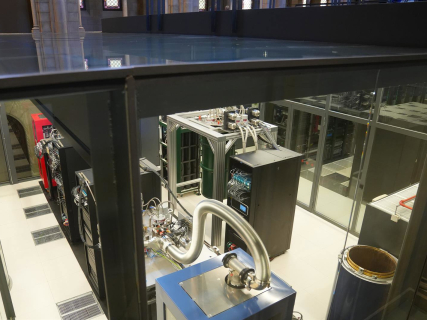

The Barcelona Supercomputing Center-National Supercomputing Center (BSC-CNS) is at the head of the European project funded by the EU EU-LAC Supercomputing Network for AI, whose objective is to improve the interoperability of supercomputing infrastructures between Latin America and Europe and strengthen the competitiveness of artificial intelligence (AI) and supercomputing in both areas.
Driven and coordinated by the BSC, the initiative is integrated into the European Union’s Global Gateway strategy and is part of the EU-Latin America and Caribbean Digital Alliance, launched in March 2023, as the center itself detailed this Monday in a statement.
The program includes an extensive training plan, with training activities and summer schools, in which the BSC will make available its accumulated experience over more than 20 years of cooperation with entities from Latin America and the Caribbean, as well as its track record in the training of research staff in supercomputing and AI.
The director of the BSC, Mateo Valero, has emphasized that EU-LAC is the result of more than two decades of joint work and of the idea that "supercomputing and AI are more useful when they are developed by everyone together," and has stressed that these advances must incorporate the languages and diversity of the different societies.
Inclusive AI and practical applications
This orientation toward an inclusive AI that represents the diversity on both sides of the Atlantic will be reflected in the Ibero-American Digital Forum, which will take place this Tuesday in Madrid and at which Valero will give a talk.
The initiative will foster the creation of more efficient AI applications, with a reduced carbon footprint and water consumption, as well as the development of language models adapted to Latin American Spanish and Brazilian Portuguese. It will also promote high-resolution simulation of phenomena such as earthquakes and tsunamis, in addition to the analysis of the impact of climate change on strategic crops such as coffee.
In the case of Mexico and Brazil, the BSC maintains a shared agenda in AI, language models and digital twins, where talent training is one of the central axes: in Mexico it supports the development of the future supercomputer Coatlicue and, in Brazil, it works jointly with the National Laboratory for Scientific Computing.