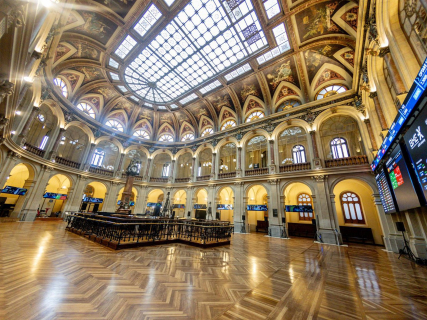

The Ibex 35 of the Madrid Stock Exchange has ended the session this Wednesday with a decline of 0.44%, which has meant losing the threshold of 19,900 points and marking its worst record so far in August.
At the close, the main Spanish index stood at 19,847 points in a day again conditioned by the escalation of the conflict in the Middle East, which keeps the price of crude oil above 92 dollars a barrel.
Last Monday, the 60-day margin that the United States (US) and Iran had given themselves to try to reach a global agreement to end the war in the Middle East concluded, with no results so far. The declared efforts of Washington to pressure Tehran to reopen the Strait of Hormuz and resume talks have been fruitless, and the military conflict has already reached six months.
In this context, the US president, Donald Trump, reiterated this Tuesday that "there are no talks or dialogue" planned with Iran and that the naval blockade over the Strait of Hormuz remains in effect after the agreement signed between the parties expired last June.
For his part, the president of the Parliament and Iranian chief negotiator, Mohammad Baqer Qalibaf, has reproached the United States that the Donald Trump Administration "believes that pressuring Iran more will allow it to obtain concessions that were never part of the agreement" signed between Washington and Tehran in mid-June.
At the same time, the authorities of the Islamic Republic have stated this Wednesday that the United States seeks a "dignified exit" from the region amid the ongoing military 'impasse'. "The United States seeks a dignified exit from the region, and the 'from the river to the sea' project of the Zionist entity is nothing more than a chimerical dream," emphasized Qalibaf.
In parallel, at least six Palestinians have died and more than a dozen have been injured in a new bombing by the Israeli Army on the city of Gaza, despite the ceasefire agreed between Israel and the Islamic Resistance Movement (Hamas) in October 2025. Gazan authorities already raise the death toll to 1,265 and the injured to 4,198 due to actions by the Israeli Army since the truce.
On the other side of the Arabian Peninsula, Houthi rebels from Yemen have claimed that their forces have attacked eight Saudi oil tankers and blocked the transit of almost fifty more through the Bab el Mandeb Strait, within the naval blockade imposed on the neighboring country since July 20.
With this backdrop, the Brent barrel, a reference in Europe, rose at the close of the markets in the Old Continent by 1.27%, to 92.18 dollars, while the West Texas Intermediate (WTI), a reference in the United States, advanced by 1.66%, to 86.35 dollars per barrel.
In the realm of international trade, Trump has announced a three-day delay in the implementation of a 50% tariff on Canada, which was set to take effect this Thursday, following an agreement to resume the construction of the Keystone XL pipeline, intended to connect Nebraska (USA) with Alberta (Canada).
Fed Minutes and Lagarde's Message at the World Economic Forum
This Wednesday, after the close of European markets, the minutes of the last monetary policy meeting of the Federal Reserve of the United States (Fed) will be published. At the same time, the president of the European Central Bank (ECB), Christine Lagarde, has defended at an event of the World Economic Forum the convenience of reducing the fragmentation of the European market so that investments and community companies can grow in size and compete, with the aim of not being left out of the revolution of Artificial Intelligence (AI).
In the macroeconomic sphere, the year-on-year inflation of the eurozone stood at 2.9% in July, one-tenth above the June figure, while in the whole of the European Union it also rose by one-tenth, to 3%, as confirmed by Eurostat this Wednesday.
Before the opening of the stock markets, the inflation of the United Kingdom was also known, which accelerated in July its annual rate to 2.9%, three-tenths more than in the previous month and its highest level since March, driven by the increase in energy prices.
Within the Spanish selective, the biggest rises of the day have been for Grifols (+3.32%), Rovi (+2.93%), Inditex (+2.14%), Solaria (+1.83%) and Puig (+1.67%). On the downside, Caixabank (-2.01%), Unicaja (-1.78%), Bankinter (-1.7%), Indra (-1.69%) and Merlín (-1.56%) have stood out.
As for the rest of the major European markets, all have ended in negative except for the British FTSE, which has advanced by 0.14%. The Italian Mib has fallen by 0.75%, the German DAX 30 by 0.14% and the French CAC 40 by 0.09%.
USA intervenes to curb the rise in debt yields
In the foreign exchange market, the euro appreciated against the dollar (+0.78%), up to an exchange rate of 1.1666 'green bills'. In sovereign debt, the yield on the Spanish ten-year bond fell to 3.697%, placing the risk premium —the differential with the German 'bund' at the same term— at 44.44 basis points.
In light of the global rise in yields, some governments are beginning to act to contain the premium demanded by investors. Thus, the U.S. Department of the Treasury has announced that it will increase "at least double" the volume of long-term bond repurchase operations to bolster liquidity, after the interest in debt with maturities between 10 and 30 years has surged to two-decade highs in recent days.
Specifically, the auction of 30-year U.S. Treasury bonds held last week recorded the highest yield since 2001, reaching 5.216% in the auction on August 13, in which 25 billion dollars in securities were placed.
In the segment of assets considered safe havens in times of high volatility, the ounce of gold rose by 3.53%, up to around 4,500 dollars, while the main cryptocurrency, bitcoin, advanced nearly 6%, up to 68,600 'green bills'.