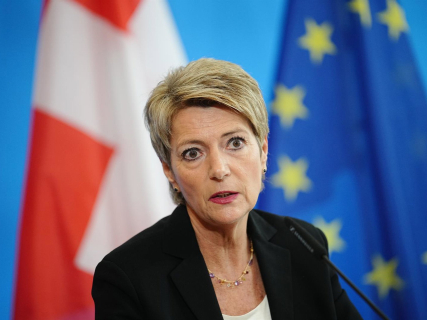

The head of Finance of Switzerland, Karin Keller-Sutter, has shown her rejection of the decision of the Commission of Economic and Tax Affairs of the Council of States —the Swiss Upper House—, which has voted against the line set by the Government in the draft reform of the Banking Law and the Capital Adequacy Ordinance, still in the parliamentary debate phase.
The Executive's plan aims for entities considered systemically important in the country to back 100% of their CET1 capital —the highest quality— the stakes in their foreign subsidiaries, in order to strengthen their resilience against possible disruptions and avoid episodes similar to the collapse of Credit Suisse in 2023.
UBS, the largest Swiss bank, has repeatedly expressed its opposition to this regulatory tightening, arguing that it would result in a loss of competitiveness against other large international banks and a burden for the Swiss economy.
In contrast to the Government's approach, the majority of the Commission has supported a motion that lowers the threshold to 50% of CET1, allowing the rest of the requirements to be covered by contingent convertible bonds ('CoCos'), which represents a substantial relaxation compared to the original design of the Federal Council.
"The proposal of the Federal Council stipulates that systemically important banks established in Switzerland must cover all their stakes in foreign subsidiaries with common equity tier 1 (CET1) capital. However, from the perspective of the (Commission), this severely limits the competitiveness of UBS and, consequently, harms the economy," reads the statement issued after the vote.
Following the arguments defended by UBS, the parliamentary body urged the Executive, with seven votes in favor, four against, and two abstentions, "to completely abandon the legal regulation of capital adequacy for foreign investments and leave this responsibility in the hands of the Federal Council, as is currently the case, through ordinances."
"In general, the majority of the committee believes that the proposed solution establishes very strict regulations, aligned with international standards and comparable to those of the European Union and the United Kingdom. It considers that its solution is suitable for the market and viable, and that it allows UBS to maintain its competitiveness," reads the published document.
The Minister of Finance has defended before the press that "it is a solution that benefits the bank and harms the taxpayers," to then add that, in her opinion, the Commission's approach does not effectively reinforce the solidity of UBS.
UBS considers the proposed reduction insufficient
UBS has thanked the Commission for exploring alternative avenues against the "extreme proposals" of the Government regarding banking regulation, although it has warned that even the scenario of reducing the requirements to 50% would imply a "significant increase in costs" for the entity.
"Along with a broad set of other regulatory measures, these recommendations would further increase financing costs for the financial center and the Swiss economy in an international context where other major financial centers are simplifying and streamlining their regulatory frameworks for banks," UBS stated in a note.
At the same time, the bank has demanded that the regulatory changes "be aligned with international standards, be proportional, and address the root causes of the Credit Suisse crisis."
According to its calculations, full compliance with the original project would imply an impact of 22 billion dollars (18.788 billion euros) on its capital ratio, while with the flexibility backed by the Commission, the effect would be reduced to 13 billion dollars (11.200 billion euros), part of which could be covered through the issuance of 'CoCo' bonds.