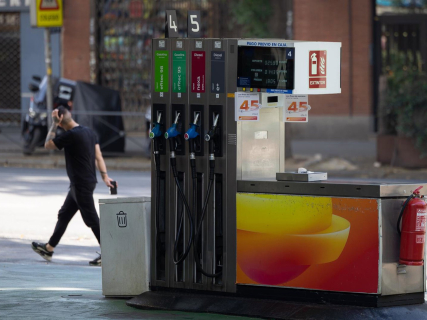

The reduction of the Hydrocarbon Tax applied to diesel will increase to 20 cents per liter next Tuesday, September 1. This increase, compared to the 5 cents initially planned for that month, responds to the notable rise in the price of this fuel during July.
The breakdown of the CPI for July confirmed that the subclass of diesel recorded a year-on-year increase of 15.7% in that month, exceeding the 15% threshold set in the decree of measures designed to contain the economic impact of the war in Iran.
When that limit is exceeded, the safeguard clause included in the anti-crisis response plan is automatically activated, so the reduction of the Hydrocarbon Tax applicable to diesel will be 20 cents per liter starting next Tuesday.
In contrast, gasoline prices increased by 7.3% year-on-year in July, below the 15% threshold established in the regulation, so it maintains the ordinary schedule for gradual withdrawal, with a bonus of 5 cents per liter in September. "The mechanism thus acts proportionately, reinforcing protection only where price pressure justifies it," emphasized the Ministry of Economy.
The Ministry maintains that the latest Royal Decree-law of anti-crisis measures presents a protection approach "adapted to the evolution of the conflict in Iran, with a prudent design that allows for increased protection if an adverse scenario recurs."
The rest of the actions included in the anti-crisis package remain in force under the terms provided in that same Royal Decree-law.
According to the Ministry of Economy, the set of measures approved so far is yielding results. Both the first Response Plan, in effect since March 20, and its extension, validated by the Council of Ministers at the end of June, are achieving their main purpose: to cushion the impact of the external 'shock' on inflation and on the purchasing power of families.
Specifically, the department estimates that these initiatives have contributed to reducing inflation by an average of one point in recent months. "In other words, the response plan has cushioned more than 60% of the price increase due to the external 'shock' represented by the war in Iran," defend those from the Department led by Carlos Cuerpo.
The Executive insists that it will continue to carry out "minute-by-minute" monitoring of the impact of the war on the Spanish economy, "hand in hand" with social agents and the most affected sectors.
The CPI of August rises to 4.3%
Last Friday, the National Institute of Statistics (INE) released the advance of the CPI, which again reflects a strong escalation of fuels.
The year-on-year inflation rose from 3.6% in July to 4.3% in August, seven tenths more, reaching its highest level since February 2023 and exceeding 4% again for the first time since April 2023.
Statistics attributed this strong rise in the CPI in August to the increase in the prices of fuels and lubricants for private vehicles, as well as to the evolution of food, whose prices fell less than in August 2025.
"The general inflation in August stands at 4.3% in the year-on-year calculation, mainly due to the increase in fuel prices due to the persistence of the energy 'shock' derived from the war in Iran," they pointed out from the Ministry of Economy.
In any case, the 4.3% is still a provisional figure. The definitive figure will be published on September 15, when the products in the shopping basket that contributed most to the price increase in August will be detailed.
Eight consecutive weeks of increases in fuels
The price of fuels has already accumulated eight consecutive weeks of increases, chaining a rise close to 24% since the VAT reduction to 10% was eliminated at the beginning of July, and marking summer highs during the return operation in August.
Specifically, the price of diesel has increased this week by 1.8% compared to the previous week, reaching 1.861 euros, consolidating at maximum levels since mid-April.
For its part, the average price of a liter of gasoline has risen this week to 1.723 euros, after increasing by 1.55% compared to the previous week, reaching highs since March, according to data from the European Union's Oil Bulletin consulted by Europa Press.
With these new increases, diesel has accumulated a rise of over 23.7%, while gasoline records an increase of 19.8% in the same period.