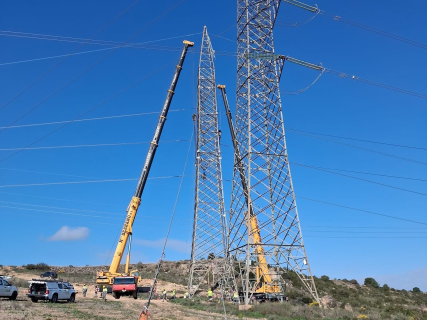

The Spanish electrical grid launches since this September 1 a new flexible access permit system designed to facilitate the connection of new industries and large consumers in areas where the firm capacity is exhausted. The measure, approved by the National Commission of Markets and Competition (CNMC) and published in the BOE on August 11, aims to make better use of existing infrastructures without compromising the security of the system.
Until now, when a node did not have sufficient capacity to guarantee supply under all circumstances, a new installation could face a denial of access even though there were many hours of the year when the grid could indeed handle its consumption. With the new regulation, a conditional connection may be authorized: the company may consume electricity while the grid has margin and must reduce its demand, adapt it, or disconnect when required by the manager.
The change is especially aimed at facilitating the electrification of new industrial projects and also affects storage, such as large batteries or pumping stations when they operate as consumers. The CNMC believes that this model will allow for the incorporation of more demand without necessarily waiting for all the planned network expansions to be built.
What exactly is a flexible access permit
A flexible permit does not guarantee the ability to consume all the contracted power during 24 hours a day and 365 days a year. That is precisely the difference compared to a firm permit. The CNMC will only be able to allow this type of access when there is no firm capacity available at the node and as long as it is technically possible to incorporate the new demand with certain restrictions.
In practice, an installation may accept that its consumption is conditioned to certain schedules, to the situation of the grid, or to instructions from the distributor or the system operator. This will allow for the use of capacity that currently remains unused for many hours due to the need to reserve sufficient margin for scenarios of failures, unavailability, or peaks in demand.
The system is not designed for any supply. Excluded are, among others, essential supplies, certain facilities that require security power, and collective projects that must comply with mandatory degrees of electrification, because in those cases it is not acceptable to depend on a possible reduction or disconnection.
Four types of permits depending on how consumption can be limited
The resolution creates four distinct modalities, from relatively simple systems based on schedules to models that allow managing consumption practically in real time.
The type 0 will apply in distribution networks and will operate through hourly patterns. A company will be able to use its flexible power only during the authorized time slots. If, for example, the network has capacity during certain hours but is saturated at others, the permit will limit consumption to those available periods.
The type 1 will also apply in distribution, but for facilities that could operate normally under usual conditions and present problems only when some element of the network is out of service. In these cases, there must be the possibility of remotely disconnecting the facility if a contingency arises. The regulation is based on an expectation that these facilities can consume at least during 90% of the hours of the year, although it makes clear that this figure does not constitute a guarantee of supply.
The type 2 will allow for much more active management. It will initially be aimed at facilities connected to distribution with more than 1 MW of flexible power and will allow the manager to order partial or total reductions in consumption, both in a scheduled manner and in real time.
The type 3 is reserved for large consumers directly connected to the peninsular transport network, also with a flexible capacity greater than 1 MW. In this case, it will be Red Eléctrica, as the system operator, who can demand a reduction in consumption when necessary to preserve safety.
The regulation comes into effect on September 1, but permits will arrive progressively
One of the keys is that the system will not be fully operational from the first day of September. The resolution begins to take effect on September 1, but sets different deadlines for each modality to begin to be requested.
The permits of types 0, 1, and 3 must be enabled within the following six months. Type 2 will depend on each distribution manager having the necessary tools to control and supervise these installations and, in any case, they must be available by January 1, 2028, at the latest.
In addition, type 1 and type 2 permits will initially start for connection points of 30 kV or more. Subsequently, the threshold must be reduced to networks of more than 1 kV, which will considerably expand the number of consumers who can benefit from the system.
More control in exchange for more capacity
Flexibility will be accompanied by more monitoring and more capacity for intervention on consumption. Managers must know in real-time what certain installations are doing, have control equipment, and be able to send power reduction instructions when problems arise in the network.
To this end, the CNMC has also approved a new operational procedure, called POD1, which establishes the operating criteria for flexibility in distribution, information exchanges, and coordination mechanisms between distributors, Red Eléctrica, and consumers.
Holders must also have the necessary measuring equipment to correctly differentiate the energy associated with flexible capacity and allow for its billing and settlement.
Batteries are considered flexible demand
The regulation has special importance for storage installations. Batteries and pumping need to consume electricity when charging and return it to the grid later, so in certain areas they could occupy capacity that prevented the connection of other projects.
From now on, their access requests in consumption mode will be analyzed as flexible demand. Even installations that already have permits will have to progressively adapt them to the new model under certain circumstances. The CNMC believes that this change will help free up firm capacity for other consumers and facilitate the deployment of storage.
Why Spain needs more access capacity
The pressure on the grid has rapidly increased due to the electrification of industry, the development of storage, and the arrival of new large consumers. Red Eléctrica pointed out in February that there were already 19 GW of demand with access permits in the transmission grid, of which 11.8 GW had been granted since 2022 but were still not operational.
The situation has also forced the introduction of measures to prevent capacity from being blocked by projects that ultimately are not built. This summer, 16 facilities renounced 1,040 MW of granted permits, after the Government introduced a financial provision for reserving capacity without using it.
The flexible permits aim to solve the other side of the problem: to allow new connections where there is technically room for part of the time, even if it cannot be guaranteed at all times.
It does not mean that the grid can connect any project
The new formula also does not eliminate the physical limits of the system. Each request will continue to be subject to a technical study, and the manager may reject it if they consider that even with restrictions it is not compatible with the safety and quality of the supply. The CNMC will also publish maps with the available flexible capacity and will require managers to submit annual reports on the actual use of these permits.
Therefore, electric capacity is not created from nothing nor is the need to invest in new networks replaced. What changes since September is the way to use the already existing ones: where before the lack of firm capacity could directly close the door to a new consumer, now there may be a second option provided that the project agrees to operate with restrictions.
The result will be a more flexible grid, but also a different relationship between companies and the electrical system: connecting earlier may mean accepting that, at certain moments, it is the grid itself that decides how much can be consumed.