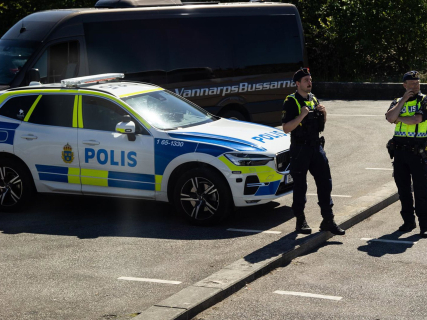
Sweden lowers the age of criminal responsibility to 14 years for very serious crimes

Sweden allows since September 10 to demand criminal responsibility from minors under 14 years old for especially serious crimes. The reform, approved three days before the elections, will be temporary and responds to the recruitment of children by gangs to commit shootings, attacks, and murders.

fotonoticia 20260821205952 1920

fotonoticia 20260821205952 1920

Add DEMÓCRATA to Google

Ask FREN

Published

Last updated

4 minutes

Most read

Elecciones 29N · Encuestas

La media de las encuestas

Media a 11 de noviembre de 2026 · 15 institutos

  • PP31,5 %
  • PSOE26,8 %
  • Vox19,1 %
  • Frente Amplio6,2 %
  • ERC2,5 %
01020304050ene 2024jul 2024ene 2025jul 2025ene 2026jul 2026

Media del último estudio de cada instituto en 30 días y su evolución semanal desde el 23J. Partidos con al menos un 2 %.

Todas las encuestas

Elecciones generales del 29 de noviembre · Demócrata

Sweden has introduced a historic exception in its penal system. From this Thursday, September 10, minors under 14 years old can be held criminally responsible when accused of some of the most serious crimes provided for by the country's legislation.

The general age of criminal responsibility remains set at 15 years. The new rule only affects crimes whose minimum penalty is at least four years in prison. Among the examples mentioned by the Government are murder, aggravated rape, kidnapping, and certain serious crimes related to weapons.

The reform came into effect three days before the general elections on September 13 and will initially be in force for five years. Its continuation will depend on a subsequent evaluation.

What changes for minors under 14 years old

Until now, a child under 15 years old could not be convicted criminally in Sweden. Although the courts could investigate serious facts and determine their participation, the response mainly corresponded to social services and the child protection system.

The new law allows a court to impose a criminal sanction starting at 14 years old when the crime meets the established threshold of severity. This does not mean that any offense committed by a teenager will end in a conviction or that imprisonment is automatic.

The judge must assess the circumstances of the case and the age of the accused. The legislation maintains other responses specifically designed for minors, such as youth supervision, movement restrictions, and follow-up programs.

The Swedish Parliament also approved tightening the reduction of sentences that was applied due to age. In addition, the maximum duration of a prison sentence for crimes committed before turning 18 years old increases from 14 to 18 years.

Gangs recruit children to commit murders

The reform seeks to respond to one of the most concerning changes experienced by organized crime in Sweden: the use of minors who have not yet reached the age of criminal responsibility.

Criminal networks contact children and adolescents through messaging apps and social media. They offer them money to transport weapons, place explosives, or shoot at members of rival groups. Some of the recruited minors are only 11 or 12 years old.

During 2025, 52 minors under 15 years old appeared in judicial proceedings as suspects of murder or attempted murder, according to data collected by Reuters. As they had not reached the age of criminal responsibility, those proceedings had an evidentiary purpose and could not end with an ordinary conviction.

The Swedish Police estimate that around 17,500 people are actively involved in gangs and that another 50,000 maintain some type of relationship with these organizations. The problem has turned juvenile delinquency into one of the central issues of the Swedish political debate.

The Government initially wanted to set the age at 13 years

The Executive led by Ulf Kristersson initially proposed that the exception start at 13 years old. The proposal did not gain enough parliamentary support and was replaced in June by the limit of 14 years.

The final text was approved on August 13 with 281 votes in favor and 66 against. The Social Democrats, the main opposition party, supported the compromise of 14 years, while the Left, the Centre Party, and the Greens rejected the reduction.

Critics argue that gangs can respond by recruiting even younger children and question whether criminal punishment has a deterrent effect at those ages. The Government defends that the State needs a proportionate response for minors involved in murders and other extremely serious crimes.

Sweden prepares specific prisons for minors

The possibility of imposing prison sentences requires separating minors from the adult prison population. Since July 1, special units for children and adolescents have been operating in the prisons of Kumla, Rosersberg, and Sagsjön.

These facilities have a school, healthcare, psychological treatment, and adapted activities. The Swedish Prison Administration plans to open three more units in Högsbo, Skenäs, and Ystad during 2027.

The entry into force of the reduction expands the group of minors who could enter them. However, prison will continue to be reserved for the most serious cases and must be decided individually by judicial sentence.

Shooting incidents decrease, but criminal networks remain active

Sweden has managed to reduce the number of shootings after the peak recorded in 2022. That year, 391 incidents and 62 fatalities were counted. During the first eight months of 2026, 48 shootings and 12 deaths had been recorded.

The evolution does not mean that organizations have disappeared. Authorities point out that part of the networks has shifted their activity towards fraud, drug trafficking, money laundering, and infiltration in public benefits and contracts.

The Swedish National Council for Crime Prevention confirmed 42 cases of fatal violence with firearms during 2025, half of all homicides recorded that year.

The criminal reform thus arrives at the elections as one of the most forceful measures of the legislature. Its implementation will allow verifying how many minors under 14 years old are ultimately judged, what sanctions they receive, and whether the gangs modify their recruitment methods.

More key points, information and questions with FREN

AI-GENERATED CONTENT

What are the pending parliamentary procedures to evaluate the continuation of the reduction of the penal age in Sweden after the initial five years?

I do not have structured or specialized access to detailed information about the Swedish parliamentary procedure regarding the reduction of the penal age, nor about the specific pending procedures to evaluate its continuation after an initial five-year period. My area of expertise is the Spanish political and institutional system (Congress, Senate, regional parliaments, Official State Gazette and regional bulletins, Spanish regulations, Spanish political actors, etc.), so I cannot provide you with a precise and reliable answer about the steps the Riksdag (Swedish Parliament) must follow in this specific case.

Still, to give you a general framework, I can explain how this type of "review clauses" or temporary reviews are usually structured in parliamentary systems, and how it would conceptually resemble what a parliament like the Spanish one would do. This does NOT describe the Swedish case specifically, but a typical comparative scheme that many countries use when approving penal reforms subject to review after a set period.

1. Temporary review clauses in penal reforms

In some countries, when especially sensitive reforms are approved (such as changes in the penal age, maximum penalties, security measures, or juvenile justice systems), the legislator introduces a clause in the law itself that establishes:

  • An initial period of validity (for example, five years).
  • The obligation to evaluate the impact of the reform before extending, modifying, or reversing it.
  • Sometimes, a mandatory report from the Government or an independent agency.

The consequence is that, as the end of that period approaches, the parliament must take a position: either let the norm expire (if it was designed as temporary), confirm it, or adjust it based on the evaluation.

2. Typical parliamentary procedures

Although each legal system has its particularities, the steps commonly seen in many parliamentary systems are the following:

  • Preparation of an evaluation report. This usually corresponds to the Government, a technical committee, or a specialized authority (for example, a criminal policy council or a judicial statistics agency). Its objective is to measure:
    • The evolution of juvenile crime.
    • The real impact of the reduction of the penal age in terms of convictions, recidivism, system saturation, etc.
    • Possible undesirable side effects.
  • Submission of the report to parliament. Once produced, it is registered and distributed to the competent committee (usually justice, interior, or social affairs).
  • Committee debate. The parliamentary committee analyzes the report, may convene expert hearings, civil society organizations, judges, prosecutors, police, youth associations, etc., and assesses whether it is advisable to maintain, toughen, soften, or reverse the measure.
  • Committee conclusions or recommendation. This can be specified as:
    • A committee report without direct normative effects (simple political recommendation).
    • The drafting of a bill or legislative proposal to reform the current penal regulation (for example, definitively confirming the new penal age or introducing nuances).
  • Processing of the legal reform, if it is decided to modify the law:
    • Presentation of the initiative (governmental or parliamentary).
    • Debate in first reading, amendment phase, committee work, and, if applicable, second reading and final vote.
    • Possible review by a second chamber, if the system is bicameral.
3. How this could translate to the Swedish case

In the specific case of Sweden, to rigorously know what "pending parliamentary procedures" currently exist, one would have to consult:

  • The exact text of the penal reform that introduced the reduction of the age, to see how the five-year review was regulated.
  • The Riksdag's register of initiatives to check if there is already:
    • Any formal commission of a report to the Government or an expert commission.
    • Any evaluation report presented.
    • Any legislative proposal underway to extend, adjust, or reverse the reduction of the penal age.

Since my area is the Spanish system, I do not have that consultation capacity nor structured information about the Riksdag, so I cannot detail if, for example, a specific debate is pending, a confirmation vote, or only the presentation of the evaluation report.

4. What I can help you with more precisely

What I can do in detail is:

  • Explain how a similar reform would be managed in Spain (lowering the penal age, review clause, mandatory reports, etc.).
  • Compare, in general terms, the Swedish and Spanish models if you provide the specific references from Sweden.
  • Analyze, from the perspective of criminal law and public policies in Spain, the advantages and disadvantages of reducing the penal age and subjecting that reduction to a review after five years.

If you are interested, you can reformulate the question towards the Spanish context or pose it in a comparative key, and I will respond with the maximum detail within my area of expertise.

What powers does Prime Minister Ulf Kristersson have regarding criminal policy and legislative reforms according to the Swedish Constitution?

In the Swedish constitutional system, Ulf Kristersson does not have personal "criminal powers" differentiated, but acts as head of a collegiate Government that shares executive functions. The Swedish Constitution (particularly the Instrument of Government, Regeringsformen) assigns legislative power to the Parliament (Riksdag) and government power to the Executive, so criminal policy and penal law reforms are mainly articulated through: the Government's legislative initiative, the Prime Minister's general political direction, and the management of agencies responsible for security and justice.

1. Basic constitutional framework

The Riksdag holds the general legislative power, including penal legislation. According to the Instrument of Government:

  • The Parliament adopts formal laws, also in matters of substantive criminal law (definition of crimes and penalties) and criminal procedure.
  • The Government "governs the Kingdom" and is responsible for the execution of laws, internal and external security, and the organization of the public administration, including the police, prosecution, and prison system.

Therefore, there is no discretionary punitive power of the Prime Minister or Government outside the law: all criminal policy must be channeled through norms approved by the Riksdag and applied by independent authorities in specific cases.

2. Government powers in criminal policy and legislative reforms

The Government's influence—and Kristersson as its head—in criminal policy derives from several constitutional functions:

  • Legislative initiative: the Government plays a central role in drafting bills submitted to the Riksdag. This includes reforms of the Penal Code as well as changes in procedural laws (investigation and prosecution) and police or prison regulations.
  • Administration direction: the Executive sets objectives, priorities, and resources for the police, the prosecution authority (Public Ministry), and the prison administration. This is done through regulatory norms, general instructions, and the annual budget.
  • Setting criminal policy guidelines: the Government can adopt national strategies or plans against organized crime, gang violence, terrorism, etc., and propose toughening or softening penalties, new criminal offenses, or procedural reforms.
  • Participation in European and international legislation: as the representative of the Swedish State before the EU and other organizations, the Government negotiates directives and conventions that then condition internal criminal policy (judicial cooperation, arrest warrants, anti-money laundering, etc.).

All these functions are exercised collegiately in the Council of Ministers but are politically directed by the Prime Minister.

3. Specific role of the Prime Minister

The Prime Minister (statsminister), appointed by the Riksdag, has mainly functions of political direction and coordination of the Government in the Swedish Constitution:

  • Proposes the Cabinet composition and distributes portfolios (for example, Justice, Interior, Integration), allowing him to configure the team that will carry out criminal policy.
  • Sets the general lines of the Government program, including priorities in security, crime, penalties, immigration linked to crime, etc.
  • Chairs the Council of Ministers, being able to promote or block criminal bills and coordinate the involved ministers (Justice, Interior, Social Affairs, Education, depending on the type of measures).
  • Leads parliamentary negotiation with groups to advance penal reforms, something especially relevant in coalition systems like Sweden's.

He does not personally decide on convictions, investigations, or specific prosecutions: that corresponds to the courts and prosecution, which act independently in individual cases.

4. Limits and checks

Kristersson's actions in criminal policy are constrained by several elements:

  • The parliamentary monopoly on law: any substantive or procedural penal reform requires Riksdag approval.
  • The requirement to respect fundamental rights recognized in the Instrument of Government itself and other constitutional texts (personal freedom, principle of criminal legality, proportionality, procedural guarantees).
  • The judicial and Public Ministry independence in resolving specific cases, which prevents individualized political instructions.
  • The parliamentary control over the Government (interpellations, committees, possibility of censure) if the majority considers a certain punitive orientation excessive or harmful.
5. Application to the case of Ulf Kristersson

In summary, according to the Swedish Constitution, Ulf Kristersson:

  • Does not have the power to enact or modify penal laws alone, nor to intervene in individual judicial decisions.
  • Does have a decisive capacity to guide criminal policy through Government leadership: legislative programming, penal reform proposals, design of strategies against crime, and direction of competent ministries.
  • Ultimately depends on the Riksdag's support to turn that political agenda into effective laws and is subject to the guarantees framework and checks typical of the Swedish rule of law.

What requirements must be met in Sweden for a minor to be sentenced to prison under the new legislation?

Based on information available in recent news, the Swedish "new legislation" on juvenile criminal responsibility has focused on lowering the minimum age of criminal responsibility and linking the detention of minors to very serious crimes, especially related to organized crime and attempted murder. However, the consulted sources do not provide a complete text of the law, but key elements of political and judicial context.

1. Minimum age of criminal responsibility

According to an analysis by Demócrata on the Swedish elections and the security debate (Sweden votes with the right divided…), the governing coalition agreed to:

  • Reduce the age of criminal responsibility from 15 to 14 years.
  • Explicitly exclude minors under 13 years from this toughening, keeping them outside the ordinary penal system.

That is, with the latest reform, only from 14 years old can a minor be treated criminally as responsible in the strict sense of Swedish criminal law. Before that age, even in the context of toughening against gangs and violent crimes, the reform has not included them.

2. Deprivation of liberty measures: detention of minors

In practice, when in Spain it is reported that "a minor is sentenced to prison" in Sweden, it usually refers to detention measures in juvenile centers, not direct admission to adult prisons. A recent example is reported by Demócrata in the news about the attempted murder of an Iranian dissident: Sweden sentences five minors for the attempted murder of an Iranian dissident.

  • The main accused, a 17-year-old youth, is found guilty of attempting to murder a university researcher and is sentenced to three years and nine months of detention in a juvenile center.
  • Four other youths are convicted of complicity and related crimes, also to juvenile detention measures.

This case illustrates the practical functioning of the system: for minors under 18, the typical penalty for very serious crimes is not the "classic" adult prison, but closed detention in juvenile centers, although journalistic language refers to it as "prison."

3. Types of crimes generating these sentences

The political debate and reforms are directly linked to a strong increase in violence associated with gangs and organized crime:

  • Ulf Kristersson's government has made the fight against gangs and shootings a banner, with a significant drop in deadly violence that he himself claims during the campaign.
  • The Sweden Democrats (far right) pressure for a radical toughening of the Penal Code, including their proposal (not fully accepted) that even minors under 13 years could serve longer sentences for serious crimes.

In this context, the reform that finally passes (according to Demócrata) focuses on allowing adolescents aged 14 and over to be prosecuted more harshly when involved in serious crimes, such as:

  • Attempted murder and homicides linked to settling scores.
  • Shootings and use of firearms in public spaces.
  • Actions commissioned by criminal networks (such as the minor recruited to assassinate an Iranian dissident).
4. Limits and cautions about what we can affirm

The sources accessed are press news and political analyses, not the complete official text of the Swedish reform. From them it is clear that:

  • The minimum penal age has been lowered from 15 to 14 years.
  • Minors under 13 years are excluded from this toughened responsibility.
  • Sentences of minors for very serious crimes translate, in practice, into detention in juvenile centers for several years.

However, the news do not detail all the technical requirements of the law (for example, possible exceptions, rules on recidivism, conditions for transfer to adult prisons upon reaching majority, etc.). For a complete legal precision level, one would have to consult the updated Swedish Penal Code and specific juvenile justice regulations.

In summary, under the new Swedish legislation a minor can be sentenced to a deprivation of liberty measure when: (a) they are at least 14 years old, (b) they are attributed a serious crime—frequently linked to extreme violence or organized crime—and (c) the court opts for the severest punitive route within the juvenile system, detention in a closed juvenile center, which in practice is perceived as a form of "juvenile prison."

Play

Test your knowledge with FREN!

How much do you know about this topic? Answer the following 3 questions.

What is the minimum age of criminal responsibility for very serious crimes after the new reform in Sweden?

Question 1 of 3

What type of crimes does the new law allow minors under 14 to be criminally responsible for?

Question 2 of 3

Which political parties supported the agreement to set the criminal age at 14 in the Swedish Parliament?

Question 3 of 3