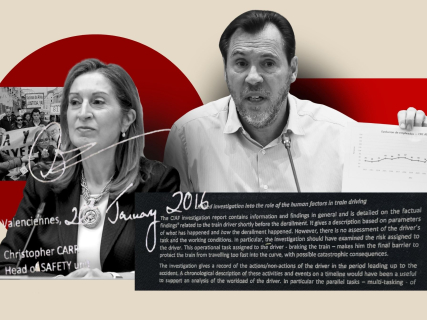

Same arguments, different moments. As happened after the 2013 rail accident at the Angrois curve, the Government is now pointing to "human error" as one of the possible causes of the rail tragedy. However, European precedents require broadening the focus. The European Commission had already warned then, as a result of the investigation into the Galician incident, that the inquiries could not be limited to pointing to the actions of the driver, but had to examine the comprehensive supervision of the safety system, the risks identified, and the decisions adopted by the responsible organizations.
The Angrois accident, which claimed the lives of 80 people in July 2013, occurred when a train entered at a speed much higher than the permitted one on a curve limited to 80 kilometers per hour. The driver had to reduce speed before reaching that section, but did not brake in time. The judicial investigation concluded that a phone call with the inspector had distracted the driver, who also did not respond to several visual and acoustic signals.
However, the analysis of the circumstances of the incident could not be exhausted by that explanation. One of the central elements was that the section lacked an automatic protection system that could intervene in a dangerous situation. ERTMS, the European rail traffic management system, would have made it possible to monitor speed and activate automatic braking if the train had not reduced its speed in accordance with the established safety conditions.
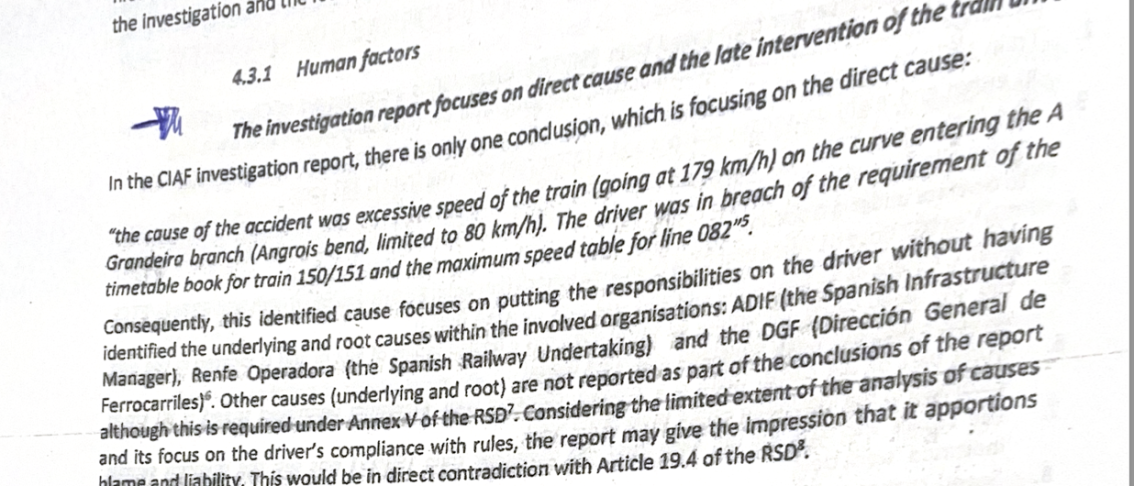
Five years after the tragedy, at the request of the Community Executive, the European Union Agency for Railways (ERA) prepared a report in which it openly questioned the conditions under which the Spanish investigation had been carried out. The European body concluded that the Commission of Investigation of Rail Accidents (CIAF) had not guaranteed the degree of independence required by Community regulations, since it was linked to the then Ministry of Development (Fomento), headed by Ana Pastor.
Brussels also considered that the investigation had focused fundamentally on the actions of the driver, without sufficiently extending the analysis to structural deficiencies in the rail system. An approach, in the view of European technicians, that prevented clarifying why the available prevention mechanisms had not been sufficient to avoid the accident.
European regulations prevent reducing the causes to human error
The report of the European Railway Agency emphasized that attributing responsibility for the accident exclusively to the driver contravened the spirit and requirements of the Railway Safety Directive. The Community regulations expressly establish that "the investigation in no case will have as its purpose to determine fault or responsibility", but rather to identify the causes of the accident and draw conclusions that make it possible to prevent it from happening again.
In this way, the document consulted by Demócrata argues that a railway accident cannot be explained or attributed exclusively to human error without investigating the underlying causes and the possible shortcomings of the organizations involved. In the case of Angrois, the analysis had to be extended to Adif, Renfe and the Directorate General of Railways (DGF), as well as to the procedures and decisions that conditioned the safety conditions of the line.
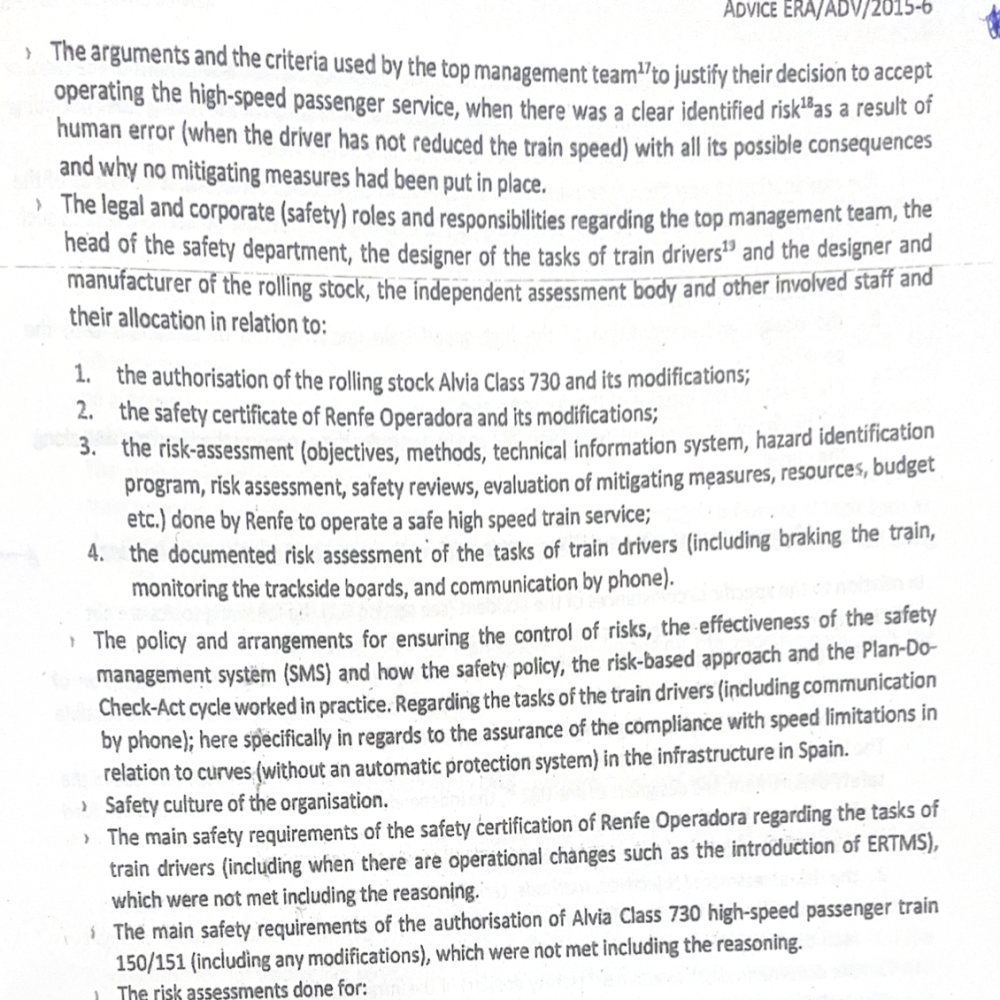
European technicians particularly criticized that the investigation had not adequately examined the risk that had been transferred to the driver, nor the conditions under which he had to carry out his work. In practice, the driver had become the last and only safety barrier to prevent the train from entering the curve at an excessive speed, in the absence of an automatic technical protection system.
In addition, the report noted that the management of Adif, Renfe and the DGF were aware of the risk of derailment derived from a possible human error if the driver did not reduce speed. Despite this, the investigation did not find sufficient justification for the reasons why mitigation measures or automatic protection systems had not been implemented.
The prior warnings that did not prevent the tragedy
One of the decisive elements of the case was that the risk had already been warned about before the accident. In December 2011, a Renfe chief driver had formally conveyed to management his concern about the danger posed by the sudden reduction of speed when approaching the Angrois curve without having an automatic protection system.
The three entities therefore knew the risk of derailment in the event that the driver did not reduce speed. However, the investigation by national authorities did not sufficiently delve into the reasons or the criteria by which the management decided to put line 082 into service without incorporating additional technical measures to mitigate that risk.
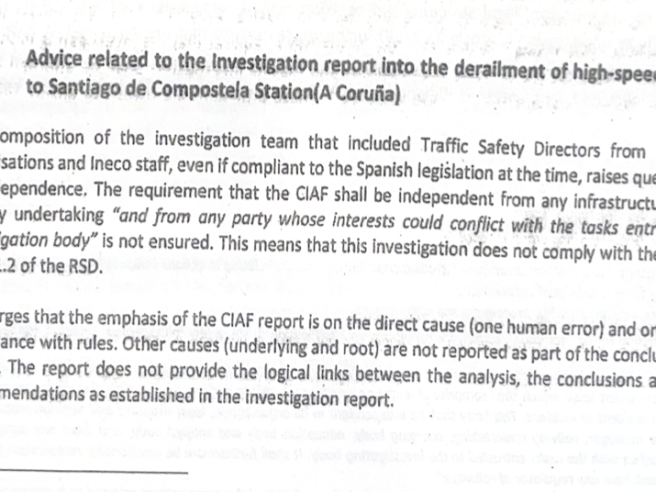
The underlying issue was not only to determine what the train driver had done in the moments prior to the derailment, but to clarify why the rail system did not have mechanisms capable of preventing an individual failure from ending up triggering a catastrophe. A distinction that constitutes one of the fundamental principles of the European rail accident investigation model.
Strasbourg demands explanations from the European Commission
European legislation establishes that, in the face of tragedies like those in Toledo or Adamuz, the underlying causes of accidents must be analyzed. Within this regulatory framework, the Galician MEP Ana Miranda has put forward a set of questions to the Community Executive in order to find out whether an investigation will be opened into the Urda accident and whether the relevant audits had been carried out during 2025 to "verify the highest levels of safety".
The BNG representative has also requested explanations about the knowledge that European institutions had regarding the delay in the rollout of ERTMS on the rail line where the accident occurred. This is an especially relevant issue in light of the conclusions drawn by the European Union Agency for Railways after the Angrois disaster, where the absence of automatic protection systems occupied a central place in the analysis of safety deficiencies.
"Will it demand responsibility from the Spanish State?", Miranda asks in a letter sent this Monday to the Community official responsible for Transport, Tzitzis Kostas. The Urda accident once again puts on the table an issue that Brussels already had to address after the Galician tragedy. Rail safety cannot be assessed solely based on the actions of those who drive the trains, but also on the decisions, the checks, and the protection systems that must prevent human error from having irreversible consequences.