

In recent years, Ireland has become the European birthplace of some of the largest technology companies in the world. A combination of tax incentives, language, skilled labor, and direct access to the Community market has placed Dublin on the global digital map. Meta, Google, Apple, Microsoft, TikTok, and X have found in the island a privileged gateway to Europe. Now, the city that hosts their main Community headquarters will also be the setting in which the Twenty-Seven will try to define what role the European Union wants to play in the next stage of the technological revolution.
Next week, the heads of State and Government will travel there to address for the first time in a leaders’ summit the challenges posed by the advance of Artificial Intelligence (AI) for the continent. The chosen location is not accidental. A few meters from the European offices of the digital giants, the leaders will discuss how to reduce technological dependencies, strengthen their own industrial capabilities, and prevent the development of the most advanced model from being left in the hands of a small group of global actors.
Diplomatic sources warn that the most advanced AI models "are reaching unprecedented capabilities". The challenge now is to prevent the market power of "a limited number of global actors" from ultimately undermining European autonomy. "Europe needs to define its position in this global race: what technological capabilities must be developed in Europe and what instruments are necessary to reduce the dependencies," they explain at the Schuman roundabout.
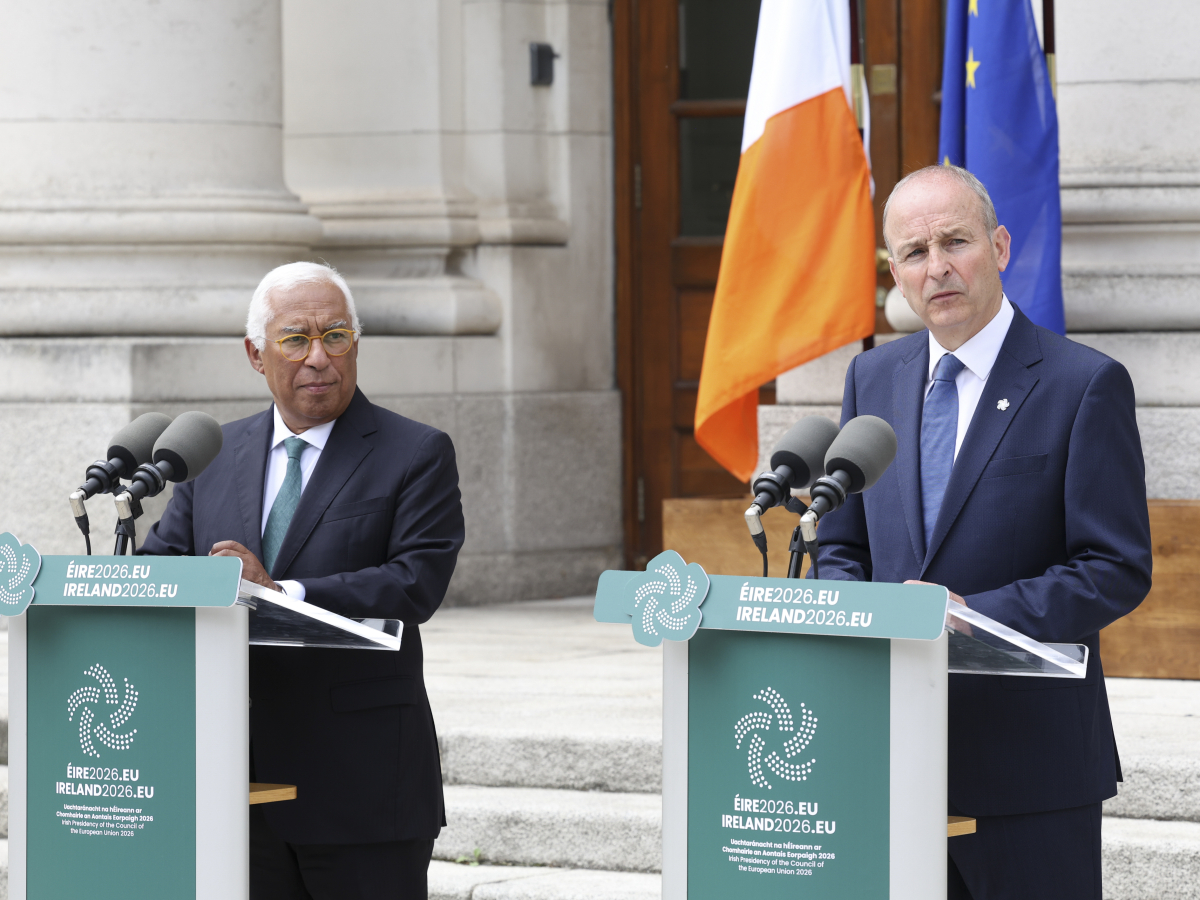
The President of the European Council, António Costa, wants the leaders to take advantage of the occasion to redefine the Community digital offensive. In a letter sent to his counterparts this very week, the Portuguese considers it "necessary" to hold a "first specific debate at the level of leaders on the opportunities offered by AI, as well as on its transformative effect on our economies and societies".
The choice of Dublin adds a political dimension to a conversation that, until now, had been more closely tied to legislative files and debates on competitiveness. The EU wants to be a relevant actor in the development of these technologies, but it does so from a continent in which much of the infrastructure, capital, and the main providers of digital services depend on American companies.
The Irish dilemma: attracting tech companies and supervising their activity
The paradox of holding this conversation in Ireland is difficult to overlook. The country has built a reputation for "looser" regulation, linked to the "historical slowness and moderation of its data protection authority," as explained by a diplomat in Brussels. Between pubs, pints of Guinness, and large business complexes, digital giants have found an especially favorable environment in which to set up their European operations. But behind that appeal there is also a particular feature of the Community regulatory system.
The key lies in the General Data Protection Regulation (GDPR) and its "one-stop shop" mechanism. When a company establishes in Ireland its main European headquarters, the Data Protection Commission (DPC), as a rule, becomes the lead authority responsible for investigating cross-border complaints related to the processing of personal data. Its decisions can have consequences for the activity of these platforms across the entire European Union.
In this way, Dublin has ended up de facto serving as one of the main European supervisors for some of the largest technology companies on the planet. A position that has placed its data protection authority under considerable pressure and that has fueled criticism from other national regulators.

There is some consensus in the community capital when pointing out that the DPC has taken too long to resolve certain cases, has tended to "prefer friendly resolutions," and has imposed penalties lower than those demanded by some of its European counterparts. The criticism is not limited to processing times: it also affects the effective supervisory capacity of an authority that must oversee companies with enormous legal, financial, and technological resources.
From within the community institutions they recall that both the GDPR and the rules on digital services and competition are mandatory to comply with in all Member States, including Ireland. The legal framework is common and does not provide for territorial exceptions for companies that establish their headquarters there. However, the difference lies in "how and how quickly" these regulations are applied.
Brussels fears that Ireland's economic dependence, with regard to employment, investment, and tax revenues generated by the big tech firms, may have fueled incentives for less aggressive supervision. Experts from the United Nations and organizations dedicated to the defense of digital rights have publicly expressed their concerns about shortcomings in control within the DPC and the barriers that exist to pushing for collective lawsuits.

To this is added Ireland's tax policy, which for decades has maintained a corporate tax rate that is especially competitive and has favored the arrival of international business structures that allowed significant benefits of multinationals to be concentrated in the country. A strategy that has contributed to transforming the Irish economy, but that has also placed the Dublin Government in a delicate position when it comes to supervising some of the companies on which much of its prosperity depends.
The problem of the 1%: when paying a fine becomes profitable
The debate about the ability of European authorities to enforce their own rules is not limited to the Irish case. In a conversation with DEMÓCRATA, Leonardo Cervera, the Secretary General of the European Data Protection Supervisor, explained that one of the main problems of Community regulation lies with certain actors, especially the large technology platforms. "They have so much power and so many resources that they can afford to take the risk that, at a certain moment, it will be more profitable for them to pay a fine than to fully comply with the regulations," he said.

Featured story
Leonardo Cervera (EDPS): "Data protection must allow the needs of companies to be met"
11 minutes
The assessment points to one of the contradictions of European regulatory policy. The Union has, over the past few years, developed an ambitious legislative framework to regulate the digital market, from data protection to the platforms’ obligations and the control of large intermediaries. However, the existence of demanding rules does not, by itself, guarantee their enforcement when the affected operators have sufficient resources to extend the procedures or assume the economic cost of penalties.
Cervera argues that, for 99% of operators, the system established by legislation works. Now, it opens the door to reflecting, as a democracy, on how to ensure that that 1%, especially in the field of large Artificial Intelligence companies, also complies with the obligations set by the legislator.
For these actors, he warned, "ordinary mechanisms may not be enough". A reflection that connects directly with the debate that European leaders want to open in Dublin: how to ensure that the EU’s regulatory capacity is accompanied by effective instruments for supervision and enforcement.

The issue takes on an additional dimension with the expansion of generative AI and the development of increasingly sophisticated models. The concentration of technological capabilities in a small number of companies not only raises competition problems, but also questions about security, the protection of fundamental rights, and the European capacity to maintain control over infrastructures considered strategic.
Mistral and Hinton, two perspectives for defining European autonomy
To feed that discussion, Costa has invited to the meeting the chief executive officer of Mistral AI, Arthur Mensch. The presence of the French executive will make it possible to address "Europe's position in the global AI landscape", as well as the "strategic" challenges the continent faces in order to strengthen its competitiveness.
The office of the president of the European Council expects that the exchange will focus on reducing critical dependencies and strengthening European capabilities. The conversation will also put on the table the development of the infrastructure needed to sustain an indigenous industry, from computing capacity to data centers and the energy resources required for the training and operation of the models.

Featured story
Mistral changes strategy: what it means for the European alternative to ChatGPT
2 minutes
At this point, European leaders want to link technological autonomy to the availability of "affordable clean energy and large-scale public and private investment". It is not enough to develop European models if the continent lacks the necessary infrastructure to compete with the main international players. The bet, therefore, requires mobilizing capital, guaranteeing energy supply, and creating conditions that allow European tech companies to scale.
The agenda will also set aside space for an exchange with Geoffrey Hinton, Nobel Prize winner in Physics and one of the fundamental figures in the development of modern neural networks. His intervention will make it possible to shift the focus from industrial competitiveness to the social consequences of these technologies.

The leaders will analyze the impact of AI on European societies and the implications that its development has for security and trust. "It will also be analyzed how Europe can contribute to international cooperation and governance on advanced AI security", Costa says in his letter.
The objective is that the debate not be confined to the race to develop its own models. The EU also wants to discuss what safeguards must accompany the expansion of these tools and what role it can play in building international standards. A particularly relevant issue in light of the difficulty of establishing global governance mechanisms in a sector whose technological evolution is moving at a faster pace than political consensus.
The Digital Equity Act, legislative prelude to the summit
The leaders’ conversation will also be preceded by a legislative move by the European Commission. Just a day before discussions begin in Dublin, the Community Executive will unveil the details of its new Digital Equity Act (Digital Fairness Act), the latest piece of its strategy to strengthen consumer protection in the digital environment.
The proposal aims to intervene in some of the commercial and design practices that condition users’ experience on platforms. Among the measures expected are restrictions on the so-called "dark patterns" (dark patterns), design mechanisms that can guide or manipulate consumers’ decisions through interfaces, default settings, or deliberately complex contracting processes.
The initiative adds to the set of rules with which Brussels has sought to establish specific obligations for digital operators and strengthen consumers’ position against the large platforms. Its presentation will allow the officials to arrive in Ireland with a new case file on the table and an additional example of the Commission’s regulatory will.
Dublin will, in short, be something more than the setting for a new discussion on Artificial Intelligence. In the city that has become one of the main operations centers for American tech companies in Europe, the Twenty-Seven will have to address a contradiction that accompanies the entire EU digital strategy: the Union wants to compete with the tech giants, but it also needs to reduce the dependence it maintains on them and ensure that those operating in its market comply with the rules it has approved itself.