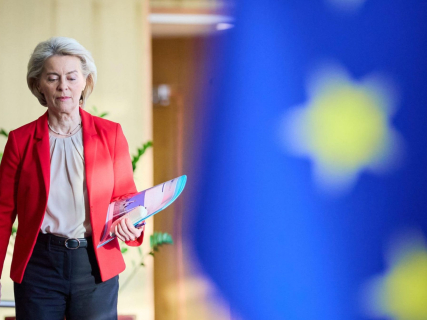

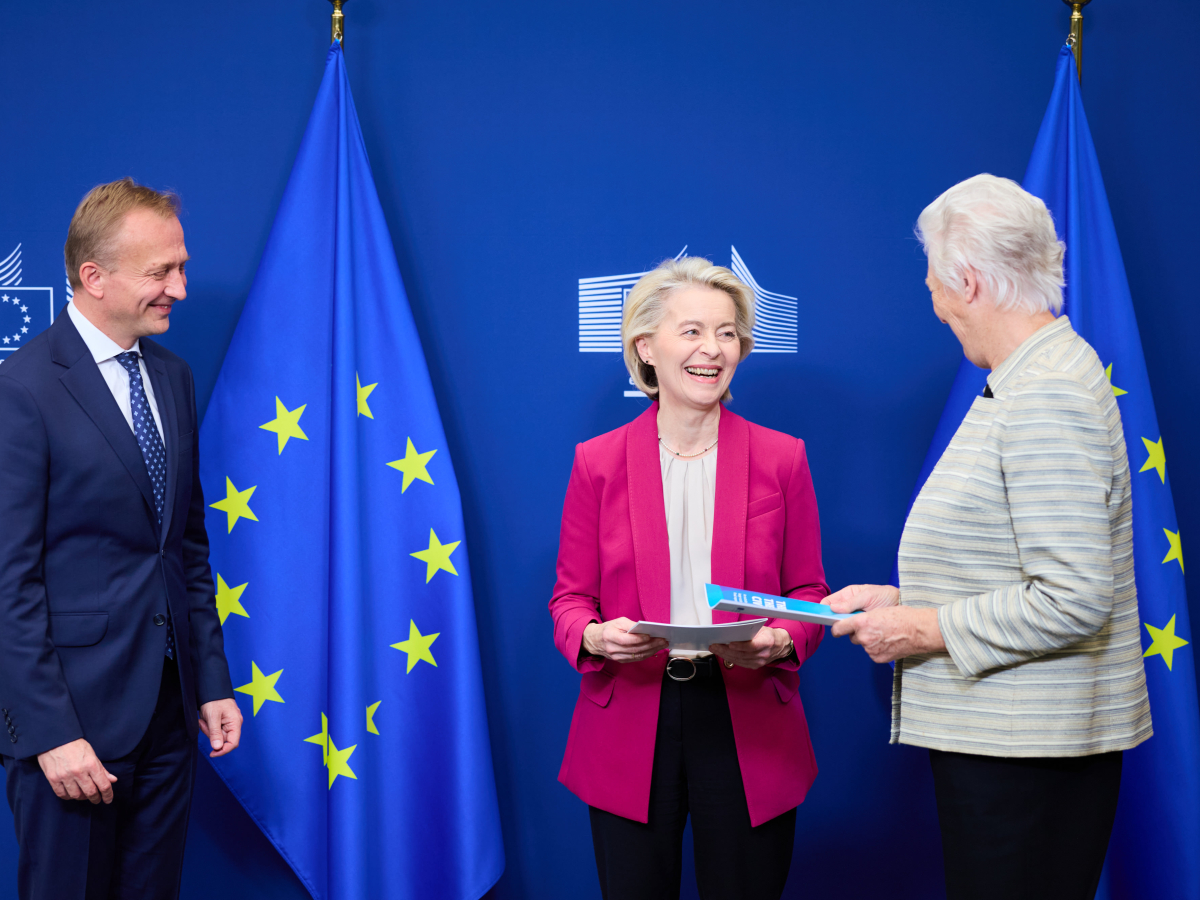
The European Commission has been under pressure in recent months to undertake a reform of its internal organization. From the way decisions are made to the composition of each department or the number of officials that make up the institution. Not to mention, the president of the community executive, Ursula von der Leyen, received this week a report warning that the current structures "are too compartmentalized and are excessively risk-averse" to address the global challenges facing the European Union.
The study, prepared by a group of experts at the request of the Commission, directly urges to "break" the internal division caused by the current 42 directorates-general (DG). The proposal involves moving towards a model based on a culture of shared responsibility, which allows for systematic evaluation of the organizational capacity of the institution in the face of future scenarios that the community bloc will have to confront.
"Resources are increasingly limited. Technology opens new possibilities," acknowledged Von der Leyen herself when addressing the need to modernize the functioning of the community administration.
Interdepartmental teams to promote legislative files
One of the main proposals currently being considered by the Presidency of the Commission suggests overcoming the traditional distribution of legislative files among directorates-general and assigning the different initiatives to interdepartmental teams organized by work portfolios.
The document refers to this model as Cross-DG portfolio teams, a formula that would allow bringing together officials from different departments around specific political priorities. These teams would be equipped, from the start of each regulatory process, with a clear mandate, a designated leader, specific resources, and measurable objectives.

The aim is to reduce administrative fragmentation and facilitate a coordinated execution of initiatives that require the simultaneous participation of several directorates-general. The General Secretariat would also assume new competencies under this approach. Experts propose that it act as a "true strategic center that connects the political and administrative level," strengthening its capacity to coordinate the priorities of the Executive.
Within this unit, a specialized figure could be created to directly accompany the teams responsible for priority projects, with the ability to intervene in their development and unblock procedures through direct contact between departments, instead of exclusively resorting to the exchange of documents.
Another of the recommendations consists of drafting "briefs for debate" that allow for agile responses to urgent situations, even before developing complete legislative proposals.
A Director of Artificial Intelligence for the Entire Commission
Artificial intelligence occupies a central place in the administrative redesign that Brussels is studying. "We must provide our colleagues with the skills and tools to use it in the best way," Von der Leyen has stated about the incorporation of this technology into the daily work of European officials.
In this sense, the report recommends appointing a Director of Artificial Intelligence for the Commission, integrated into the General Secretariat itself and endowed with "institutional authority and political mandate." This figure would be supported by specific AI managers in each directorate-general, with the aim of coordinating its implementation across the entire administrative structure.

The president of the community executive is also considering the possibility of equipping all Commission staff with an artificial intelligence assistant, a measure that would allow the use of these tools to be extended to different levels of the organization.
Throughout the document, the experts designated by Brussels refer to AI as a third working resource in practice, alongside in-house staff and contracted services. They argue that this technology has ceased to be merely a tool for automating simple procedures to become a system capable of performing more complex analytical tasks.
Among its possible applications, the report proposes using artificial intelligence tools to map and simplify the entirety of community legislation through five-year review cycles.
Mobility of Officials and Opening of Senior Management to External Profiles
Another of the main axes of the report presented this Monday is the alignment between the political strategy of the Commission and its human resources policy.
The experts open the door to modifying the selection procedures for management positions, giving greater weight to competencies such as change leadership or technological preparedness. They also propose opening certain senior management positions to external candidates, thus expanding the possibilities for incorporating new professional profiles.
At the same time, they recommend establishing an alternative pathway that allows talented officials to lead high-impact strategic projects without exclusively depending on their position in the hierarchical scale or their administrative grade.
Featured story
Von der Leyen has already shown her cards: what Brussels is preparing for 2027
7 minutes
The proposal also includes the creation of a central job fund to which a fixed percentage of officials from each general directorate would be added annually. This mechanism would allow for the reassignment of personnel more quickly based on new political priorities, taking as a reference, among other elements, the efficiency gains derived from the implementation of artificial intelligence.
Brussels proposes to review its 35 decentralized agencies
The administrative reorganization would not be limited to the internal structure of the Commission. The group of experts has also requested to evaluate the relevance and workload of the 35 decentralized agencies of the European Union, applying a model of organizational redesign supported by artificial intelligence.

The objective would be to determine whether their current structures and mandates continue to respond to the needs of the Union or if, on the contrary, it is advisable to introduce modifications. Among the possibilities outlined in the document are mergers between agencies, adjustments to their competencies, and even the elimination of certain agencies. During this evaluation process, the experts recommend applying a "strict" moratorium on the creation of new agencies, so that any expansion of the institutional structure is conditioned on the prior review of existing agencies.
A reform whose details will be finalized before the end of the year
Von der Leyen argues that the ongoing reform, the details of which must be finalized before the end of the year, constitutes "a shared responsibility across the Commission." The president wants the process to transcend the political direction of the institution and also involve "colleagues at all levels of the organization." The report thus places on the table a possible transformation of the administrative functioning of the European Executive, from the distribution of legislative files to the management of its human resources and the incorporation of new technologies.
"Our ambition remains clear: to provide the best possible public service to our European citizens," Von der Leyen has defended during a statement to the press, without a question-and-answer session, held at the very headquarters of the European Commission.