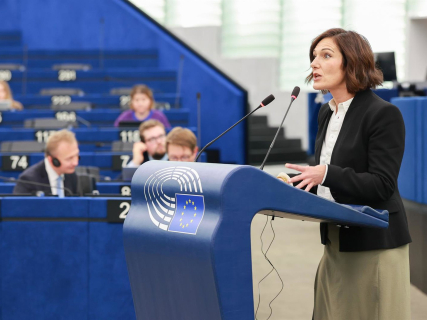

The Industry, Research and Energy Committee of the European Parliament has appointed the PNV MEP Oihane Agirregoitia as the person responsible for the report on the new European Innovation Law. This regulatory proposal, presented by the European Commission at the end of September, aims to promote an environment that allows for the development, financing, and scaling of the most cutting-edge ideas within the continent, preventing their exit from Europe while facilitating their global expansion.
The jeltzale representative has emphasized that "Competing on equal terms with the United States or China requires, in addition to talent and investment, a more integrated capital market and talent. This law will not create new funds, but it will help to resolve one of the bottlenecks that exist. That is to say, that good European ideas find customers, financing, and clear rules to grow within Europe."
Agirregoitia has expressed her satisfaction at being in charge of "an important report with which the EU wants to improve the regulatory framework so that innovation acquires the scale it needs to grow." In her view, the challenge is to adapt the European regulatory framework so that innovative initiatives can consolidate and not remain in initial phases.
In her speech, she recalled that "In Europe we have universities, research centers, and top-level talent. But we do not always provide those who innovate with the means to move from the laboratory to the market," which causes, too often, "many ideas either do not take off or companies are forced to seek financing outside to grow."
The MEP considers it "evident" that, "if we want to compete globally and create an innovative environment that helps us not only to develop and compete but to be more autonomous from a technological point of view, this has to change." In this regard, she emphasized that "Innovation is not a luxury, it creates jobs and can help improve people's well-being and the competitiveness of our companies, so we are going to work to build the best possible legislation."
As a demonstration of this orientation in Euskadi, she mentioned the Innovation Lighthouses program, which has just launched its first funding call aimed at supporting scientific and technological projects capable of generating social and economic impact in the Basque Country, accelerating the transfer of scientific and technological knowledge to the social and business fabric.
Agirregoitia has pointed out that, currently, "only a small part of the research and innovation generated in Europe translates into successful products and services in the market." In the same line, he has warned that "the dependence on suppliers from outside the EU remains large while global competitors advance faster and invest more aggressively."
He has also emphasized that "there are no common standards for many public R&D contracts, which generates legal insecurity and fragmentation." The new law, he explained, aims to "create a more favorable regulatory framework that allows companies to better leverage intellectual property rights and certification to help innovative solutions reach the market more quickly and on a larger scale."
In reference to data on high-growth technology companies, he recalled that "According to the Draghi report, almost 30% of the unicorns created in Europe between 2008 and 2021 moved their headquarters abroad, mainly to the United States. We cannot continue losing innovative companies due to the difficulties of growing in Europe. We need to simplify the rules, eliminate unnecessary bureaucracy, and facilitate access to financing, especially for innovative startups and SMEs," he defended during a debate in the plenary session of the Eurochamber focused on support measures for entrepreneurship.