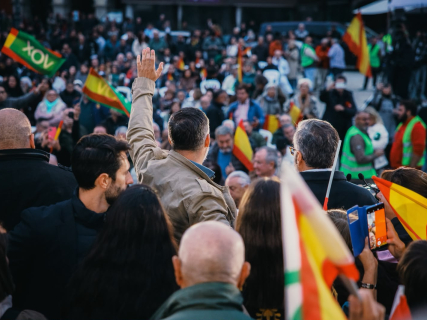
Abascal asks for the vote to correct "the weaknesses of the PP" and promises that the sacrifices will not be for the Spaniards.

Abascal gathers hundreds of supporters in the Leonese locality, where the party leaders claim their management in Castilla y León and attack the Government. The party once again trusts Pablo Calvo to recover the seat for León that was lost in 2023.

WhatsApp Image 2026 10 20 at 21.17.32

WhatsApp Image 2026 10 20 at 21.17.32

Add DEMÓCRATA to Google

Ask FREN

Published

Last updated

3 minutes

Most read

Elecciones 29N · Encuestas

La media de las encuestas

Media a 20 de octubre de 2026 · 16 institutos

  • PP31,7 %
  • PSOE26,8 %
  • Vox18,7 %
  • Sumar6,3 %
  • Podemos3,1 %
  • ERC2,2 %
010203040ene 2024jul 2024ene 2025jul 2025ene 2026jul 2026

Media del último estudio de cada instituto en 30 días y su evolución semanal desde el 23J. Partidos con al menos un 2 %.

Todas las encuestas

Elecciones generales del 29 de noviembre · Demócrata

Ponferrada. Santiago Abascal has kicked off this Tuesday in Ponferrada (León) his pre-campaign tour with criticisms of the Government of Pedro Sánchez and the "weaknesses" of the Popular Party. The leader of Vox has mocked the sacrifices demanded by Alberto Núñez Feijóo and has assured that, if his party is decisive for the next Government, the efforts will not fall on the citizens.

"The PP has had many weaknesses over these years. We hope to fix this too," he stated before hundreds of supporters, to whom he warned that a "dirty campaign, with traps" is coming. He also urged to distrust the polls and mobilize on November 29: "That day we stake everything".

Abascal mocks Feijóo's sacrifices

"They have already sacrificed us enough, women, young people...", Abascal pointed out, who took advantage of Feijóo's statements to claim his proposal for "national priority".

"If the next Government depends on Vox, the sacrifices will not be for the humble people, but for those who have come by boat, the unions...", he proclaimed. "If it depends on Vox, they will not be for our people," he added.

The exchange of criticisms comes as Vox still has not clarified whether it will renounce to present candidacies for the Senate in certain provinces or if they will reach an agreement with Feijóo's party, after the electoral agreement between the PSOE and Frente Amplio in 47 constituencies.

Again, the Grandchildren's Law

The president of Vox has also revived his criticisms of the grandchildren's law and its implications on Spanish nationality and voting from abroad. "I am very glad that you all know what we are talking about," he commented before a square filled with hundreds of people.

"We have taken them to the Supreme Court and now they are with the trap of the Constitutional Court, which they control due to the clumsiness of the PP, that must also be said", he stated, before accusing Sánchez of "buying votes, gifting nationalizations, and persecuting judges."

"For eight years they have betrayed Spain by negotiating with all its enemies, abroad and at home," he concluded.

Recovering the seat

The event also served to support the candidacy of Pablo Calvo, head of the Vox list for Congress in León, who will run again after failing to retain his seat in the general elections of 2023.

Calvo was a deputy during the XIV Legislature and his return is part of the strategy of the formation to regain representation in the constituencies where it lost seats by a narrow margin of votes.

"We are being governed by the enemy," he stated during his speech, in which he called to regain the electoral support necessary for Vox to have representation in the province again.

For his part, Carlos Pollán, vice president of the Junta de Castilla y León, defended the main proposals of Vox regarding immigration and the economy, with references to the "national priority," deregulation, and "remigration", the campaign axes of the far-right party for this 29N. "We do not resign ourselves to seeing how the third world assaults our borders and leaves Spaniards last in services," he stated.

The provincial president of the party, Mercedes Machín, in charge of opening the event, also criticized the Executive and called to "throw the traitor out of Moncloa." "We are going to win this battle," she proclaimed before the attendees.

Flags of Ceuta and electoral caravan

Abascal was received with shouts of "president, president" by the hundreds of supporters gathered in the square. The leader of Vox entered accompanied by the song of his formation dedicated to the "national priority," after a previous warm-up with music from Spanish groups from the 2000s.

"You are here of your own free will. There are no party buses here, maybe some came on a regular bus", Abascal joked, who thanked the attendance and highlighted the significance of starting his electoral journey in Ponferrada, which always "receives us so well."

"It is the place where we practically started this pre-campaign," he pointed out, before stating that he faces the upcoming weeks of the campaign with the goal of "getting to know the homeland again, our compatriots."

Among the Spanish flags carried by the attendees, there were also banners from Ceuta, a presence that particularly caught the leader's attention. "I am very moved to be here and find a flag of Ceuta, being so far north. In Ceuta is our heart and our sleeplessness," he stated from the stage.

Abascal has closed his electoral messages with a warning about the next month, in which he anticipates "a dirty campaign, with traps." This week, the president of Vox will continue his electoral tour through A Coruña, Avilés, Burgos, and Ibiza, while he remains pending to resolve his strategy for the Senate.

EuropaPress 7838795 imagen lider vox santiago abascal 2d vicepresidente segundo consejero

Featured story

General elections in Spain

Vox gets underway: closed lists and Abascal sets out to conquer new seats

2 minutes

More key points, information and questions with FREN

AI-GENERATED CONTENT

What is the status of the parliamentary processing of the Grandchildren Law and what are the next steps for its possible reform or repeal?

As of October 20, 2026, the so-called Grandchildren Law is neither pending approval nor is there an approved repeal: it is the eighth additional provision of Law 20/2022, on Democratic Memory. The reform promoted in September through an amendment to an education law did not become law; with the dissolution of the Cortes for the November 29 elections, that parliamentary processing expired. Therefore, a reform must be promoted again in the next legislature.

What remains in force

The Law of Democratic Memory maintains the regulation that opened an exceptional path for nationality option. It includes certain descendants of Spaniards affected by exile, children of Spanish women who lost their nationality upon marrying foreigners before the Constitution, and adult children of those who obtained nationality by origin through the 2007 or 2022 laws.

A distinction must be made between validity of the provision and application deadline. The extraordinary deadline ended in October 2025, after a one-year extension, but files submitted within the deadline continue to be resolved. Its closure does not equate to a repeal nor does it annul granted nationalities.

What happened with the parliamentary reform

On September 30, the Board of the Education Commission admitted an amendment from Sumar aimed at modifying the regulation and protecting the vote of naturalized citizens affected by judicial injunctions. The admission was supported by PSOE and Sumar and rejected by PP; it did not mean approving the reform. The legal advisors had warned about the lack of connection between nationality and the educational purpose of the project. (Demócrata, 09/30/2026).

Before the dissolution, the examination of amendments, the report, and the corresponding votes remained. That process does not continue automatically after the elections: the pending initiative and its amendments expired.

Also published in October was a Senate motion on the impact of the Law of Democratic Memory on the electoral census. It called for reviewing administrative criteria and submitting any substantial modification to the Cortes. A motion expresses a political request to the Government: it does not modify or repeal the law.

Additionally, the Royal Decree-law 6/2026, which modified other aspects of Democratic Memory, deals with recognition of deceased or persons with disabling injuries for defending democracy. It did not reopen the nationality path for descendants.

Next steps to reform or repeal it
  • Present a new initiative. The Government can promote a bill; parliamentary groups can propose a motion. The text must specify whether it changes beneficiaries, reopens applications, or removes the provision.
  • Pass the legislative procedure. After the corresponding initial procedures, amendments, parliamentary examination, and approval by the Congress would follow. The Senate could introduce changes or veto the text; the Congress would make the final decision when appropriate. Then would come publication in the BOE and entry into force.
  • Regulate transitional effects. A reform should clarify what happens with pending files. Repeal does not automatically revoke nationalities already granted.
The judicial controversy is different

The Supreme Court injunctions affect the electoral effects of certain registrations; they do not constitute a parliamentary repeal nor do they themselves revoke nationality. On October 16, the Ombudsman’s appeal to the Constitutional Court was reported. That procedure may alter the voting situation but does not replace the approval of a legal reform. (Demócrata, 10/16/2026).

What are the powers and attributions of the president of Vox and the vice president of the Junta of Castilla y León according to current legislation?

The president of Vox and the vice president of the Junta of Castilla y León hold positions of different nature: the former belongs to the organization of a political party; the latter, to the regional government. Their attributions should not be confused or inferred from their political influence. The necessary current texts have not been obtained to provide a verified legal list of the competencies of both positions.

President of Vox: functions within the party

The answer regarding this position must distinguish between the legal framework of political parties and the internal rules that distribute functions among their bodies. Legislation establishes the party’s framework of action but does not replace its statutes to determine which decisions specifically correspond to its president.

Therefore, to identify their attributions it is necessary to consult the current statutes of Vox and, when appropriate, the internal rules that develop them. Without that text, it is not rigorous to attribute to the president a specific power of appointment, sanction, approval of candidacies, or economic decision.

The matters to be checked are the following; this enumeration identifies relevant issues, not powers that can be taken as accredited:

  • Representation: who represents the party and to what extent.
  • Political direction: what decisions the presidency can adopt and which require intervention of collegiate bodies.
  • Organization: what participation it has in appointments, proposals of positions, and territorial functioning.
  • Internal functioning: who calls and presides over meetings and how its agreements are executed.
  • Control and responsibility: what limits, review procedures, and substitution mechanisms exist.

Also, the president’s powers must be separated from those he may exercise by another position. Presiding over a party does not, by itself, equate to exercising administrative competence over citizens or companies.

Vice president of the Junta: institutional attributions

In this case, the main reference must be the legal framework of the Autonomous Community, along with provisions that organize the Government and distribute its functions. It is also important to check whether the vice presidency is associated with a ministry and if there are express delegations.

To answer correctly, four levels must be differentiated:

  • Functions inherent to the position: those directly attributed to the vice presidency by regulation.
  • Substitution of the presidency: the cases, conditions, and limits in which it can temporarily assume its functions.
  • Coordination and delegation: tasks entrusted by organizational provisions or corresponding agreements.
  • Competencies of a ministry: those it might exercise as head of a department, distinct from those derived from being vice president.

It should not be assumed that the vice presidency allows directing any government area, reviewing any minister’s decision, or exercising all presidential powers. Each attribution needs an identifiable legal basis, and a coordination task should not automatically be equated with authority to resolve files.

Practical conclusion

The essential difference is internal party leadership versus exercise of public functions. Political agreement commitments should not be confused with legally attributed competencies: a negotiated responsibility requires the corresponding instrument to become an institutional power.

The consulted sources do not contain the necessary articles to specify those attributions. Therefore, this answer limits itself to how both positions should be distinguished but does not present as current legislation a list of powers that could not be verified.

What results did Vox obtain in the constituencies of León and Castilla y León in the last general elections, and how many seats did it achieve compared to previous elections?

In the last general elections held, those of July 23, 2023, Vox obtained 35,451 votes and no deputies for León. In the whole of Castilla y León it obtained 197,172 votes and one seat. Compared to the November 2019 general elections, it lost one deputy in León and five in the entire community.

The comparison refers to the Congress of Deputies, not the Cortes of Castilla y León. It is also advisable to distinguish the two scopes: León is a provincial constituency, while the Castilla y León result sums those obtained in its provinces; it does not correspond to a single constituency.

León: lost the deputy obtained in 2019

In the July 2023 general elections, Vox obtained in León 35,451 votes, 12.88%, but was left out of the seat distribution. The four deputies of the province were distributed between PP and PSOE, with two for each party. Therefore, the support received by Vox did not translate into representation for this constituency. Details can be consulted in the León results.

In November 2019, Vox had obtained 40,884 votes, 15.56%, and one deputy. The difference between both calls was as follows:

  • Votes: lost 5,433 ballots.
  • Percentage: decreased by 2.68 percentage points, from 15.56% to 12.88%.
  • Seats: went from one to none.

The loss of representation in León is also noted by Demócrata, which recalls that Vox obtained a deputy in November 2019 and lost it four years later. That is the essential difference: in 2023 it maintained more than 35,000 votes but no longer had a representative elected by the province.

Castilla y León: from six deputies to one

In the whole of Castilla y León, Vox gathered in July 2023 197,172 votes, 13.78%, and one deputy, out of the 31 elected in the community. In November 2019 it had obtained 230,743 votes, 16.61%, and six deputies. The data from both calls can be contrasted in the Castilla y León results.

The evolution of the aggregated regional result was:

  • Votes: lost 33,571 ballots.
  • Percentage: dropped 2.83 percentage points, from 16.61% to 13.78%.
  • Seats: lost five deputies, going from six to one.

The reduction in seats was therefore much more intense than the drop in vote percentage. Vox went from holding six of the 31 deputies elected in Castilla y León — approximately 19.4% of those seats — to retaining one, equivalent to 3.2%. These percentages describe its weight in the community’s representation, not its vote percentage.

How to interpret the comparison

The results show a setback in both scopes, but they should not be added together: León is already included in the total of Castilla y León. Likewise, the deputy lost in León is part of the five that Vox lost in the whole community.

In short, taking as reference the immediately previous general elections, those of November 2019, Vox went from one to zero deputies in León and from six to one in Castilla y León. The balance corresponds to the 2023 general elections and should not be confused with results from regional elections.

Play

Test your knowledge with FREN!

How much do you know about this topic? Answer the following 3 questions.

Where did Santiago Abascal start Vox's pre-campaign tour?

Question 1 of 3

Who did Vox support as the lead candidate for Congress for León in this event?

Question 2 of 3

What campaign axis has Vox highlighted in the event held in Ponferrada?

Question 3 of 3