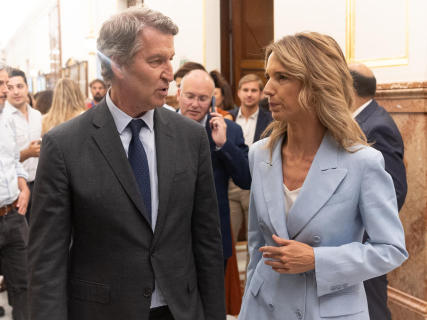
Feijóo places Cayetana Álvarez de Toledo as number two of the PP for Madrid for the general elections

Borja Sémper will repeat in the third position of the candidacy. In 2023, Feijóo chose Marta Rivera de la Cruz for the second place.

fotonoticia 20261022085411 1920

fotonoticia 20261022085411 1920

Add DEMÓCRATA to Google

Ask FREN

Published

Last updated

1 minute

Most read

Elecciones 29N · Encuestas

La media de las encuestas

Media a 26 de octubre de 2026 · 15 institutos

  • PP31,2 %
  • PSOE27,2 %
  • Vox18,8 %
  • Sumar6,3 %
  • Podemos3,0 %
  • ERC2,3 %
010203040ene 2024jul 2024ene 2025jul 2025ene 2026jul 2026

Media del último estudio de cada instituto en 30 días y su evolución semanal desde el 23J. Partidos con al menos un 2 %.

Todas las encuestas

Elecciones generales del 29 de noviembre · Demócrata

Alberto Núñez Feijóo has chosen Cayetana Álvarez de Toledo as number two of the PP candidacy for Madrid to Congress for the general elections on the upcoming November 29, according to the party's confirmation. The national spokesperson of the formation, Borja Sémper, will again occupy the third position on the list, the same one he had in the 2023 elections.

Álvarez de Toledo, current deputy spokesperson of the Popular Group in the Lower House, rises from the sixth position she occupied in the Madrid candidacy in the last general elections. Her name was among the most mentioned in the internal pools to accompany the president of the PP in the top positions.

Feijóo had already pointed out on Tuesday that the deputy would be his number two. In an interview on esRadio, he highlighted that she opposed the amnesty and called for the appearance of the director of the National Intelligence Center (CNI) in the Official Secrets Commission. The popular leader defined her as a politician "predictable, honest, and who does not say one thing and do the opposite."

The change regarding the general elections of 2023

The election of Álvarez de Toledo resolves one of the uncertainties that remained to be clarified in the PP lists. In the general elections of July 2023, Feijóo placed Marta Rivera de la Cruz, former Minister of Culture and former deputy of Ciudadanos, as number two for Madrid.

Rivera de la Cruz subsequently resigned from her seat in Congress to focus on her responsibility in the Madrid City Council, where she served as delegate of the Government Area of Culture, Tourism, and Sports.

More key points, information and questions with FREN

AI-GENERATED CONTENT

What is the status of the candidate submission process for the general elections on November 29?

As of October 22, 2026, the period for submitting candidacies to the Congress and Senate for the general elections on November 29 is open. Parties can register their lists from Wednesday the 21st until midnight on Monday, October 26. Therefore, the submission period has not yet closed, nor have the candidacies been officially proclaimed.

What phase are we in

The process is in the phase of formal submission of lists before the Provincial Electoral Boards, which are responsible for the submission and proclamation of candidates. Political parties, federations, coalitions, and groups of voters may participate. The enabled period covers six calendar days, as reported by Demócrata on the registration.

This phase should be distinguished from the communication of electoral coalitions, whose deadline ended on October 16. Communicating a coalition is not equivalent to submitting its candidates: afterwards, it must formalize the lists with which it intends to compete in the corresponding constituencies. Public announcements or internal ratifications of candidates made by parties are also different.

The call comes from Royal Decree 806/2026, dated October 5, published and in force since October 6. The official Interior guide confirms that the provincial boards are responsible for these electoral operations.

What will happen after the deadline

Submitting a list does not imply its automatic proclamation. After the deadline, the boards will review the candidacies and communicate any irregularities detected or reported. The upcoming milestones are:

  • October 26: last day to submit candidacies to the Congress and Senate, until midnight.
  • October 28: publication in the Official State Gazette of the submitted candidacies. This first list will not yet be the proclaimed candidacies.
  • Two days later: the boards will communicate possible irregularities. Parties will have a maximum of 48 hours from notification to correct the indicated defects.
  • November 2: proclamation of candidacies, after review and corresponding corrections.
  • November 3: publication in the Official State Gazette of the proclaimed candidacies.

The sequence is recorded in the Demócrata electoral calendar. The essential difference is that on October 28 the submitted lists will be officially known, while on November 3 those that have passed the proclamation phase will be published.

How to interpret the lists already known

The names announced or ratified by the parties should not be confused with officially proclaimed candidacies. The Demócrata candidate search tool, updated on October 19, gathers announcements and ratifications for the Congress but warns that it does not replace official lists and does not include Senate candidacies.

Additionally, for parties that require endorsements, October 26 is also the deadline to submit signatures along with electoral documentation. Subsequently, the Electoral Census Office verifies the requirements of the signatories, as explained by Demócrata on endorsements.

In summary: lists are currently being submitted, not proclaimed. The next decisive point will be the deadline on Monday the 26th; then publication, review, and proclamation will follow. The electoral campaign will begin on November 13 and end on November 27, before the reflection day and the voting on Sunday the 29th.

What are the competencies and powers of the national spokesperson of the Popular Party?

The national spokesperson of the Popular Party has as their main function to publicly communicate and defend the party's political position. They do not have autonomous leadership of the PP nor a statutory catalog of competencies comparable to that of the president or the general secretary. To understand their powers, it is useful to distinguish between the communicative functions they perform in practice and the decision-making faculties that correspond to the governing bodies.

Main functions
  • Express the official position of the party. Acts as one of its voices before the media, the public, and other political and social actors. Explains and defends the orientations adopted by the national leadership, without replacing the bodies that decide them.
  • Communicate agreements and decisions. Publicly conveys messages from the president and national bodies, especially after leadership meetings. Press conferences and statements are common tools for this function.
  • Respond to current political events. Presents the PP's assessment of government decisions, parliamentary debates, negotiations, and other national matters. This intervention must remain within the political orientation established by the leadership.
  • Contribute to message coherence. Participates in the articulation of national political communication and helps maintain a recognizable line between the central organization, its territorial structures, and its institutional representatives. This task should not be confused with a general statutory power to direct them.
  • Act as a communication link. Facilitates the transmission of the leadership's general positions to the party's various areas of activity, respecting the responsibilities of each body and spokesperson.

These functions derive from the organization and public practice of the PP. Information about the continuity of the national spokesperson role in the leadership structure illustrates this political and communicative role but does not itself constitute a rule granting it its own powers (Europa Press, 11/29/2023).

Limits of their powers

The main reference is the 2025 National Statutes. The national spokesperson is not configured as a body with an autonomous and detailed catalog of competencies. The political and legal representation of the party, the direction of its political action, and the coordination or authorization of statements that may commit it fundamentally correspond to the national president.

Therefore, the spokesperson role alone does not grant general executive power. Its holder cannot replace the president, the National Executive Committee, the National Board, or the National Congress in their decisions. Nor can they commit the party outside the instructions or authorizations of the competent leadership, nor appoint parliamentary spokespeople or heads of institutional groups on their own.

Difference with the parliamentary spokesperson

The national spokesperson communicates the general political position of the PP. The spokespeople of the Congress, Senate, and other chambers carry out the representation and activity of their respective parliamentary groups. Consequently, the national spokesperson role does not imply directing the Popular Parliamentary Group nor automatically assuming its powers within a chamber.

Practical scope of the position

Ultimately, it is a position of political trust whose concrete scope depends on the approved structure and leadership assignments. If its holder accumulates other organizational responsibilities, their additional powers come from those positions, not from the spokesperson title. Likewise, their membership in governing bodies and rights therein must derive from the statutes and corresponding agreements, not be presumed.

The essential distinction is this: the spokesperson explains and defends the PP's line; the competent bodies decide it.

What is Alberto Nadal's political and professional background before joining the national leadership of the PP?

Alberto Nadal joined Alberto Núñez Feijóo's team with a background focused on economic administration, government management, and international financial relations. Before assuming the PP's Deputy Secretary of Economy and Sustainable Development, he had worked at the Treasury, the Official Credit Institute, the Spanish commercial representation in Washington, the CEOE, and the Inter-American Development Bank. He had also been Secretary of State under Mariano Rajoy and the party's economic head during Pablo Casado's presidency.

Education and early positions in the Administration

Born in Madrid in 1970, he holds degrees in Law and Economic and Business Sciences from the Pontifical University of Comillas, ICADE. Since 1994, he has belonged to the Senior Corps of State Commercial Technicians and Economists, according to his professional profile. This training forms the basis of a career mainly developed in technical and executive responsibilities.

His first assignments were linked to the Ministry of Economy and Finance, where he held various roles in the Directorate General of the Treasury and Financial Policy. During José María Aznar's governments, he was economic advisor to Rodrigo Rato, then second vice president and Minister of Economy. Later, he directed the Research Service of the Official Credit Institute, as noted by Demócrata in his profile.

Foreign trade, Washington, and business representation

In 2003, he was appointed Secretary General of Foreign Trade. From this position, he participated in trade talks related to Mercosur. After the 2004 government change, he served as economic and commercial counselor at the Spanish Embassy in Washington, a post he held until 2009. His international career thus began before his responsibilities as Secretary of State.

In 2009, he joined the CEOE as deputy director of its General Secretariat. Two years later, he assumed the Deputy Secretary General of Economic Affairs. This stage added experience in business representation and economic and labor matters to his previous career in administration and foreign trade. The sequence of these positions is detailed in the cited Demócrata review.

Two Secretariats of State with Rajoy

His main period of governmental responsibility began at the end of 2012, when he was appointed Secretary of State for Energy, under Minister José Manuel Soria. He remained until 2016 and participated in the reform of the energy system, particularly in measures aimed at correcting the tariff deficit: the accumulated imbalance between the regulated revenues of the electrical system and its recognized costs.

In November 2016, he moved to the Secretariat of State for Budgets and Expenses, in the Ministry of Finance led by Cristóbal Montoro. He held this responsibility until June 2018, when Rajoy's government ended. His work was then linked to budget preparation and public spending policy, according to the summary of his career.

First party responsibility and return from the IDB

His incorporation with Feijóo was not his first national responsibility in the PP. In 2018, Pablo Casado entrusted him with the Secretariat of Economy and Employment. In 2019, he left that role to return to his civil service career, as reported by Cinco Días.

Later, he was executive director of the Inter-American Development Bank in Washington. Feijóo announced his hiring in July 2025, but his effective incorporation took place in September, after completing those international obligations. This is explained by Demócrata on his return. He thus arrived with experience in economic administration, business dialogue, energy, budgets, and multilateral financing.

Play

Test your knowledge with FREN!

How much do you know about this topic? Answer the following 3 questions.

Who has been chosen as the number two candidate for the PP list in Madrid for the Congress in the general elections on November 29?

Question 1 of 3

What position will Borja Sémper hold on the PP list for Madrid in the upcoming general elections?

Question 2 of 3

What position does Alberto Nadal currently hold in the national structure of the Popular Party?

Question 3 of 3