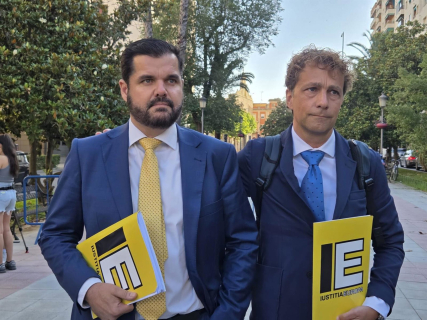

Iustitia Europa, the lawyer Luis María Pardo's party wants to submit to a referendum Spain’s continued membership in the European Union and NATO, change the electoral system so that citizens directly elect the President of the Government, and end public funding for political parties, unions, and employers’ associations. These are some of the main proposals of the "Electoral Contract" with which the formation is contesting for Madrid in the general elections of next 29 November, a 27-page document that lays out 15 commitments on how institutions, the economy, immigration, and public services work.
Founded in 2024, Iustitia Europa is known for its activities as a popular prosecution in judicial proceedings affecting the PSOE, including the cases involving Begoña Gómez and Koldo, and also the PP, such as the Montoro case. In that year’s European elections it obtained around 26,600 votes, equivalent to 0.15% of the ballots.
With a speech opposed to the political system that emerged from the Transition, which it accuses of having favored corruption and “moral decadence,” the party presents itself as an “anti-party” and claims that it has no ideology. Its program defends overcoming what it calls the “78 regime” through a deep constitutional reform, which would affect both the election of the Government and the functioning of the Judiciary and the Cortes Generales.
Among its commitments is also approving a law that would allow the removal and the withdrawal of the salary of public officeholders who fail to comply with the electoral program for which they were elected.
Direct election of the president and changes in the Congress and the Senate
The constitutional reform that Iustitia Europa advocates would modify the procedure for electing the president of the Government, who would be voted for directly by citizens every four years. The change would affect several articles of the Constitution, including those that govern the investiture, a motion of no confidence, and the dissolution of the Cortes.
The current system of closed lists and proportional representation in elections to the Congress would also disappear, to be replaced by majority single-member districts, in which each constituency would elect a single representative. The party proposes applying this model to both the Congress and the Senate.
Elected offices, including city councilors, would have a limit of two terms and would lose the privileges and immunities that current legislation grants to certain public representatives. In addition, citizens could promote binding referendums by collecting signatures, while electoral boards would come to be made up of people chosen by lottery.
A CGPJ elected by the judges and a Constitutional Court ratified in a referendum
To reduce the involvement of political parties in Justice, Iustitia Europa proposes that the ten members of the General Council of the Judiciary be elected directly by the judges. The body would also take on the appointment of the attorney general of the State, with a nine-year term during which it could not receive instructions from the Government.
The election of the justices of the Constitutional Court would be left in the hands of jurists with more than 25 years of professional experience, although the candidates would subsequently need ratification by citizens through a referendum. Their terms would continue to be nine years, and it would be required that they had not been members of any political party during the three decades prior.
The party also wants to shield popular action through a reform of Article 125 of the Constitution, to recognize it as an "inalienable right" that cannot be limited by law. This figure allows participation in certain criminal proceedings without the need to be the direct victim of the offense, and it is precisely the path that Iustitia Europa has used to appear in different judicial investigations.
Referendums on the EU and NATO and repeal of the policies linked to the 2030 Agenda
The permanence of Spain in the European Union and NATO would be subject to binding referendums if the proposals of Iustitia Europa were to succeed. The formation accuses the Community institutions of being dominated by pressure groups from the arms, pharmaceutical, energy and food industries, while in foreign policy it defends Spanish neutrality in the face of the commitments of the Atlantic Alliance.
In the energy sphere, it advocates for nuclear, gas and the exploitation of national resources, together with the elimination of subsidies for renewable energies. It also includes the nationalization of rare earths.
For the countryside, it calls for repealing the European Green Deal, the Common Agricultural Policy (CAP) and the Nature Restoration Law, as well as various Spanish regulations, including laws on animal welfare and the food chain. To these measures it adds the elimination of the mandatory digital notebook and rejection of policies derived from the United Nations Agenda 2030.
Seven ministries, 75% fewer advisers and elimination of subsidies
The cut in political spending is one of the commitments with the greatest economic development within the program. Iustitia Europa proposes limiting the Government to seven ministries, reducing by 75% the number of advisers and cutting by 20% the salaries of political officeholders, in addition to removing from former senior officials privileges such as offices, chauffeurs and special pensions.
The public funding of political parties, unions, employers’ associations and NGOs would disappear, as would 80% of the subsidies. The formation also advocates reducing by 40% the number of public bodies, abolishing provincial councils and closing public companies that accumulate losses.
To these cuts it adds the closure of more than 2,000 bodies that it describes as “chiringuitos” and whose cost it calculates at more than 6,000 million euros per year. This is an estimate by the party itself, which the executive summary does not accompany with a breakdown that allows it to be checked which entities it includes or how it obtains that figure.
Four years without fees for self-employed workers and zero VAT on the first home
Self-employed workers would be exempt from paying into Social Security during their first four years of activity and would also not pay contributions in those months in which they did not obtain income. Iustitia Europa also proposes eliminating the modules system used to calculate the IRPF of certain professionals.
On housing matters, it advocates removing VAT on the purchase of a first residence and eliminating rent price-control measures. For illegal occupations, it calls for establishing a procedure that would allow occupants to be evicted in less than 24 hours from the filing of the complaint.
The program also includes eliminating the sustainability factor of pensions and banning freezing them without economic compensation.
Closing the southern border with the Army and mass deportations
Iustitia Europa uses the term "invasion" to refer to immigration that it considers out of control and proposes completely closing the southern border with the intervention of the Army, in addition to carrying out mass deportations and expelling foreigners who commit crimes.
Vessels that attempt to reach the Spanish coasts irregularly would be automatically returned, while the Navy would receive the assignment to prevent the operations of NGO ships that operate along migration routes.
The implementation of these measures would have to be aligned with Spain’s international obligations and with the legal guarantees that govern expulsions, international protection, and the actions of authorities at the borders.
Education without gender content, natural therapies in healthcare, and rejection of the digital euro
Eliminating educational content related to the Agenda 2030, the "gender ideology" and "radical environmentalism" forms part of Iustitia Europa’s proposals for education. The party advocates strengthening the authority of teachers, rewarding academic effort, and guaranteeing freedom of school choice.
In healthcare, it calls for incorporating the so-called natural therapies into the public system, applying a 0% VAT rate to the services of its professionals, and putting an end to what it describes as the "pharmaceutical monopoly". The executive summary does not specify which treatments would be included or how their incorporation into healthcare would be regulated.
For the Guardia Civil, it proposes submitting to an internal consultation its possible demilitarization and ensuring that the salaries of its agents are not lower than those of the regional police forces.
The electoral contract also includes rejection of the digital euro, biometric control systems and facial recognition, low-emission zones, and restrictions on rights adopted during the pandemics.