New Generations turns Feijóo into an anime hero for the 29N with a video reminiscent of Lula’s in Brazil

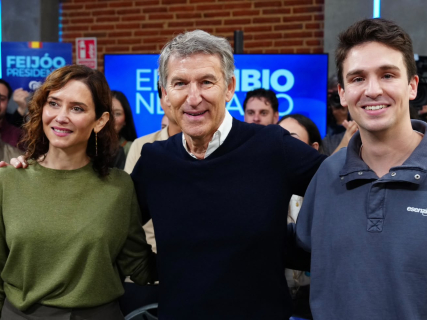
The PP youth organization will premiere this Friday the Japanese animation piece during a campaign event with Alberto Núñez Feijóo and Isabel Díaz Ayuso. The popular candidate appears as a superhero who fights Pedro Sánchez, portrayed as a villain with supernatural powers

WhatsApp Image 2026 11 13 at 12.43.51

WhatsApp Image 2026 11 13 at 12.43.51

Add DEMÓCRATA to Google

Ask FREN

Published

Last updated

3 minutes

Most read

Elecciones 29N · Encuestas

La media de las encuestas

Media a 13 de noviembre de 2026 · 15 institutos

  • PP31,4 %
  • PSOE26,8 %
  • Vox19,1 %
  • Frente Amplio6,3 %
  • ERC2,4 %
01020304050ene 2024jul 2024ene 2025jul 2025ene 2026jul 2026

Media del último estudio de cada instituto en 30 días y su evolución semanal desde el 23J. Partidos con al menos un 2 %.

Todas las encuestas

Elecciones generales del 29 de noviembre · Demócrata

Nuevas Generaciones (NNGG) has prepared an anime-styled election video in which Alberto Núñez Feijóo becomes a superhero to take on Pedro Sánchez. The youth organization of the Partido Popular will premiere the piece this Friday, November 13, during the campaign event with young people in which Feijóo and Isabel Díaz Ayuso will take part, according to what DEMÓCRATA has been able to find out.

The footage, approximately one minute and twenty seconds long, draws on the codes of Japanese animation to present the popular candidate as the protagonist of a battle against the president of the Government, portrayed as a red-eyed villain with supernatural powers. The production combines everyday scenes, election music, and clashes typical of action series.

Feijóo, with armor and a shield in front of a Sánchez with red eyes

The first part of the video shows Feijóo’s trajectory from his youth to his arrival at the head of PP leadership, going through his experience as a manager and President of the Xunta de Galicia. The sequence moves to a much darker scene when the action shifts to Madrid, where the sky is covered with red clouds.

At that moment, a figure appears reminiscent of Pedro Sánchez, with eyes lit up and clothing typical of the antagonists of anime. Around him, characters with a threatening appearance emerge, while a red energy runs through the streets of the capital.

In the video, other members of Feijóo’s team also appear, such as Cayetana Álvarez de Toledo and Ester Muñoz,characterized as superheroes, with blue and white armor, who participate in the fight against the forces of the antagonist. Feijóo ends up transforming into a warrior protected by blue armor and equipped with a shield, with which he defends himself from an attack of red energy.

The battle ends with an image of the candidate together with a girl and a group of citizens in front of the Royal Palace of Madrid.

Similarities with Lula’s electoral anime

During the second round of the October 2026 presidential elections, a video titled "Lula Lá – Brilha Uma Estrela" circulated, produced using artificial intelligence by producer André Rocha.

In that animation, Lula flew over Brazil riding a star, a symbol of the Workers’ Party, before facing Flávio Bolsonaro, characterized as a villain with a cape and superpowers. The production also used the music from the historic electoral jingle "Lula Lá", first used in 1989.

Both videos share several narrative resources. Both Lula and Feijóo acquire extraordinary powers to fight their respective political opponents, while Bolsonaro and Sánchez appear associated with a threat that must be defeated.

They also coincide in the use of recognizable settings, transformations of the protagonists, energy attacks, and battles accompanied by electoral music. These are common elements of shōnen, a Japanese manga and anime genre characterized by fights, personal growth, and confrontations between heroes and villains.

New Generations bets on anime to connect with young voters

The release of the video during an event with Feijóo and Ayuso responds to Nuevas Generaciones’ bet on audiovisual formats linked to popular culture and on-demand content consumption on social networks.

In this way, the PP’s youth organization incorporates into the 29N campaign a language far removed from conventional election advertisements, with a narration that turns the political rivalry between Feijóo and Sánchez into a fictional battle.

Over the past few weeks, the Partido Popular has also turned to humorous content and digital montages featuring its candidate, taking advantage of viral references and formats typical of social platforms.

More key points, information and questions with FREN

AI-GENERATED CONTENT

What phase is the Popular Party's electoral campaign for 29N in, and what are its upcoming planned events?

As of November 13, 2026, the Popular Party is in the first day of the official electoral campaign for 29N, not at its midpoint or final stretch. After yesterday's opening event in Badalona, Alberto Núñez Feijóo has planned a first tour through Madrid, Santiago de Compostela, Santander, Lleida, Pamplona, Bilbao, and La Rioja, as well as a rally in Valencia on Saturday the 21st. (Demócrata, November 13)

What phase it is in

The official campaign began at 00:00 on Friday the 13th and will end on Friday, November 27. Saturday the 28th will be the reflection day and Sunday the 29th the elections will be held. Therefore, the previous events belonged to the pre-campaign, although politically they served to present the candidate, mobilize the organization, and prepare the electoral messages. (Campaign calendar)

The PP arrives at this start with the slogan "The necessary change", its new image, and Feijóo's poster already presented. These elements were unveiled on November 6, one week before the official start. (Slogan presentation)

The Badalona event on November 12 opened this stage with Feijóo accompanied by Xavier García Albiol. The initial agenda now combines meetings with young people, rallies, and territorial trips, with participation from regional leaders and provincial candidates. (Campaign opening)

Upcoming announced events

The published agenda allows specifying the following appointments. These are planned events: they should not be considered held before their occurrence. The itinerary and companions appear in the information released this Friday. (Announced agenda)

  • Friday 13 — Madrid. Meeting of Feijóo with young members of the organization, alongside Isabel Díaz Ayuso. The attendance of Ignacio Dancausa, president of Nuevas Generaciones and candidate for Congress for Madrid, is also announced.
  • Saturday 14 — Santiago de Compostela. Event with the president of the Xunta, Alfonso Rueda, at 12:00 at the Multiusos Fontes do Sar. This is the next scheduled event with a specific time and venue. (Event details)
  • Sunday 15 — Santander. Rally with the president of Cantabria, María José Sáenz de Buruaga; Isabel Urrutia, candidate for Congress; and Gema Igual, mayor of Santander and head of the Senate list.
  • Monday 16 — Lleida and Pamplona. Morning visit to Lleida and rally in the afternoon in Pamplona. These are two separate stops within the same day.
  • Tuesday 17 — Bilbao and La Rioja. Feijóo will be in Bilbao in the morning, accompanied by the leadership of the Basque PP headed by Javier de Andrés. In the afternoon, he plans to travel to La Rioja.
  • Saturday 21 — Valencia. Major rally announced at the bullring, when the campaign will have passed its first week. No specific time is given in the consulted information.
What remains to be finalized

The agenda is not yet complete. The published information leaves pending the rest of the itinerary and the dates of the debates prepared by the Television Academy. A face-to-face between Sánchez and Feijóo and a four-way debate are contemplated, but without dates or formats specified; there is also no announcement here of the PP's campaign closing event. (Planned debates)

What are Alberto Núñez Feijóo's competencies and powers as president of the Popular Party according to the party's statutes?

As national president of the Popular Party, Alberto Núñez Feijóo has powers of representation, political leadership, organization, and internal coordination. The reference is the Statutes approved at the XXI National Congress, held in July 2025, which concentrate the presidential functions mainly in article 44. These powers correspond to the position, they are not personal powers of its holder.

Representation and political leadership

The president holds the political and legal representation of the PP. This places Feijóo at the head of the party's representation, both in its political action and in its status as an organization with legal personality. Additionally, he directs and coordinates the party's political action at the national level: his function is not limited to publicly representing the PP, but includes leading its political activity and coordinating it internally. The reference is article 44 of the 2025 national Statutes.

Presidency of national bodies

Feijóo presides over the National Board of Directors and the National Executive Committee. In both bodies, he has a casting vote in case of a tie: his vote resolves the tie but does not replace decisions that must be adopted collectively.

He is also responsible for adopting the necessary measures to comply with and develop the agreements of the National Congress and the party bodies with superior statutory competence. Therefore, the presidency combines leadership capacity with the obligation to execute agreements adopted within the PP structure. These powers are set out in article 44 of the published statutory text.

Appointment proposals

One of his most relevant organizational powers is to propose to the National Executive Committee the appointment of the main management officials. This capacity includes the following positions:

  • Secretary General and General Coordinator.
  • Deputy Secretaries General.
  • Coordinators and Secretaries.
  • Director General of Finance and Administration.

The distinction is important: making the proposal does not equate to unilaterally making the appointment. In these cases, the Statutes articulate the intervention of the president together with that of the National Executive Committee. Likewise, the presidency makes appointment proposals related to specialized bodies, including the Electoral Committee, the Rights and Guarantees Committee, and the Membership Committee. The list appears in article 44 of the PP Statutes.

Parliamentary groups and extraordinary powers

Among his powers is also presiding over the PP parliamentary groups in the Congress of Deputies, the Senate, and the European Parliament, according to their respective regulations. This presidency must be distinguished from the functions of the spokespersons and the operating rules of each group.

The statutory framework also contemplates powers to initiate proceedings and adopt disciplinary measures, subject to internal procedures and guarantees. In extraordinary circumstances, it also provides for the provisional exercise of certain powers of collegiate bodies, with the obligation to subsequently report to the competent body. These provisions should not be interpreted as a general authorization to sanction or permanently replace party bodies.

The fundamental limit

In summary, Feijóo represents the PP, directs its national political action, presides over its main bodies, and proposes part of its leadership structure. But he does not concentrate all competencies: he must act within the distribution of functions established by the Statutes and respect the powers of the National Congress, the Board of Directors, the Executive Committee, and specialized bodies.

What have been the Popular Party's results in the last general elections and how many seats does it currently hold in Congress?

The Popular Party obtained 137 seats, 8,091,840 votes, and 33.05% of the vote in the last general elections held on July 23, 2023. However, as of November 13, 2026, there is an important clarification: Congress is dissolved due to the electoral call for November 29, so the 137 seats correspond to the previous legislature, not to a currently constituted Plenary.

The PP's electoral result

The most recent general elections that have already taken place are those of July 2023. The elections called for November 29, 2026, have not yet been held and, therefore, there is no new electoral result to replace that of that call. The date of the upcoming elections can be consulted in the INE's electoral information.

The Popular Party's outcome in the 2023 elections was as follows:

  • Votes: 8,091,840.
  • Vote percentage: 33.05%, approximately one in three votes.
  • Deputies elected: 137 of the 350 that make up Congress.
  • Position: first force in votes and seats, although without an absolute majority. (Demócrata reference to 23J)

The 137 deputies represented 39.14% of the seats in Congress. This representation percentage should not be confused with the vote percentage: one expresses the share of seats obtained and the other, the proportion of votes received. The absolute majority is set at 176 deputies, so the Popular Party's result was 39 seats short of that threshold. (Results and absolute majority)

How many seats does it currently have?

If the question refers to the PP's last electoral representation, the answer is 137 deputies. That is the figure to use to describe its 2023 result and its representation in the legislature that has just ended. (2023 electoral distribution)

If "currently" is interpreted in a strictly institutional sense, it must be added that the Cortes have been dissolved to hold the November 29 elections. Therefore, it would not be accurate to state without qualification that today the PP occupies 137 seats in a Congress convened with its ordinary composition. The situation derives from the electoral call published in the BOE.

Representation during dissolution

Dissolution does not eliminate all parliamentary continuity. While the new Chamber is elected and constituted, the Permanent Deputation remains, a reduced body that retains certain functions of Congress. It does not replace the Plenary for all its activity but ensures that some competencies are not interrupted during the electoral period.

The Popular Group has 27 representatives in the Permanent Deputation. This number is different from the 137 seats obtained at the polls: it measures its presence in that specific body, not a new electoral distribution nor a loss of deputies. (Composition of the Permanent Deputation)

In conclusion: 137 seats is the PP's last result in a general election; 27 is its representation in the Permanent Deputation during dissolution. The next composition of Congress will depend on the November 29 elections. Figures appearing before that vote in polls are estimates, not assigned seats or official results.

Play

Test your knowledge with FREN!

How much do you know about this topic? Answer the following 3 questions.

What format does the Nuevas Generaciones electoral video use to present Feijóo?

Question 1 of 3

Which character appears as the antagonist in the Nuevas Generaciones video?

Question 2 of 3

With which other electoral video is the Nuevas Generaciones piece compared in the news?

Question 3 of 3