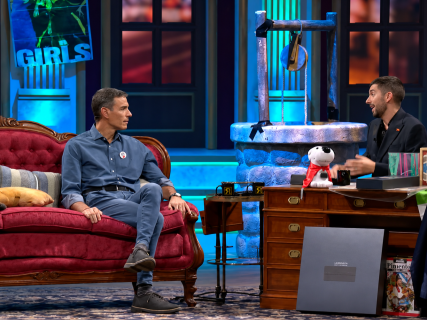

The president of the Government, Pedro Sánchez, has acknowledged this Thursday during his interview on 'La Revuelta', the program of David Broncano on TVE, that his Executive could have managed the migration crisis in Ceuta better. He also referred to the corruption cases that have affected the PSOE, especially that of former minister José Luis Ábalos, which he described as a "double disappointment".
The interview took place in the midst of the pre-campaign for the general elections on November 29, during Sánchez's first visit to the Spanish Television program. During the conversation, the head of the Executive defended his migration policy and claimed the need to combine border control with respect for human rights.
Sánchez admits mistakes in the Ceuta crisis
Asked by Broncano about the situation in Ceuta, Sánchez acknowledged that "we could have managed it better", although he defended the investments made by his Government in the borders of Ceuta and Melilla and the cooperation with Morocco.
"Those borders are among the most complicated due to the difference in GDP between the two sides. You need cooperation from Morocco to stop it on their side," explained the president, who recalled the difficulties of responding to the arrival of thousands of people, including minors.
Sánchez assured that during the crisis 141 people died, many of them children, and defended that a more forceful response could have worsened the consequences. "If we had done something more aggressive, we would be talking about a higher number," he pointed out.
He also indicated that more than 12,000 Moroccan citizens have returned voluntarily and that the Government has made accommodation places available to assist the people who arrived during the crisis.
"The strength of the State does not mean having an inhumane treatment of immigrants," he defended.
The PSOE corruption, a "double disappointment"
During the interview, Sánchez also addressed the corruption cases that have affected his party and, in particular, the one related to former minister José Luis Ábalos.
"The corruption cases I have suffered in my party with Ábalos have been a double disappointment," the president stated, who acknowledged the personal impact of the investigations on former collaborators he trusted.
"You think you know people and, suddenly, a side is revealed in certain collaborators that leaves you frozen", he lamented.
In taking stock of his eight years at the head of the Executive, Sánchez has also admitted the existence of errors in political and parliamentary management. He has described the difficulties of governing and the need to rectify decisions throughout the same day.
Defense of regular immigration and integration policies
The head of the Executive has claimed that Spain is "one of the safest countries in the world" and has linked the economic growth of recent years to the arrival of migrant populations.
"We have received a lot of migration and we have one of the lowest crime rates in Europe," he has assured.
In this regard, he has defended a migration policy based on border control, the fight against human trafficking networks, the promotion of legal entry routes, and integration measures.
Sánchez has pointed out that his Government has allocated 500 million euros to integration policies, although he has criticized the difficulties in developing these initiatives when the competencies belong to other administrations.
He has also denounced the spread of misinformation on social media during the Ceuta crisis and has defended that each request for international protection must be examined individually.
"When you listen to public debates, it gives the impression that behind those people there are no human rights," he has stated.
Finally, Sánchez has claimed his personal involvement in the autonomous cities and has assured that he has been "the acting president of the Government who has gone to Ceuta and Melilla the most times".