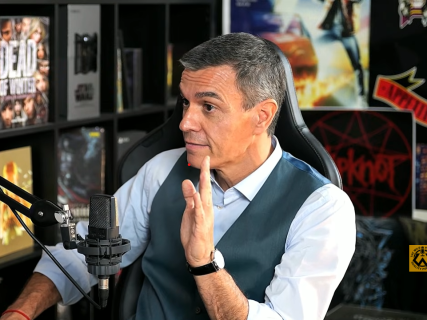

Pedro Sánchez has defended that responsibility for political polarization in Spain is not distributed equally among the parties. During his interview with Jordi Wild, published this Friday, 13 November, in The Wild Project, the head of government described political tension as "asymmetric" and linked the dehumanization of the opponent to propaganda strategies historically used by fascism. The interviewer disagreed with that interpretation and reminded him that confrontation is also fueled from other political positions.
The conversation, almost two hours long, is part of the election interviews organized by Wild on the occasion of the 29 November elections. Sánchez answered questions about government management, immigration, rail accidents, and corruption cases affecting the PSOE, although one of the first disagreements arose precisely when addressing the political climate.
Wild questioned whether responsibility falls fundamentally on the right and mentioned the attacks directed at Santiago Abascal. "All of you share some blame", he replied to the president, who maintained his interpretation of the unequal nature of polarization.
Wild reproaches Sánchez for rail management and demands "more self-criticism"
Rail accidents have caused one of the most tense exchanges of the interview. Wild questioned the performance of the Executive and asked the president to assume responsibilities. "I think management is bad", he reproached him, before demanding that he be given "more self-criticism" after eight years at the head of the government.
Sánchez acknowledged that "mistakes were made" and defended improving the training of workers at control centers, increasing simulations, and establishing double supervision. He also admitted that rail investment may have been insufficient. Although he assured that his government multiplied spending "by 20" on the affected line, he acknowledged that "maybe it was necessary by 40".
Asked whether he would have dismissed Óscar Puente if he had not resigned, the president avoided answering directly. "That debate today is already over", he replied, before insisting that "Óscar Puente was the one who made the decision". Wild reproached him that none of those answers solved his question.
Sánchez admits that the left has neglected the integration of immigrants
Immigration has taken up a good part of the conversation. Sánchez has acknowledged that "the left on many occasions does not pay him enough attention" to integration and has identified as a challenge "assimilation by migration of the codes, of the laws, of the way of life" of Spain.
At the same time, he has defended the economic contribution of foreign workers, to whom he attributed 25% of Spanish economic growth. The president warned that, without a greater arrival of immigrants, "we are going to be poorer", due to the aging of the population.
Wild has also asked him about the migration crisis in Ceuta and the Government’s response. "I did not go on vacation", Sánchez insisted, who said he was working during the emergency. Regarding the possible involvement of Moroccan authorities, he avoided accusing them directly: "I do not have information to accuse an entire government of this".
"I trusted him a lot", he acknowledges about Ábalos
Judicial investigations affecting former Socialist leaders have led the interviewer to ask about José Luis Ábalos, Koldo García, Santos Cerdán and Leire Díez.
Sánchez has acknowledged that Ábalos represents "an enormous disappointment" and has admitted that "I trusted him a lot". He has also said that he was unaware of aspects of his private life. "I did not know that he was using prostitutes", he said, before denying that the former minister made sexist comments in front of him.
The president has defended that Ábalos’s departure from the Executive in 2021 responded to a reshuffling of the Government and not to knowledge of possible irregularities. "I knew nothing about that", he insisted. He has also rejected that his praise of Koldo García in a 2014 publication implied a close relationship with the former adviser.
Asked about José Luis Rodríguez Zapatero and investigations related to Plus Ultra, he has expressed his confidence in the former Socialist president. "I put my hand in the fire for José Luis", he assured, before adding that "I believe in his innocence".
On the housing crisis
Access to housing was another of the issues addressed. Sánchez admitted that the situation "is bad", although he has defended public intervention and the construction of protected housing as "the only way out we have".
Wild has asked how many of the 184,000 affordable homes promised during the legislature are already occupied. "I don't want to tell you the exact figure right now", the president replied, who has estimated the homes in various stages of processing between 120,000 and 130,000 and has insisted that "we are going to comply with that commitment".
He has also acknowledged the need to increase private construction and speed up administrative procedures, a matter in which he has admitted differences with Podemos. Regarding rentals, he has argued that the regulation applied in Barcelona is containing prices, as opposed to the policy followed in Madrid.
"I've changed my mind," he admits about the amnesty
Changes in political position have occupied the final stretch of the interview. Asked about the amnesty, Sánchez acknowledged: "I've changed my mind". And he defended that "policy is not a fixed photograph."
The president has linked that evolution to a meeting held in 2019 with Catalan healthcare workers, who reproached him for the imprisonment of independence leaders. He has also justified the approval of the amnesty by the need to resolve the political conflict and avoid a repeat election.
Regarding EH Bildu, he has defended parliamentary agreements to pass social measures. "What I have done is achieve agreements, for the benefit of the people", he said. He has also attributed the delay in repealing the gag law to the need to negotiate with other groups.