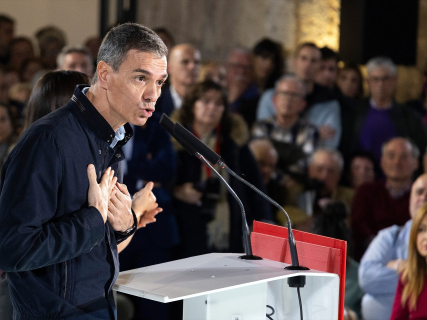
Sánchez warns from Burgos that PP and Vox will do with Spain "the same as Milei in Argentina" if they win on 29N

The president of the Government responds to the attacks of the Argentine president during his visit to Madrid and accuses Feijóo and Abascal of sharing his policy of cuts. "Chainsaws and cuts do not build anything, they destroy," he assures.

EuropaPress 7324127 presidente gobierno pedro sanchez interviene acto inicio campana electoral

EuropaPress 7324127 presidente gobierno pedro sanchez interviene acto inicio campana electoral

Add DEMÓCRATA to Google

Ask FREN

Published

Last updated

3 minutes

Most read

Elecciones 29N · Encuestas

La media de las encuestas

Media a 21 de octubre de 2026 · 15 institutos

  • PP31,6 %
  • PSOE26,9 %
  • Vox18,7 %
  • Sumar6,3 %
  • Podemos3,1 %
  • ERC2,2 %
010203040ene 2024jul 2024ene 2025jul 2025ene 2026jul 2026

Media del último estudio de cada instituto en 30 días y su evolución semanal desde el 23J. Partidos con al menos un 2 %.

Todas las encuestas

Elecciones generales del 29 de noviembre · Demócrata

Pedro Sánchez took advantage of his electoral rally in Burgos this Wednesday to respond to Javier Milei and turn the visit of the Argentine president to Spain into an argument against PP and Vox. The socialist candidate warned that Alberto Núñez Feijóo and Santiago Abascal would apply Milei's economic policies in Spain if they come to power after the general elections on November 29.

"Milei can come here to give lessons, but if Feijóo and Abascal win the elections, they are going to do with Spain what unfortunately Milei is doing with Argentina," Sánchez assured during his speech at the Fórum Evolución in Burgos.

The president of the Government responded in this way to the statements made hours earlier by Milei in Madrid, where he called him "an unacceptable dictator," "a criminal," and "a thief." The Ministry of Foreign Affairs condemned the insults and rejected the words of the Argentine leader as an interference in Spanish politics.

Sánchez mocks Milei's visit

The Secretary General of the PSOE questioned the relationship of the main leaders of the Spanish right with the Argentine president, whose visit included a meeting with Isabel Díaz Ayuso and a video call with Santiago Abascal, but not a meeting with Feijóo.

"Mr. Milei has come around here. Of course, he has created a problem for them because Feijóo and Abascal invited him and now they don't know what to do with him", Sánchez mocked.

The socialist leader accused both parties of sharing the same economic project as Milei, whom he identified with cuts in public spending. "Chainsaws and cuts do not build anything, but rather destroy", he stated.

Sánchez presented the elections of November 29 as a choice between "solidarity or selfishness" and "social justice or cuts", insisting that the result will determine the future of social policies and the welfare state.

Employment and wages, against the Argentine model

During his speech, Sánchez resorted to labor market data to defend the economic management of his Executive. He highlighted that Spain has 22.6 million affiliates to Social Security and that more than ten million women are working.

The president contrasted these figures with the labor situation in Argentina, assuring that in the country governed by Milei there are eleven million people working in the informal economy, without contributing to Social Security.

It has also claimed the increases in the interprofessional minimum wage approved during its years in government against the public spending reduction policies promoted by the Argentine president.

The intervention prolongs the political confrontation that both leaders have starred in throughout the day. Before the rally, Sánchez had shared on X the song "Fanático," by Lali Espósito, an Argentine artist publicly opposed to Milei.

The PSOE has also displayed a banner at the Ferraz headquarters to welcome the Argentine president with the message "The leftists welcome you to Spain," while Sánchez has released a video claiming his leftist condition.
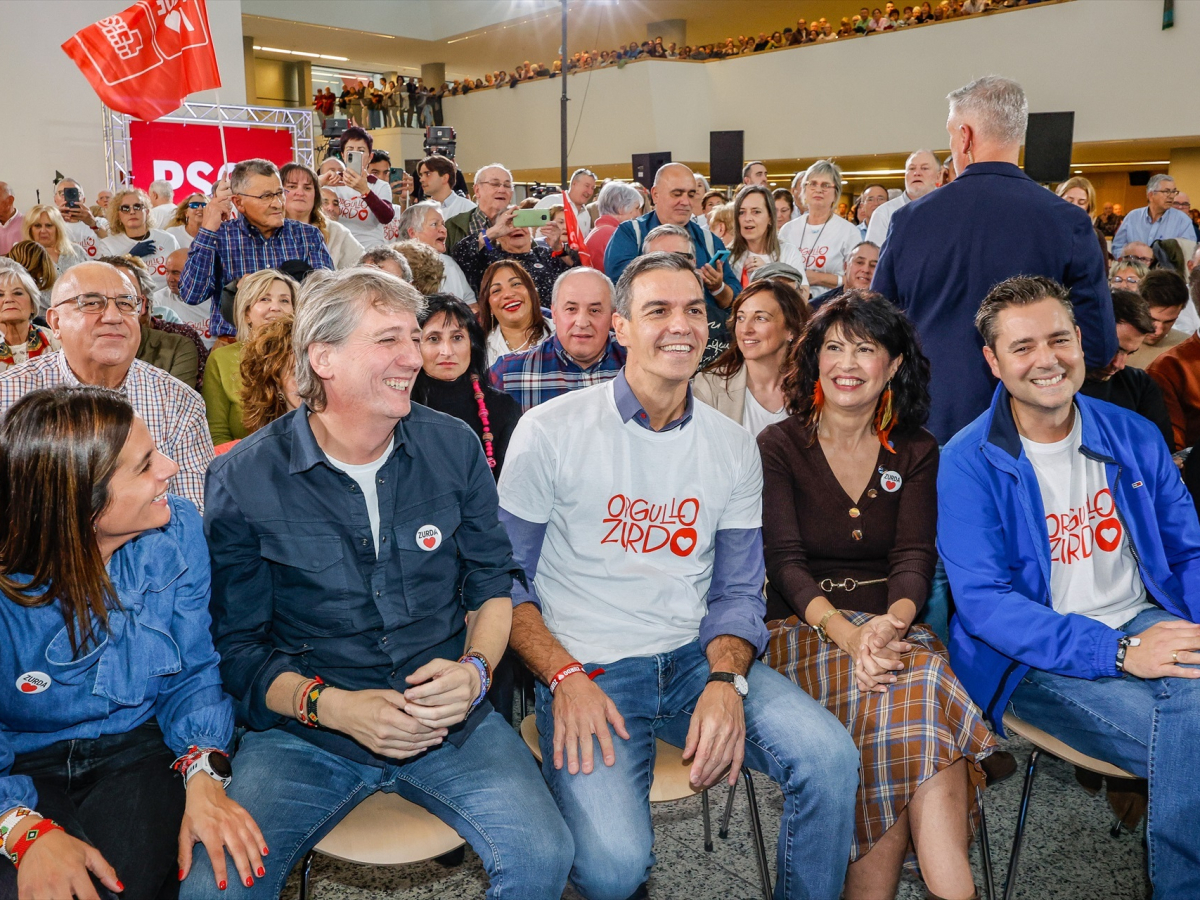
The general secretary of the Castilian and Leonese socialists, Carlos Martínez; the president of the Government, Pedro Sánchez; and the Minister of Equality, Ana Redondo; during a pre-campaign event
The general secretary of the Castilian and Leonese socialists, Carlos Martínez; the president of the Government, Pedro Sánchez; and the Minister of Equality, Ana Redondo; during a pre-campaign event | Europa press

Third electoral stop in Castilla y León

The event in Burgos is Sánchez's third visit to Castilla y León since the call for general elections, after the rallies held in Ponferrada and Valladolid.

On this occasion, the president has been accompanied by the general secretary of the PSOE of Burgos and head of the list for Congress, Esther Peña, and the leader of the socialists of Castilla y León, Carlos Martínez.

The visit also comes after the discrepancies that arose in the Burgos PSOE due to the exclusion of Luis Tudanca from the Senate candidacy, despite the support he had received from the provincial membership.

More key points, information and questions with FREN

AI-GENERATED CONTENT

In which parliamentary phase are the economic initiatives proposed by PP and Vox for Spain?

As of October 21, 2026, the state economic initiatives from PP and Vox located do not follow a single phase: several expired on October 6 and others had ended earlier due to rejection, inadmissibility, or withdrawal. Therefore, they should not be presented as currently pending approval proposals. The following detail focuses on the Congress and Senate and distinguishes each file, including parallel proposals in both chambers.

PP: expired proposals
  • Public pensions. The proposal to guarantee their purchasing power, presented on November 7, 2025, was admitted and published but expired on October 6, 2026; it proposed applying the 2026 revaluation according to the CPI. (Published text; dissolution of the Cortes).
  • Transport discounts. The proposal presented on January 23, 2025, about discounts and aid for public transport, also expired on October 6, after its admission and publication. (Congress text).
  • Contributions in Ceuta and Melilla. The proposal from October 18, 2024, to recover business discounts also expired on October 6, 2026. (Congress text).
  • IRPF and minimum wage. The initiative from the Senate to adjust the exempt limit to the minimum wage had reached the Congress but expired on October 6; it did not complete approval. (Senate publication).
  • Taxation of the primary sector and Rural Guarantee Mechanism. Both PP proposals in the Senate reached the Congress and expired on October 6, without becoming laws through those procedures. (Agricultural taxation; Rural mechanism).
PP: other completed procedures
  • Tax measures and family support for 2025. The Congress proposal ended in March 2025, with rejection published on April 1. The Senate version was still pending the Plenary's decision to start processing and expired with the dissolution. (Congress; Senate).
  • IRPF linked to the minimum wage, Congress version. Its procedure ended on March 28, 2025, with subsequent publication on April 1. It is different from the initiative coming from the Senate. (Procedure conclusion).
  • Disaster aid. A first proposal was not admitted, according to a February 2025 publication. The second awaited the Plenary's initial decision and expired with the dissolution. (First proposal; Second proposal).
  • IRPF-exempt compensations and judicial remunerations. The respective proposals were withdrawn on April 9, 2026, and July 22, 2025. (IRPF reform; Judicial remunerations).
Vox: expiration and closed procedures
  • Waste tax and low emission zones. The proposal presented on October 28, 2025, was admitted but expired on October 6, 2026. (Congress text).
  • Protection of self-employed workers. The May 2024 proposal, which included discounting contributions and deferring tax payments, ended on September 10, 2024. (Final publication).
  • Birth and care bonuses. The initiative to recover the full business discount ended on May 6, 2025; rejection was published on the 9th. (Published rejection).
  • Electric and nuclear taxes. The proposal for suppression did not continue: its inadmissibility was published on May 30, 2025. (Final publication).
  • Subsidy for foreign minors after internment. This initiative on benefits was rejected on September 10, 2024, and concluded its processing. (Published rejection).

Practical consequence: these procedures are closed; expired proposals would need to be presented again to regain parliamentary progress.

What are the powers and attributions of the Prime Minister according to the Spanish Constitution?

According to the 1978 Spanish Constitution, the Prime Minister is the highest political authority of the executive power and the center of direction of the country's general policy. Their powers combine political leadership functions, internal Government coordination, and relations with the King and the Cortes Generales, especially with the Congress of Deputies.

In general terms, the Constitution assigns three main roles: directing the Government's action, being politically accountable before the Congress, and articulating the Executive's relationship with the Head of State (the King) and, partly, with the other branches of the State.

1. Direction of the Government's action

Article 98 of the Constitution establishes that the Prime Minister:

  • Directs the Government's action, that is, sets the general lines of domestic and foreign policy and establishes the Executive's priorities.
  • Coordinates the functions of the other Government members (vice presidents and ministers), ensuring unity of action: resolves competency conflicts between ministries and defines the Government's common position.
  • Is responsible for the overall functioning of the Council of Ministers, which is the collegiate body where the main executive and regulatory decisions are made.

This leadership function implies that the Prime Minister sets the Government's political program, promotes bills and decrees, and decides priorities in preparing the General State Budgets, always within the framework set by the Constitution and laws.

2. Appointment, dismissal, and political responsibility

The Prime Minister's position is also shaped by how they access office and how they can lose it:

  • Investiture (articles 99 and 114): appointed by the King after obtaining the confidence of the Congress of Deputies in an investiture vote. Without that confidence, there can be no Prime Minister or fully functioning Government.
  • Appointment and dismissal of ministers (art. 98.2 and 98.4): proposes to the King the appointment and removal of vice presidents and ministers. In practice, this grants the power to configure and reshape their Government team.
  • Political responsibility before the Congress: the Government, particularly the Prime Minister, is accountable for its management before the Congress, which can withdraw confidence through a motion of censure (art. 113) or force resignation through repeated parliamentary lack of support.
  • The Prime Minister can, in turn, raise a vote of confidence (art. 112) to verify the Congress's backing of their program or a general policy declaration.

If the Prime Minister loses a motion of censure or fails a vote of confidence, they must resign, opening the door to a new investiture or a new Government.

3. Relationship with the King and formal attributions

The Constitution assigns the Prime Minister a key role as the political responsible for many acts of the King:

  • In general, the King's acts must be countersigned by the Prime Minister or the competent ministers, meaning political responsibility for those acts lies with the countersigning party.
  • The Prime Minister proposes to the King the appointment and dismissal of ministers, as already noted.
  • The King may submit certain politically significant decisions to a consultative referendum at the Prime Minister's proposal, with prior authorization from the Congress (art. 92.2). In practice, the political initiative is the Prime Minister's.

Additionally, the Prime Minister represents the Government in its relations with the King, placing them at the center of institutional communication between the Head of State and the executive power.

4. Dissolution of the Cortes and calling elections

Article 115 of the Constitution grants the Prime Minister a very relevant power:

  • Propose the dissolution of the Congress, the Senate, or the Cortes Generales and the calling of general elections to the King.

This faculty allows them to decisively influence the political calendar, always with certain constitutional limits (for example, they cannot dissolve while a motion of censure is underway, nor before a minimum time has passed since the previous dissolution).

5. Other constitutional functions

Alongside the above, the Constitution specifies other powers or roles of the Prime Minister:

  • Direction of domestic and foreign policy, of the civil and military administration, and of the State's defense, through the Government (art. 97).
  • Joint responsibility with the rest of the Government for the Executive's acts, without prejudice to the specific competencies of each minister.
  • Participation in the drafting of norms with the force of law (bills, royal decrees, legislative decrees), which the Council of Ministers approves under their direction.

In summary, the Prime Minister is the apex of the executive power: coordinating and directing the rest of the Government, accounting before the Congress, managing the relationship with the King, and having key instruments such as the dissolution of the Cortes, cabinet configuration, and the initiative for votes of confidence or consultative referendums.

Could you explain in more detail how the investiture of the Prime Minister works according to the Constitution? What constitutional differences exist between the functions of the Prime Minister and those of the King? What exactly is a constructive motion of censure and how does it affect the Prime Minister?

What has been Javier Milei's political trajectory before becoming president of Argentina?

Javier Milei became president of Argentina in December 2023 after a relatively short but very intense and media-focused political trajectory. Before becoming president, his path is characterized by three main stages: a long career as an economist and consultant without visible party militancy, a phase as a media figure with a strongly anti-statist discourse, and finally, his formal entry into electoral politics, which led him to Congress and then to the Casa Rosada.

For decades, Milei was mainly known as an economist. He studied economics at the University of Belgrano and pursued postgraduate studies at Argentine institutions, orienting himself towards classical liberal and libertarian thought. He worked in the private sector as an analyst and chief economist in various companies and firms, including the private group Corporación América, linked to Eduardo Eurnekian, and financial firms where he prepared macroeconomic reports. During this period, his activity was fundamentally technical, focused on fiscal forecasts, inflation analysis, and criticism of interventionist policies of various Argentine governments.

His leap to public notoriety occurred from the 2010s thanks to his presence in the media. First on specialized cable channels and then on high-audience programs, Milei became a "media economist" who commented on the economic situation with a combative and provocative style. In these interventions, he popularized topics such as:

  • Radical criticism of the "political caste model," which he holds responsible for chronic inflation and Argentine stagnation.
  • Defense of a much smaller State, with drastic cuts in public spending.
  • Advocacy of liberal economists and the Austrian School (Mises, Hayek, Rothbard) against Keynesianism and Latin American structuralism.

In those years, he promoted conferences, popular science books, and mass talks where he mixed academic elements with direct and confrontational language. Although he did not yet hold office or lead a party, he began gathering around his figure young and liberal activists dissatisfied with traditional political offers.

The transition from media figure to political actor accelerated from 2019. In this context, Milei approached small liberal and libertarian parties seeking a leader with national projection. He participated in spaces such as the Libertarian Party and other minor electoral attempts, although without yet consolidating a competitive candidacy. At the same time, he continued building his public image with an increasingly anti-political and anti-establishment discourse, which differentiated him both from the ruling Peronism and the traditional center-right opposition.

The turning point came in 2020-2021, when the political space that would be the base of his later rise was formed: La Libertad Avanza. This label, which groups leaders from liberal, conservative, and libertarian parties, presents itself as a disruptive alternative to the two major Argentine coalitions ("Kirchnerism" and traditional opposition). Milei was proclaimed candidate for national deputy for the City of Buenos Aires in the 2021 legislative elections.

In that campaign, Milei focused his message on the "battle against the caste," reducing the State, eliminating the Central Bank, and drastically lowering taxes and regulations. With a style of massive outdoor events and strong social media presence, he managed to attract voters disenchanted with traditional parties. The result was significant: La Libertad Avanza obtained a sufficient vote percentage for Milei to be elected national deputy, his first formal political office.

Already in the Chamber of Deputies, his performance reinforced his outsider profile. He maintained a small but very visible bloc, voted against most government projects, and often harshly criticized the entire political class. At the same time, he used the parliamentary platform to continue expanding his media presence. During this period, he outlined more concrete proposals that would later be central to his presidential campaign: dollarization of the economy, closure of the Central Bank, deep labor and public spending reforms, and a broad privatization program.

Between 2022 and early 2023, his decision to run directly for the presidency was consolidated. La Libertad Avanza began weaving a national structure of provincial alliances to present lists throughout the country. Although the space remained minor in terms of organization, Milei's figure gained weight thanks to economic discontent, high inflation, and the perception of exhaustion of the traditional party system.

Thus, when the 2023 elections were called, Milei arrived as a leader with barely two years of parliamentary experience but with a prior trajectory of long public exposure as an economist and communicator, and with a very defined ideological discourse. That prior path — technical, media, and then parliamentary — is what allowed him to capitalize on social discontent and transform, in very little time, into a competitive candidate and finally president of Argentina.

How was Javier Milei's 2023 presidential campaign structured and what factors explain his electoral success? What are the main economic proposals Javier Milei defended before becoming president and how have they evolved? What ideological and strategic differences exist between La Libertad Avanza and the traditional coalitions of Argentine politics?

Play

Test your knowledge with FREN!

How much do you know about this topic? Answer the following 3 questions.

What has Pedro Sánchez stated about what PP and Vox would do if they win the November 29 elections?

Question 1 of 3

What number of Social Security affiliates in Spain did Sánchez highlight during his rally?

Question 2 of 3

What action did the Ministry of Foreign Affairs take after Milei's statements?

Question 3 of 3