Sánchez, on the offensive on Twitter: a "fucking great pizza" against Feijóo and an Argentine song for Milei

The "fucking pizza" from Luna Rosa and a song by an artist opposed to Milei have served the president of the Government to respond to a day marked by the visit of the Argentine president and by a comment from Alberto Núñez Feijóo about the illegal occupation.

fotonoticia 20261021142950 1920

fotonoticia 20261021142950 1920

Add DEMÓCRATA to Google

Ask FREN

Published

Last updated

3 minutes

Most read

Elecciones 29N · Encuestas

La media de las encuestas

Media a 21 de octubre de 2026 · 15 institutos

  • PP31,6 %
  • PSOE26,9 %
  • Vox18,7 %
  • Sumar6,3 %
  • Podemos3,1 %
  • ERC2,2 %
010203040ene 2024jul 2024ene 2025jul 2025ene 2026jul 2026

Media del último estudio de cada instituto en 30 días y su evolución semanal desde el 23J. Partidos con al menos un 2 %.

Todas las encuestas

Elecciones generales del 29 de noviembre · Demócrata

The president of the Government, Pedro Sánchez, has landed the political offensive on Twitter this Wednesday. Without big speeches or statements, the head of the Executive has taken advantage of two posts to respond to Alberto Núñez Feijóo and Javier Milei. A pizza from 16 years ago and an Argentine song have served him to intervene in two of the political controversies of the day, using irony as an alternative to direct confrontation.

The messages arrive in the midst of the pre-campaign for the general elections on November 29, when every statement from the main leaders takes on an electoral dimension.

Sánchez has opted for a different register than usual: recognizable references, brief comments, and allusions that make sense when related to the news of the day.

Feijóo's pizza and a tweet from 2010

The first recipient has been Feijóo. During an electoral event about housing held in Seville, the leader of the PP denounced the insecurity that, in his opinion, property owners suffer due to squatting.

"If a squatter enters your house, with a paper saying they ordered a pizza, no one can evict them for several years," assured the popular candidate. Feijóo used that example to defend his proposal to evict occupants within 48 hours if he reaches Moncloa, one of the measures he intends to approve during his first 100 days in Government.

Sánchez has not directly responded to the PP's proposal. He preferred to recover a message he posted on December 24, 2010, when he was still a practically unknown socialist deputy to the general public.

"With my colleagues at the luna rosa restaurant, eating a great pizza," he wrote then in a memorable tweet that occasionally shines among the most searched posts on the social network.

This Wednesday, the president has revived that tweet and accompanied it with a phrase: "Today, as there is so much talk about pizzas, I want to remember this memorable tweet…".

The coincidence with Feijóo's statements turns the message into an ironic response to the popular candidate. Sánchez avoids entering the legal discussion about occupation and uses one of his most well-known tweets to ridicule the example chosen by his opponent.

Lali Espósito, the musical response to Milei

Hours earlier, Sánchez had resorted to a similar formula to respond to the Argentine president, Javier Milei, who was visiting Madrid.

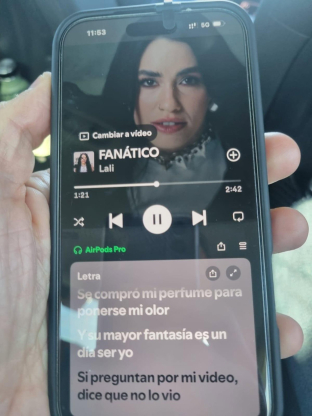
"Taking advantage of the fact that I'm in the car, on my way to Burgos, to listen to this Argentine hit. I love it!", he published on X.

The chosen song is "Fanático," by Lali Espósito, an artist who has been involved in a public confrontation with Milei. The Argentine president even referred to her as "Lali Depósito" amid his criticisms of public funding for musical shows.

The singer responded in 2024 with "Fanático," a song whose music video includes references interpreted as a parody of the Argentine president and his attacks.

The publication of Sánchez coincides with a visit in which Milei has again attacked the Spanish Government. During an informative breakfast in Madrid, the president called "unpresentable dictator" the president of the Executive, statements that have provoked a response from the Ministry of Foreign Affairs.

Sánchez has precisely chosen one of the artists who have most publicly confronted Milei to launch his message, without mentioning the Argentine president or reproducing his statements.

The political battle is also fought with irony

The two publications share a characteristic: Sánchez does not identify his recipients, but uses references directly linked to the interventions of Feijóo and Milei.

The choice of format is also significant. Against institutional interventions or campaign videos, the president resorts to brief messages, with a personal tone and cultural references that allow participation in the political conversation without developing an argument.

The digital offensive is not limited to these two publications. This Wednesday, Sánchez has also publicly claimed his leftist condition against the derogatory use of the word "leftist" by Milei, while the PSOE has displayed a banner in Ferraz with a message directed at the Argentine president.

The difference is that, with the pizza and the song, Sánchez seeks for the reference itself to do the political work. He does not need to mention Feijóo to recall his statements about squatting, nor cite Milei to recover the confrontation of the Argentine with Lali Espósito.

In a pre-campaign in which the parties compete to impose their messages, the president of the Government rehearses a response that is less solemn and closer to the language of social networks. The unknown is whether these interventions will remain as two jokes from a particularly hectic day or will become a usual formula of his electoral communication.

More key points, information and questions with FREN

AI-GENERATED CONTENT

What is the current status of the parliamentary processing of Feijóo's proposal to evict squatters within 48 hours?

As of October 21, 2026, Feijóo's proposal to evict illegal occupants within 48 hours is a political commitment for the next legislature, not an approved law nor an initiative that continues to advance in the Cortes. Previous legislative proposals from the PP that were still pending expired with the dissolution of the Cortes on October 6. Therefore, it is necessary to distinguish the current announcement from the texts that were processed previously.

The 48-hour announcement

On October 18, Feijóo announced that Xavier García Albiol, mayor of Badalona and candidate for Congress, would take charge of the drafting of a future law against illegal occupation. He linked this assignment to the commitment to allow evictions within 48 hours. This is a responsibility announced for the future, not a designation made by a parliamentary committee (Demócrata, October 18).

Feijóo also incorporated the goal of speeding up these evictions into the commitments presented on October 19. That electoral formulation does not equate to the registration, debate, or approval of a new legal text (Demócrata, October 19).

How far the previous initiative went

The most recent precedent identified is the Organic Law Proposal against the illegal occupation of properties and for neighborhood coexistence and the protection of the safety of people and property in homeowners' associations, from the Popular Group, with file number 122/000254. Its progress prior to dissolution was as follows:

  • February 6, 2026: proposal presentation.
  • February 10 and 13: qualification by the Board and subsequent publication and admission for processing.
  • May 19: the Plenary approved its consideration; that is, it accepted to start processing it, without yet approving the law.
  • May 26: referral to the Interior Committee.
  • May 29: opening of the period to submit amendments, with subsequent extensions.

These milestones can be consulted in the Congress file and in the published text. The initiative had not completed its parliamentary approval when the Chambers were dissolved.

Why it is no longer in the amendment phase

The dissolution of the Cortes, published on October 6, ended the processing of pending parliamentary law proposals. Therefore, describing this proposal today only as stalled in committee or pending amendments would be incomplete: that was its previous situation; its processing ended due to expiration.

There was also a precedent from the Senate, identified in Congress as 124/000003, which had been assigned to the Justice Committee and subjected to amendments. It was a different initiative from the one registered in February 2026 and should not be confused with an already effective law (Congress publication).

The difference between 24 and 48 hours

The proposal debated in May contemplated a judicial requirement to leave the property or present a legitimate title within a maximum of 24 hours, followed by eviction if not complied with. That mechanism should not be automatically identified with the new political commitment of 48 hours (Demócrata, May 19).

In short, to implement it, it will be necessary to present a new text in the next legislature and obtain its parliamentary approval. There is no effective date derived from the announcement, nor do the procedures completed by the previous initiative automatically carry over to the next legislature.

What are the powers of the President of the Government of Spain according to the Constitution?

The Spanish Constitution assigns the President of the Government a central role in the executive power: directing the Government's action, coordinating the ministers, setting the general political orientation, and being politically accountable before the Congress. Additionally, the President concentrates key powers in the relationship with the King, with the Cortes Generales, and in situations of political crisis. All these functions are mainly regulated in articles 97 to 101 of the Constitution, although important references appear in other provisions.

The starting point is article 97 CE, which establishes that the Government directs domestic and foreign policy, the civil and military administration, and the defense of the State, and exercises executive function and regulatory power. Within that Government, the President is the body that directs and coordinates it. This means that he is responsible for setting the major lines of political action (for example, legislative priorities, economic or social orientation) and ensuring that all ministers act coherently with those guidelines.

Article 98 CE specifies that the President directs the Government's action and coordinates the functions of its other members. From this competence derive several practical faculties:

  • Deciding the structure of the Government (creation, suppression, and modification of ministries, usually by Royal Decree of the King at his proposal).
  • Assigning and reassigning ministerial portfolios, as well as promoting or halting certain initiatives of each department.
  • Resolving coordination conflicts between ministries when their competences overlap.

Another essential area is relations with the Crown. According to article 62 CE, the King appoints and removes the President of the Government, but always according to the rules of article 99, which place the President at the center of the Executive formation process. After elections or a Government crisis, the King, after consulting representatives designated by political groups and through the President of the Congress, proposes a candidate for the presidency; that candidate undergoes an investiture session and, if obtaining the confidence of the Congress, is appointed President. From then on, all the King's political acts (such as appointing ministers or dissolving the Chambers) require governmental countersignature, which is usually assumed by the President.

In the relationship with the Cortes Generales, the President concentrates decisive faculties. First, he is the main responsible for parliamentary confidence: he undergoes the initial investiture and may request a vote of confidence (article 112 CE) to reinforce or verify majority support. The Congress, in turn, can demand his responsibility through a motion of censure (article 113 CE), which is always constructive: it must include an alternative candidate for the presidency. In practice, the entire Government falls if the President loses parliamentary confidence.

Additionally, the President plays a decisive role in the decision to dissolve the Cortes. According to article 115 CE, the dissolution of the Congress, Senate, or both Chambers, and the calling of general elections, are carried out by the King at the proposal of the President of the Government, after deliberation of the Council of Ministers. In practice, the initiative is presidential: he decides the politically opportune moment to call early elections, always within constitutional time limits.

The President also has a key role in the Government's legislative initiative. Although formally bills and royal decree-laws or legislative decrees are approved by the Council of Ministers, it is the President who, by his directing function, determines the major legislative priorities, orders the presentation of certain projects, and decides whether to resort to urgency instruments such as the decree-law, always within what the Constitution permits.

Regarding territorial unity and constitutionality, the President may file, on behalf of the Government, appeals of unconstitutionality and conflicts of competence before the Constitutional Court, which grants him relevant competence in defending the constitutional framework and the distribution of powers between the State and autonomous communities. He also plays a central role in activating exceptional mechanisms, such as the state of alarm, exception, or siege (article 116 CE), which require a proposal or initiative from the Government directed to the Cortes.

Finally, the President is politically accountable before the Congress of Deputies for the action of the entire Government. This responsibility is concretized in control debates, question sessions, interpellations, motions, and votes of confidence or censure. Although ministers are individually responsible for their management, the Constitution configures the President as the figure who ultimately assumes the overall responsibility of the Executive.

Can you explain the constitutional investiture procedure of the President of the Government step by step? What are the differences between the powers of the President of the Government and those of the King according to the Constitution? What exactly is a motion of censure against the President of the Government and what effects does it have?

What political trajectory and positions has Pedro Sánchez held before becoming president?

Before becoming President of the Government on June 2, 2018, Pedro Sánchez developed a trajectory that included European political advisory, the Madrid City Council, the Congress of Deputies, and the leadership of the PSOE. His main positions were councilor, deputy for Madrid, president of the Socialist Parliamentary Group, and secretary general of the party. His rise included a departure from socialist leadership in 2016 and his recovery through primaries in 2017.

Affiliation and early political work

Sánchez joined the PSOE in 1993. An economist by training, his first professional political experiences had an international dimension: he worked as an advisor in the European Parliament and was part of the cabinet of the High Representative for Bosnia and Herzegovina, Carlos Westendorp. It is important to distinguish that advisory work from an elected position: he was not a Member of the European Parliament. The La Moncloa biography records these stages prior to his municipal responsibilities.

Councilor in Madrid: 2004-2009

His first elected public office was as a councilor of the Madrid City Council. He had been part of the socialist candidacy led by Trinidad Jiménez in the 2003 municipal elections, but accessed the council in May 2004 after Elena Arnedo's resignation.

He renewed his seat in the 2007 municipal elections and remained as a councilor until 2009. During that period, he served in the socialist municipal opposition and participated in bodies linked to the City Council, including the Municipal Housing and Land Company. This sequence is recorded in the CIDOB biographical profile.

Deputy for Madrid: two terms

In 2009 he entered Congress to replace Pedro Solbes and left the City Council. During that first term, which ended in 2011, he was deputy spokesperson for the socialist group in the Territorial Policy Commission and participated in the Foreign Affairs and Mixed Commission for the European Union.

He did not obtain a seat after the November 2011 general elections. He returned in January 2013, this time replacing Cristina Narbona. In this second parliamentary term, he worked on economic matters and was socialist spokesperson in the Climate Change Commission until September 2014. His parliamentary trajectory preceded his leap to national party leadership, as detailed by CIDOB.

Secretary General and candidate: 2014-2016

In July 2014, he won the socialist primaries against Eduardo Madina and José Antonio Pérez Tapias. The PSOE Extraordinary Congress elected him secretary general, succeeding Alfredo Pérez Rubalcaba. He also presided over the Socialist Parliamentary Group and assumed the leadership of the opposition.

He was a candidate for the Presidency in the December 2015 and June 2016 elections. Between both calls, he tried to form a Government through an agreement with Ciudadanos but did not obtain the necessary support to be invested in March 2016. These milestones appear in the EFE political profile.

Departure, return, and arrival to Government

In October 2016, he resigned as secretary general after the PSOE Federal Committee crisis. On October 29, he also resigned his seat before the vote that allowed Mariano Rajoy's investiture.

On May 21, 2017, he won the primaries against Susana Díaz and Patxi López; the socialist congress in June formalized his return. From that leadership, he promoted the motion of censure approved on June 1, 2018, and assumed the Presidency the following day. Thus, he culminated his previous trajectory, without having held a ministry or an autonomous presidency before (CIDOB).

Play

Test your knowledge with FREN!

How much do you know about this topic? Answer the following 3 questions.

What message did Pedro Sánchez retrieve on Twitter as an ironic response to Feijóo?

Question 1 of 3

What song did Pedro Sánchez share on Twitter to respond to Javier Milei?

Question 2 of 3

What communication format has Pedro Sánchez preferred in his recent responses during the pre-campaign?

Question 3 of 3