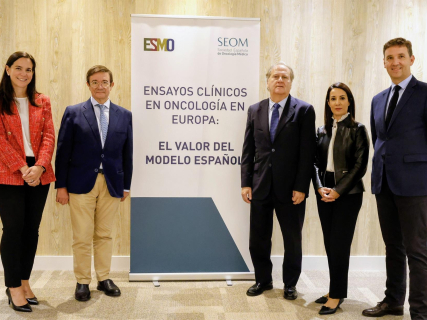

The former president of the European Society for Medical Oncology (ESMO) and head of the Medical Oncology Service at the Clinical Hospital of Valencia, Andrés Cervantes, has explained that European and American cancer specialists have decided to work together with the pharmaceutical industry to cut the bureaucracy that slows down clinical trials, a strategy in which Spain has established itself as a "model of success."
He presented this on Tuesday at a meeting promoted by ESMO and the Spanish Society of Medical Oncology (SEOM) focused on clinical trials, organized as a prelude to the Congress of the European Society for Medical Oncology 2026, which will be held from this Friday until next Tuesday in Madrid and will return to Spain next year, this time to Barcelona.
Cervantes detailed that, due to the "strict" European regulations, the researcher is forced to carry out an "extraordinary activity" during a clinical trial to collect a large amount of patient data, such as the dose of drug administered, their weight, or parameters of liver and kidney function, among others.
"And it turns out that all this information, which the industry will later take to the authorities as a regulatory paper showing that this drug is effective, contains between 10 and 20 times less information than what has been generated," he indicated, emphasizing the "over-effort" that clinical researchers assume by generating data that is not subsequently used in the drug authorization.
He warned that this "over-effort endangers the very practice of clinical trials" and compromises their speed, recalling that the average interval between the start of a drug's evaluation and its arrival on the market is around 10 years. To address this situation, ESMO has launched a specific program to reduce administrative burdens, to which the American Society of Clinical Oncology (ASCO) and various pharmaceutical companies have adhered.
The work of this commission began at the ESMO 2025 Congress and the first recommendations are expected to be announced next year through a simultaneous publication in two international scientific journals.
In this framework, it has emphasized that Spain acts as a "model of success" due to its leadership position in clinical research and the recent implementation, by the Spanish Agency of Medicines and Health Products (AEMPS), of the accelerated evaluation procedure to authorize clinical trials, the so-called 'fast-track' circuit.
"Spain constitutes an example that can help this facilitation, this extinction of barriers, to make this circuit more efficient and that will have no better consequence than making drugs reach European society," Cervantes has emphasized.
Spain consolidates its leadership in clinical trials
The president of SEOM, Javier de Castro, has highlighted Spain's role as a benchmark in clinical trials, after launching 962 studies last year, of which 378 corresponded to the oncological field, representing 40 percent of the total.
De Castro has stressed that this volume "is not casual," but responds "to the level" of the Spanish health network, its professionals, and medical oncology. He has also attributed this "success" to the work of cooperative groups, the regulatory performance of the AEMPS, and the "altruistic and selfless" participation of the citizenry.
Even so, he has emphasized the need to "continue advancing" in this field, especially in a "moment of change" for oncological care. He has mentioned precision medicine, progress in the molecular characterization of tumors, targeted therapies, and immunotherapy, noting that "this means that trials also have to be redesigned and redefined in a different way than they were conventionally done."
In this sense, he has claimed that European regulations should not hinder the Spanish momentum with an "excess" of bureaucracy and has defended a legal framework that reduces obstacles and allows Europe to position itself at the forefront of clinical research in a "super competitive" environment compared to other countries.
The secretary of the Board of Directors of SEOM, Javier Puente, has described the main difficulties surrounding clinical trials and has stressed that they are "transversal," that is, not "intrinsic" to Spain, but shared by most countries that develop clinical research.
Firstly, he has pointed out the lack of knowledge among many tumor specialists about the trials available for their patients, a barrier that, in his opinion, must be overcome by improving communication.
As a second major hurdle, he cited the existence of "demanding" inclusion and exclusion criteria, which restrict patient participation. He also added the lack of adequate infrastructure and equipment in some hospitals to carry out these studies.
For this reason, he has urged to lower the access barriers, emphasizing that health institutions are key to ensuring that trials are offered in different centers and autonomous communities, also facilitating the movement of patients. Likewise, he has called for simplifying the administrative procedures that slow down the projects.
The strategic value of academic trials
Alongside Spain's position as a reference country in clinical trials, the medical oncologist from the Hospital Universitario 12 de Octubre in Madrid, Elena Castro, has claimed the relevance of academic trials.
She explained that, unlike trials promoted by the pharmaceutical industry to evaluate one of its products, academic studies are designed to answer questions that emerge from daily practice, raised by the oncologists and other doctors themselves.
"This type of academic studies is fundamental and I believe they are what differentiate the scientific communities that are truly at the forefront," she pointed out, highlighting that Spain occupies a prominent position in this field thanks to its "large cooperative groups" dedicated to this type of research.
"The difficulty many times is funding, many times there is not a large company behind, so the resources are often more modest, but the impact can be equally great," she concluded.