
The World Health Organization (WHO) is awaiting a "formal response" from Russia to clarify the death of an employee of a laboratory in the Siberian region of Irkutsk after developing severe pneumonia. Initial reports pointed to a possible case of pneumonic plague, and international health authorities also want to confirm a second episode of pneumonia of still unknown origin.
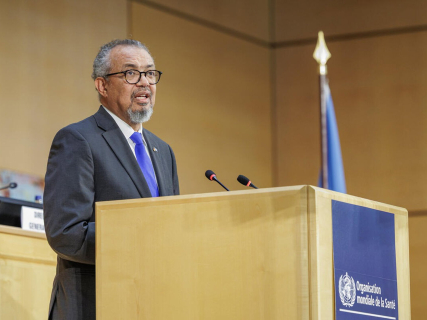
"I hope we receive a formal response regarding this. Informally, what we have received so far is that Russia has denied it. But, of course, we are waiting for a formal response about what happened and that second case that the media has reported," said the Director-General of the WHO, Tedros Adhanom Ghebreyesus, during a press conference.
The head of the WHO detailed that the organization has requested data from Moscow on both the first death and the possible second case and that close monitoring of the situation is being carried out. So far, the WHO is aware that the Russian government convened a meeting on October 2 due to the suspicion that a resident of Irkutsk may have contracted an infection considered dangerous.
"On Saturday, the WHO requested more information from Russia regarding this. Yesterday, they responded that no recent cases of plague had been reported in the Irkutsk region and that they had quarantined about 200 people who had been in contact with the deceased," said the Director-General of the WHO.
In this scenario, Tedros insisted that the WHO has made specific technical assistance on plague available to Russia, as well as support in biosafety and bioprotection in the involved laboratories. "We still do not have a complete picture of what happened and cannot conduct a thorough risk assessment. Timely, complete, and transparent exchange of information, in accordance with the International Health Regulations, is essential to clarify contradictory information and allow for an accurate assessment of potential public health risks," he added.
Questioned about possible parallels with what happened in China in the early stages of the COVID-19 pandemic, the director of the Department of Preparedness and Prevention of Epidemics and Pandemics of the WHO, Maria Van Kerkhove, explained that, with the data available so far, it is not possible to establish solid comparisons.
"We do not know exactly how this person died. We know that they had pneumonia and that it was a fatal case. In addition, we have evidence that some laboratory tests were conducted. As far as we know, the causative agent has not been identified and that is why we need more information," Van Kerkhove pointed out.
The expert emphasized that it is essential to know precisely what analyses were performed on the victim, given that the international organization still lacks a "complete view." "All that information helps us understand the risk at the local level, the risk at the national level within Russia, at the regional level, and also at the global level. That is why we still do not have a complete risk assessment, but we will always conduct initial assessments and update them when new evaluations are carried out," she concluded.