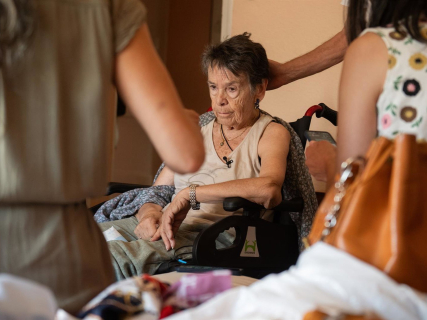
Maricarmen dies, the 87-year-old woman whose eviction triggered protests for housing in Madrid.

The neighbor from Retiro had been hospitalized since she was evicted from her home on September 23. Her family, her lawyer, and the Tenants' Union had reached an agreement for her to return to her house after being discharged.

2 minutes

fotonoticia 20260926083640 1920

fotonoticia 20260926083640 1920

Add DEMÓCRATA to Google

Ask FREN

Published

Last updated

2 minutes

Most read

Maricarmen Abascal has passed away this Wednesday at the age of 87, according to the Madrid Tenants' Union. The Retiro neighbor had been hospitalized since September 23, when she was evicted from the apartment on Alcalde Sáinz de Baranda street where she had lived for more than seven decades. Her exit occurred on a stretcher and she was transferred by ambulance to the hospital.

The death comes after her family, her lawyer, and the Union managed to reach an agreement that would have allowed Maricarmen to return to her home once she received hospital discharge. In the end, she was unable to return to the house she occupied since 1956.

"We regret to announce that today Maricarmen has passed away," announced the Union, which believes that the solution reached came "too late" after a process it describes as "torturous."

Hospitalized since the eviction

The eviction was carried out on September 23 after several previous attempts to evict. Maricarmen then left the property on a stretcher, attended by Samur medical staff, while hundreds of people gathered around to try to prevent her exit. Europa Press

The woman had been hospitalized since then. The case had gained significant public attention and became one of the main symbols of the housing protests that have taken place in Madrid over the past few weeks.

Days after the eviction, an agreement was reached for her to return to the apartment after receiving discharge, through a new rental contract. That return will no longer be possible.

From Retiro to Puerta del Sol

The eviction provoked a mobilization that transcended Maricarmen's particular case. After the eviction, protests for the right to housing followed, and since September 26, a camp has been set up in Puerta del Sol, where participants have demanded new measures against evictions and the rising cost of rent.

The case also entered fully into the political debate over the two housing decrees promoted by the Government. The texts were initially rejected by Congress on October 2 and the Executive reapproved them this week, after the announcement of the general elections on November 29.

In its statement, the Union links the mobilizations following the eviction with the demonstrations, the encampments, and the call for a general strike for housing, although the organization also includes among its political consequences the electoral advance, an interpretation that corresponds to the collective itself.

"Fight, keep fighting for what is yours"

The Tenants' Union has dismissed Maricarmen claiming her role in the protests of the last weeks and assuring that it will maintain the mobilizations for the right to housing.

The organization has also recalled one of the requests that, as it explains, Maricarmen conveyed to those who accompanied her during the process: "Fight, keep fighting for what is yours".

"Your family, your lawyer, and your Union will continue defending the right to housing and fighting against speculators, with the strength and courage that you taught us," concludes the statement.

More key points, information and questions with FREN

AI-GENERATED CONTENT

What is the current status of the parliamentary processing of the housing decrees promoted by the Government after their initial rejection in Congress?

As of today, October 7, 2026, the housing decrees that the Government has re-approved after their initial rejection in Congress are at a very early stage of processing: they are already published in the BOE and in force, but pending validation or repeal by the Permanent Deputation, due to the dissolution of the Cortes following the electoral call for November 29.

1. Which decrees were rejected and what was their status

The Plenary of Congress rejected on October 2, 2026 the first two housing decrees of this latest Government offensive:

  • A first royal decree-law focused on urgent housing measures: strengthening the anti-eviction shield, limits on certain speculative housing acquisitions, and tax measures for affordable housing. This text was repealed for not being validated by the Chamber, with 172 votes in favor and 178 against (PP, Vox, Junts, and UPN), according to the count recorded by Demócrata.
  • A second royal decree-law on extraordinary renewal of rental contracts, which was also rejected in the same Plenary, after a highly polarized debate on the impact on small landlords and rental supply (Demócrata report).

According to the Constitution, non-validation means that these initial decrees cease to have effect and do not continue as draft laws. There is no record, in the consulted registers, that Congress has agreed on their further processing as draft laws nor that they have passed to the Senate.

2. New decrees after the parliamentary defeat

After this double rejection, the Government opted for a “second round” strategy:

  • The Council of Ministers re-approved two new royal decree-laws on housing, “similar to those rejected last week” but with technical adjustments, as detailed by both Demócrata and the Congress note.
  • The BOE now contains four major recent texts:
    • Royal Decree-law 26/2026, of September 29: protection of the social function of housing and expansion of affordable housing supply.
    • Royal Decree-law 27/2026, of September 29: stability of rental contracts for primary residences.
    • Royal Decree-law 28/2026, of October 6: new text on rental contract stability, published on October 7 (BOE).
    • Royal Decree-law 29/2026, of October 6: new package for protection of the social function of housing and affordable housing (BOE).

The last two (28/2026 and 29/2026) are, in practice, the “re-launched housing decrees” after the October 2 defeat: they maintain the essence of the originals but incorporate changes resulting from negotiations with some groups, especially in the definition of large holders, regulation of seasonal rentals, and controlled extension of the eviction moratorium.

3. Current parliamentary situation: Permanent Deputation

The key now is that, once the Cortes have been dissolved due to the November 29 electoral call, validation no longer corresponds to the Plenary but to the Permanent Deputation. As explained by Congress itself in its press release of October 1, this body assumes the powers of the Plenary to validate or repeal royal decree-laws when the Chamber is dissolved.

Regarding this phase:

  • The Plenary has scheduled a specific debate on validation or repeal of royal decree-laws 26/2026 and 27/2026, but the early dissolution means the final decision falls to the Permanent Deputation (Congress note).
  • Various Demócrata reports indicate that the Executive has re-approved the two decrees and will send them to the Permanent Deputation “with modifications but maintaining the essence” (link).
  • The PNV has announced it will support the text focused on the social function of housing and affordable supply but remains opposed to the one regulating automatic renewal of rental contracts, considering it harmful to small landlords (Demócrata and PNV).

4. Summary: what may happen from now on

In summary:

  • The first housing decrees rejected in the Plenary have been repealed and are not being processed as draft laws.
  • The Government has approved new royal decree-laws with very similar content, now published and in force, but awaiting the decision of the Permanent Deputation.
  • With the current balance of power, available information suggests that the decree on the social function of housing and affordable housing stock has better chances of being validated, while the one related to rental contract renewal still lacks a clear majority.

Until the Permanent Deputation votes, the parliamentary processing of these re-launched decrees is, therefore, at an intermediate point: regulations in force due to their publication in the BOE, but validation or repeal still pending and no agreement on their transformation into draft laws.

What are the competencies and functions of the Madrid Tenants' Union in defending the right to housing?

The Madrid Tenants' Union is not a public body nor does it have legal “competencies” in an institutional sense; it is a social organization that acts as a tenants' union. Its functions in defending the right to housing derive from its capacity for collective organization, social pressure, and legal action, not from administrative powers.

As the organization itself has explained in information gathered by Demócrata , the Madrid Tenants' Union was founded in 2017, in a context of sharp rent increases, with the idea of applying a logic similar to labor unionism to the housing market: tenants who individually have very little negotiating power group together to defend themselves against landlords, real estate agencies, and large holders.

Main areas of action

The organization focuses its work on typical rental conflicts: rent increases, contract terminations, eviction threats or procedures, charges considered improper (agency fees, insurance, commissions), and negotiations with large landlords. From there, it carries out several functions:

  • Advice and support for tenants: affected individuals turn to the union when facing rent increases, non-renewals, evictions, or abusive conditions. The union offers information, collective support, and accompaniment in the conflict.
  • Organization by buildings and neighborhoods: sections linked to specific blocks or areas of Madrid are created. These sections organize neighborhood assemblies, share information about contracts, and coordinate common responses to landlords or management companies.
  • Collective bargaining: one of its pillars is grouping several tenants of the same landlord (for example, a fund or a management company) to negotiate jointly. In previous conflicts with large holders, the union has promoted contract renegotiations to avoid steep increases or loss of housing.
  • Legal action: the union uses judicial and administrative channels to denounce abuses. A relevant example is the complaint against the real estate agency Alquiler Seguro for charging illegal fees and abusive clauses, which led to a consumer sanctioning proceeding for several million euros and ongoing judicial processes.
  • Social mobilization and civil disobedience: it promotes gatherings, demonstrations, and campaigns. It has called massive housing marches in Madrid and waves of nationwide protests, and uses civil disobedience tools such as the rent strike, defined as a collective action where tenants withhold all or part of the rent to pressure and highlight structural abuses.
  • Political advocacy and legislative proposals: the union develops proposals for legal changes and conveys them to the Government and Parliament (for example, the so-called “Maricarmen decree,” with measures on rent freezes, contract extensions, and strengthened guarantees against evictions). It also participates in institutional debate spaces, hearings, and legislative drafting processes on rental and housing.
Internal structure and autonomy

The Tenants' Union organizes through an annual assembly of members, bimonthly plenaries, a coordination group, and various working commissions (union action, organization, communication, etc.), as well as territorial sections linked to buildings or city areas. It does not operate with a strong single presidency but with several spokespersons and a collegiate leadership, reinforcing a grassroots movement logic.

Regarding resources, the organization highlights that it is mainly funded by membership fees and occasional donations, without public subsidies, and reserves part of its income for a “resistance fund” to cover fines or collective legal expenses. This self-financing is presented as a mechanism to preserve its autonomy from administrations and political parties.

Political and social role in the right to housing

Overall, the functions of the Madrid Tenants' Union in defending the right to housing can be summarized as:

  • Direct defense of individuals and families against rent increases, evictions, and contractual abuses.
  • Building collective power of tenants to balance their position against landlords and intermediaries.
  • Promoting legal changes and public policies through campaigns, legislative proposals, and institutional pressure.
  • Raising awareness of the housing crisis and its structural causes, placing the right to housing at the center of public debate.

Although it lacks formal powers typical of administrations, its role as a collective actor consists precisely in organizing tenants to effectively assert the right to decent housing recognized in the Constitution and housing legislation.

What legal requirements must a person meet to access a new rental contract after an eviction in Spain?

In Spain, having suffered an eviction does not, by itself, create a legal prohibition on renting again. There is no general “disqualification” in state regulations for being a tenant after an eviction. What happens is that, when negotiating a new contract, the general rules of housing rental and certain legal limits on what the landlord can demand come into play, as well as the possible impact of previous non-payments (for example, if the person has ended up in a debtor registry).

1. Basic requirements for the future tenant

  • Capacity to contract: being of legal age (or emancipated) and able to validly bind oneself in one's own name.
  • Identification: providing DNI/NIE or passport, and if applicable, documentation proving administrative status.
  • Proving solvency: the law does not define a specific threshold, but in practice payslips, employment contracts, income tax returns, or income proofs are usually requested. This is not a strict legal requirement but a market practice, always within data protection limits.
  • No specific legal prohibition due to prior eviction: the person can sign a new contract as long as they find a landlord willing to rent, with no rule preventing it solely because they were evicted.

2. Deposit, guarantees, and other financial demands

The Urban Leases Act (LAU), as recalled by several consumer administrations, establishes clear limits:

  • Legal deposit: in rental of primary residence, only a mandatory deposit of one month's rent can be required. This is stated in article 36 LAU, cited by consumer notes from the Junta de Andalucía and the Ministry of Social Rights and Consumer Affairs.
  • Additional guarantees: may be agreed upon, but cannot exceed two months' rent. Demanding more than two months of additional guarantee is considered an abusive practice according to the note from Consumer Affairs dated 05/21/2026.
  • Real estate management and formalization costs: after the Law for the Right to Housing (Law 12/2023), these costs must be borne by the landlord, not the tenant. Charging the tenant agency commissions or similar is considered illegal in primary residence contracts (same Consumer note and other regional guides).

Other clauses considered abusive by the administration and that should not be imposed even on people coming from an eviction include, among others (Consumer 05/21/2026):

  • Disproportionate penalties for delayed eviction (e.g., penalties multiplying several times the daily rent).
  • Withholding the deposit just because the tenant did not complete the full agreed contract duration.
  • Charging all legal costs to the tenant regardless of the outcome of the procedure.

3. Debtor registries and effects of eviction

Non-payment of rent can lead to inclusion in a solvency registry (such as ASNEF), but such inclusion is regulated by Organic Law 3/2018 on data protection. As explained by the newspaper Demócrata in an analysis on ASNEF, only the following can be reported:

  • Certain, due, enforceable, and unpaid debts, not disputed in an administrative or judicial procedure.
  • With a principal amount of at least 50 euros.
  • After informing the debtor that their data may be reported to the registry and a payment request before inclusion.
  • With subsequent notification of inclusion and a maximum of five years of permanence while the debt remains unpaid.

Being in ASNEF or another registry does not legally prohibit renting, but it may make it harder for a landlord or agency to accept your application if they consult these systems to assess solvency, which the law allows in contracts with periodic payments.

Moreover, certain agency practices have been sanctioned. The Ministry of Consumer Affairs fined Alquiler Seguro, among other things, for including clauses that authorized abusive inclusion of tenants in debtor registries (note dated 04/08/2026).

4. Protection of vulnerable persons after eviction

Recent changes in the so-called “social shield” and the new housing decrees mainly strengthen protection against future evictions (suspension of evictions of vulnerable persons without housing alternatives up to certain deadlines) and the obligations of administrations to offer housing solutions, as explained by the Government and Demócrata in several pieces on evictions and housing.

Additionally, public guarantees are being arranged to cover non-payments to landlords who rent to young people or vulnerable persons, with requirements such as rent not exceeding the state reference index and having the legal deposit deposited (Demócrata, 12/09/2025). These measures do not add requirements to the evicted person but may facilitate finding a landlord willing to rent to them.

In any case, part of the regulation (aid, guarantees, vulnerability requirements) depends on each autonomous community, so it is advisable to inquire at the housing or consumer services of the corresponding region or seek specialized legal advice.

Play

Test your knowledge with FREN!

How much do you know about this topic? Answer the following 3 questions.

What event triggered the housing protests in Madrid mentioned in the news?

Question 1 of 3

Since what year had Maricarmen Abascal lived in the home from which she was evicted?

Question 2 of 3

Where was a permanent camp set up after Maricarmen's eviction to demand measures against evictions?

Question 3 of 3