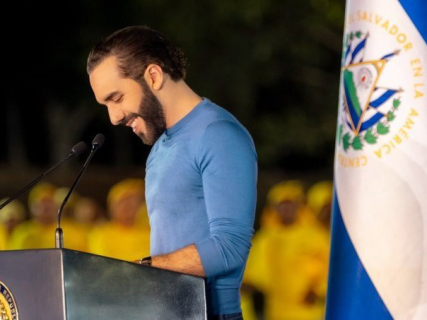

The president of El Salvador, Nayib Bukele, has reiterated that the sending and upcoming deployment of Salvadoran military personnel in Haiti has as its sole purpose locating and rescuing the four air technicians of the Armed Forces kidnapped by criminal gangs, as well as combating organized crime, stressing that this is not an "invasion" nor a plan to "dominate" or take advantage of the Caribbean nation.
In a message disseminated on social media and directed specifically to the citizens of Haiti, Bukele has placed the emphasis on the financial effort that his country is assuming to sustain this large-scale military operation. "We are almost the only ones paying for this operation. Although we receive a little logistical help from other countries, we are covering 90% of the costs with our own small coffers. This has cost us dearly, but we have learned from our own suffering: justice and peace are priceless," he has indicated.
The Salvadoran head of state has emphasized that the exclusive objective of his Administration is to achieve that the four aviation technicians dedicated to medical evacuations "return home" and "teach a lesson to the gangs" responsible for the suffering of the Haitian population. "We do not come to Haiti to make money, because nobody pays us for it. We came to Haiti to fight against the wicked," Bukele has stressed, alluding to the fact that El Salvador suffered in the past a similar "bloodbath" before becoming "the country with the most security on the continent".
"This is not an operation against the Haitian people, nor an invasion of Haiti. We are not a great power. We have no interest whatsoever in dominating the Haitian people or in seizing the wealth of Haiti," the president has insisted, asking for the trust of the local population and assuring that, once the rescue and stabilization tasks are completed, the Salvadoran troops "will return home".
Deployment of troops and coordination with the Haitian Government
Bukele's words come after the recent telephone conversation held with the prime minister of Haiti, Alix Didier Fils-Aimé, in which both leaders addressed the coordination of the broad security offensive launched to free the four military personnel.
The air technicians were detained two weeks ago in an ambush against a vehicle of the Gang Suppression Force (GSF, by its acronym in English) in the Santo area, within the metropolitan area of Croix-des-Bouquets.
Currently, El Salvador has deployed more than 2,000 soldiers on Haitian territory, who operate mainly in Plaine du Cul-de-Sac and in the surroundings of Santo. The Government of Haiti has defined the rescue as an absolute priority and has reiterated its willingness to cooperate with the Salvadoran forces, while at the same time emphasizing respect for national sovereignty.