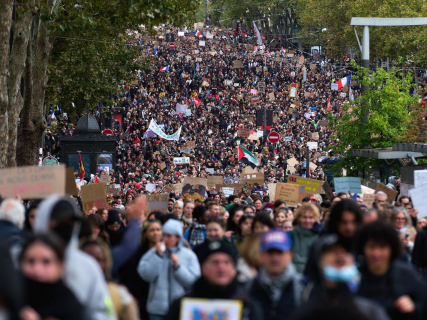

About 410,000 people, according to the count by the French government, have taken to the streets across the country this Saturday as part of social protests against the Executive. The organizers raise the figure to double, in what is the second consecutive weekend of massive mobilizations, again followed by incidents after the marches, just as happened a week ago.
The Ministry of the Interior has specified that out of the total number of protesters in France, 110,000 would have concentrated in Paris. In contrast, the main union in the country, the General Confederation of Labor (CGT), claims that "almost 800,000" people have mobilized, of which 250,000 would have gone to the capital.
The official figures represent a slight decline compared to the 550,000 attendees counted by the Interior last weekend, while the union centers maintain their estimate around 800,000 participants in the calls against the rising cost of living.
"The government and employers must respond to social demands," the CGT has stated in a statement released after the marches. "Now it is time for the strike. Let's not leave the employers at ease. They are responsible for the high cost of living and austerity," the union added, referring to the general strike set for November 5.
In Paris, the majority of attendees were high school and university students, many wearing yellow vests, alongside union delegations.
During the march, slogans such as ACAB -- all cops are bastards -- were heard, in rejection of police violence, or "Siamo tutti antifascisti" in Italian, "We are all antifascists." Banners were also seen with slogans like "A violent desire for happiness," "The land of Enlightenment is dark," and references to Victor Hugo -- "By desiring order too much, chaos ends up being created" -- and to Alexis de Tocqueville -- "The passion for equality is burning, insatiable, eternal."
The authorities have decided to modify the route to move the march away from the center of the capital and shift it towards the periphery, a decision heavily criticized by the organizers. Thus, the demonstration has departed from the Porte d'Italie and concluded at the Porte de Vincennes.
About a thousand arrests across the country
The protests have mostly taken place peacefully, although again there have been disturbances and clashes between groups of protesters and the Police once the marches ended. The Minister of the Interior, Laurent Núñez, has reported nearly a thousand detainees across the territory.
"We have nearly 1,000 arrests" at 7:30 PM, Núñez explained, who expects "this number will increase." At the same time, he emphasized that "the demonstrations have taken place without incidents," although some "dangerous groups" have formed, "as we had anticipated." "Thanks to the intervention of the law enforcement forces, looting was prevented," he stressed.
On this occasion, the minister highlighted, "there have been no attacks directed against public buildings," unlike the previous Saturday. "These attacks have been systematically prevented," he assured, referring to the assaults last week against the town hall of Limoges, infrastructure in Marseille, and the tourism office in Lyon.
In the capital, the Prefecture has reported 65 arrests and 40 detentions, including those of 60 minors. Núñez specified that "a large part of the arrests is related to the controls and the discovery of material intended to be used as a weapon."
In places like the Porte de Vincennes, numerous peaceful protesters who had reached the end of the route have found themselves trapped in the confrontations between riot police and violent groups, causing crowd movements and scenes of tension.
In that same area, the Police have resorted to water cannons and tear gas and have "secured" a vehicle dealership that was the target of an attempted assault. The attackers were unable to access the interior of the premises.
Mobilizations and clashes in other French cities
Outside of Paris, numerous marches have also been recorded in cities such as Lille, Nice, Marseille, Rennes, Montpellier, or Lyon. In Lille, authorities estimate 15,000 attendees, while in Marseille they speak of 17,000 protesters --100,000 according to the CGT-- and in Lyon, 10,000, according to the Rhône Prefecture.
In Lyon, the Police have dispersed around a thousand people gathered in Jean-Macé square, in the south of the city, outside the authorized perimeter, early in the afternoon. The agents have used tear gas, while the gathered individuals displayed a banner with the slogans "More money, less violence" and "We want teachers, not police."
In Saint-Étienne, about 400 people have blocked the A72 highway at the La Terrasse intersection, according to the Loire prefecture on social media. The blockage affects both directions of traffic and the authorities are asking drivers to "strictly avoid the area."
In Grenoble, about 400 hooded individuals "are attacking the law enforcement forces with mortars and projectiles" during the demonstration called by the CGT and the 'yellow vests', according to the Isère prefecture, which has reported the events on social media. The security forces are trying to "detain the rioters and restore order."
In Bordeaux, "hostile groups are attacking the law enforcement forces," according to the Gironde Prefecture. The rioters "are throwing projectiles and raising barricades in the stock exchange square," so the authorities recommend avoiding the area.
In Nice, the prefecture has reported 61 arrests by 7:00 PM. Additionally, there has been an assault by a far-right group against peaceful protesters.
In Marseille, the Police have used tear gas and firefighters have had to intervene to extinguish a fire caused near the march. Police sources have indicated the looting of two jewelry stores in District 5 and attacks on three other businesses. So far, 18 arrests have been counted. Incidents and arrests have also been recorded in cities like Caen, Toulon, Tours, and the Gard department.
Since early in the morning, the Ministry of the Interior has reported the seizure of potentially dangerous objects, including mortars or pétanque balls, during the checks set up at access points and around the marches. At the same time, the security forces and the prefectures maintain surveillance devices, inspections, and intelligence work to anticipate disturbances and ensure compliance with the current prohibitions.