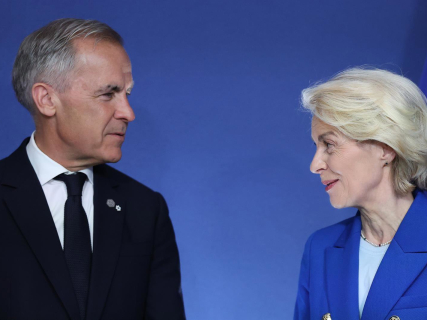

The President of the European Commission, Ursula von der Leyen, admitted this Thursday in Montreal that Canada cannot become a full member of the European Union "for geographical reasons," although she advocated promoting an "association without accession" that would raise ties between Brussels and Ottawa to a level "as close as possible" to that of a community partner.
"Canada cannot become a full member of the EU for geographical reasons, but we both want to take our relationship to the highest possible level," she stated at the C.D. Howe Institute, as part of the summit between the European Union and Canada, stressing that both parties are studying the possibility of the North American country becoming the bloc's first "associated member."
Von der Leyen explained that this figure, which she already outlined in her speech on the State of the Union in September, would make it possible to deepen political and institutional integration without the need for formal accession. "Our idea is simple: it is an association without accession. But we can replace accession with a 'common ambition and vision'," she indicated, arguing that a relationship could be built that "comes closer to member status than anything" the EU has proposed so far.
Three pillars of the future EU-Canada relationship
To make this status a reality, the head of the community Executive has set out three major lines of work. The first involves further aligning European and Canadian policies in key areas such as artificial intelligence, the fight against climate change, energy, and security.
The second axis consists of strengthening institutional ties between the European Commission and the Canadian Government, as well as between the European Parliament and the Parliament of Canada and their respective judicial systems, in order to consolidate more structured cooperation.
The third pillar focuses on more intensive participation by Canada in EU programs, in particular Erasmus+, to facilitate youth exchanges, and Horizon Europe, with the aim of tightening scientific and innovation collaboration on both sides of the Atlantic.
Brussels and Ottawa are also working to expand the Canadian presence in the next phase of Horizon Europe and on mechanisms that make it easier to recognize professional skills and qualifications, so that workers can carry out their activity with fewer obstacles both in Europe and in Canada. "In a few words, this is what being an associated member consists of," Von der Leyen has summed up, making clear that this category would be reserved for the "closest" partners of the EU outside the continent and willing to go beyond the "current terms" of cooperation.
An alliance to overcome the old world order
According to Von der Leyen, there is no "more natural partner than Canada to embark on this journey" with the European Union, in a global context marked by the deterioration of the international order and the review of the alliances that have sustained prosperity and security in recent decades.
"We are witnessing a deeper deterioration of the international order. The alliances and premises that have made our prosperity and our security possible are changing rapidly," she has warned, calling for Europe and Canada to leave behind the limits of the "old world order" and opt for new forms of cooperation based on trust and shared interests.
In her opinion, in a scenario of global "growing rivalries," sovereignty and independence are no longer defined only by the ability to act alone, but also by the possibility of doing so "jointly" with strategic allies. "That is why we will build an Alliance for the Future, and we begin with Canada," she has proclaimed, defending the creation of a common space of "growth and prosperity, resilience and economic security".
Support from António Costa and new Alliance for the Future
The President of the European Council, António Costa, has endorsed Von der Leyen's idea of turning Canada into an "associated member" of the EU, although he has left the door open to using another label to define this reinforced framework of cooperation between Brussels and Ottawa.
"President Von der Leyen has even put forward the bold idea of turning Canada into an 'associated member' of the European Union. I share her ambition," he has stated before the Montreal Council on Foreign Relations, where he emphasized that, "whether this term or another is used," the relationship between both sides will be "the closest, the deepest and the most singular" possible.
Costa has confirmed that the EU and Canada will launch this Friday an "Alliance for the Future" aimed at going "beyond a simple partnership, without reaching full accession" to the European bloc, and has advanced that at the bilateral summit a digital trade agreement will also be presented that will complement the Comprehensive Economic and Trade Agreement (CETA), in force since 2017.
The president of the European Council has also highlighted the progress in defense following Canada's incorporation into the European SAFE instrument, stressing that a first Canadian company, based in Quebec, has already secured a contract financed by this mechanism to supply radio equipment to the Polish Army. "We hope that other companies may benefit from the upcoming SAFE tenders," he concluded.