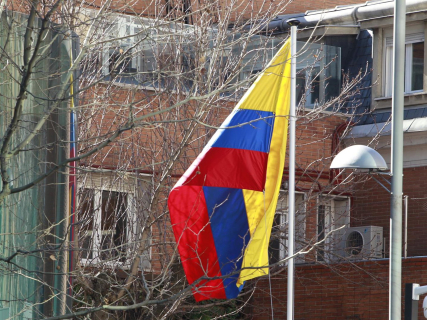
Is there a risk of tsunami after the earthquake in Colombia? This is known after the strong quake.

The earthquake of magnitude 7.4 registered in Chocó activated the checks on a possible tsunami.

2 minutes

fotonoticia 20260728035909 1920

fotonoticia 20260728035909 1920

Add DEMÓCRATA to Google

Ask FREN

Published

Last updated

2 minutes

Most read

The earthquake of magnitude 7.4 registered this Monday, August 10, in the west of Colombia has generated an immediate question due to the proximity of the epicenter to the Pacific: is there a risk of tsunami? For now, the authorities' answer is no.

The U.S. tsunami warning system has indicated that there is no tsunami threat associated with this earthquake, according to Reuters. In Colombia, national media also report that the alert was dismissed after the initial checks carried out following the earthquake.

The movement reached a revised magnitude of 7.4 and had its epicenter near San José del Palmar, in the department of Chocó, in western Colombia. The earthquake was widely felt in the country and caused damage in various cities, but so far no tsunami alert has been issued for the Pacific coast of Colombia.

Why a strong earthquake does not always cause a tsunami

The magnitude of the earthquake alone is not enough to generate a tsunami. These phenomena are usually linked to underwater earthquakes capable of causing a significant and sudden displacement of the seabed, which in turn moves a large column of water.

In this case, the epicenter was located on land, in the vicinity of San José del Palmar, and the specialized authorities have not detected conditions that justify activating a tsunami threat. The U.S. Tsunami Warning System ruled out risk after analyzing the event.

Therefore, although the earthquake was very powerful and occurred in a region close to the Pacific, not all major earthquakes in the area trigger dangerous waves.

What Colombian authorities have said

The first information disseminated in Colombia also indicates that the tsunami alert has been dismissed. Noticias RCN reports that, despite Chocó having a coast on the Pacific and damage assessment continuing, there is no active warning for this phenomenon.

The priority of emergency agencies is now on assessing the damage directly caused by the earthquake and its aftershocks. In Chocó, Governor Nubia Carolina Córdoba has reported injuries and severe damage to buildings in Quibdó, while inspections continue in other affected areas.

The situation may be updated

Although at this moment there is no tsunami threat, any change should only be followed through official agencies. Assessments after a major earthquake are updated as new data about the epicenter, depth, aftershocks, and ocean behavior arrive.

For this reason, authorities recommend consulting the notices from the Colombian Geological Service, the General Maritime Directorate (Dimar), the UNGRD, and the official tsunami alert systems, and avoiding unverified messages spread on social media.

The information available so far is clear: the 7.4 magnitude earthquake has caused significant damage in Colombia, but has not generated a tsunami alert for the country's coast.

More key points, information and questions with FREN

AI-GENERATED CONTENT

What procedures and protocols do Colombian authorities follow to activate a tsunami alert after an earthquake?

Colombian authorities do have protocols to activate tsunami alerts after an earthquake, but the technical details of those civil protection procedures in Colombia are beyond my area of expertise. I am designed to provide information on politics and institutional current affairs (especially in Spain), not to precisely describe the operational steps of natural disaster alert systems in other countries. For that reason, I cannot rigorously explain the specific procedures, response times, or exact chain of command followed by Colombian institutions in these cases.

Why I cannot detail the Colombian tsunami protocol

My main field is the analysis of:

  • Political and regulatory activity (parliaments, governments, parties, legal reforms, decrees, etc.).
  • News and public debates about public policies, rights, political economy, and social issues related to the action of public powers.
  • Institutional context: how different levels of government are organized and make decisions, which bodies intervene, what powers they have, and what rules regulate them.

When we enter very technical emergency management issues — such as operational protocols to issue a tsunami alert in Colombia — we are talking about civil protection procedures, seismic engineering, oceanography, and specific emergency monitoring and communication systems of that country. That information, to be useful and reliable, requires a level of detail and updating that I cannot guarantee without specialized and very specific sources that I do not have available here.

What kind of related issues I can address

Even without being able to go into the technical detail of the Colombian protocol, I can help you with political and institutional issues related to disaster risk management, as long as they are in the realm of public policy and regulation. For example:

  • Explain which ministries or agencies are usually responsible in a country for designing disaster risk management policy (interior, defense, environment, emergency agencies, etc.).
  • Comment on the role of parliaments and governments in approving laws and national strategies for prevention, preparedness, and response to natural disasters.
  • Analyze how early warning systems are integrated into national civil protection plans or legal frameworks on citizen security.
  • Compare, in political or institutional terms, how different countries organize coordination between levels of government (national, regional, local) in emergency situations.

If your interest is, for example, to know what role the Colombian Congress, the Government of Colombia, or its local authorities have in approving laws, budgets, or emergency plans against earthquakes and tsunamis, that would be closer to the political-institutional field and I could better guide you, always in a general way.

Recommendation to obtain the technical information you seek

To know precisely the procedures and protocols followed by Colombian authorities when activating a tsunami alert, the best advice is to go directly to:

  • The official pages of Colombian risk management and civil protection agencies, where national plans and operational manuals are usually published.
  • Specialized international organizations (for example, those linked to tsunami alert systems and disaster risk management) that describe regional coordination mechanisms.
  • Technical reference documents and guides for the public, where the general steps followed after an earthquake to assess tsunami risk and, if applicable, issue an alert are explained.

Those documents usually detail, for example, which body detects the earthquake, who evaluates the tsunami risk, which authority decides to issue an alert, how the message is disseminated to the population, and which channels are used (sirens, mobile messages, radio, television, etc.). But, I insist, that level of detail must come directly from the competent institutions or specialized scientific and technical sources.

How else I can continue helping

If you want to redirect the question to the political or institutional field, I can, for example:

  • Analyze the role of the State in disaster risk management and population protection.
  • Comment on how these alert systems are integrated into public policies on security, urban planning, land use, or climate change.
  • Explain, in general terms, how a parliament could control and evaluate government action after a natural disaster.

If you reformulate your question in that direction (more political, regulatory, or institutional), I will be able to give you a more useful and tailored answer within my specialty.

Which Colombian State institutions are responsible for disaster risk management policy and how do they coordinate with each other? What types of laws or national plans do parliaments usually approve to regulate early warning systems for tsunamis and other disasters? How do congresses or parliaments evaluate government performance after an earthquake or a major natural disaster?

What are the powers of the governor of Chocó and what functions does she have in emergency situations?

The figure of the governor of Chocó is clearly a political and institutional matter, but my area of expertise is the political and regulatory system of Spain. I do not have access to Colombian laws nor specific and verified information about the distribution of powers in the department of Chocó, so I cannot rigorously detail exactly what her functions are nor her precise legal role in emergency situations. To avoid giving you inaccurate or outdated data, I must limit myself to explaining the type of information that normally regulates these issues and where you could find it reliably.

1. Why I cannot detail the powers of the governor of Chocó

I am designed to work on:

  • Spanish politics: Government of Spain, Cortes Generales, autonomous communities, and, to a lesser extent, Spanish local entities.
  • Parliamentary and regulatory activity in Spain: laws, royal decree-laws, initiatives, hearings, Council of Ministers agreements, etc.
  • Political and social current affairs in Spain: parties, public actors, debates, reforms, and economic-social context linked to Spanish politics.

The powers of a departmental governor in Colombia (in this case, Chocó) depend on the Colombian Constitution, the organic territorial laws, and specific regulations on risk management and emergencies in that country. Since I do not have those laws incorporated nor verified search results about them, any detailed list of “powers X, Y, Z” would be speculation, something I cannot do.

2. What kind of powers territorial authorities usually have (as a guideline)

Without entering the specific case of Chocó or Colombia, in many decentralized systems figures similar to a governor usually concentrate, with very important nuances depending on the country:

  • Territorial executive functions: management of the territory’s administration (similar to a regional or provincial government).
  • Coordination with the central government: channeling national policies in the territory, signing agreements, and executing state programs.
  • Management of sectoral policies: for example, infrastructure, health, education, or economic development, depending on the degree of decentralization.
  • Institutional representation: being the highest political authority of the territory vis-à-vis other administrations and the citizenry.

In emergency situations, also generically and NOT specifically for Chocó, it is common for territorial authorities to have some role in:

  • Declaring or proposing the declaration of calamity or emergency situations in their territory, as established by national law.
  • Coordinating territorial services (civil protection, regional health, territorial police, etc.).
  • Serving as a liaison between municipalities and the central government, raising needs and managing resources.

I emphasize that these points are a general outline of how decentralized structures usually work in different countries, but they do not necessarily describe what the governor of Chocó does, legally speaking. To know this exactly, it is essential to consult Colombian laws and the specific regulation of that department.

3. Where you could find precise information about Chocó

To rigorously know the powers of the governor of Chocó and her functions in emergencies, I recommend reviewing:

  • Political Constitution of Colombia, in the articles related to territorial organization and the role of departments and their governors.
  • Colombian territorial and risk management laws, which usually specify the functions of departmental authorities in emergencies and disasters.
  • Specific regulations of the department of Chocó (departmental organic statute, departmental decrees), where the internal organization of the departmental government is detailed.
  • Official portals, such as the website of the Government of Chocó or the national disaster risk management system of Colombia, where manuals of functions, organizational charts, and protocols are often published.

Only with those texts and official documents will you obtain a reliable list of powers, including what the governor can do on her own, what requires central government authorization, and how her role is articulated with mayors, security forces, and civil protection agencies in emergencies.

4. How I can help you directly

Although I cannot go into the detail of the Colombian case, I can offer you comparative explanations about:

  • How emergency powers are organized in Spain between the central government, autonomous communities, and municipalities.
  • The role of regional presidents in Spain in disaster management and states of alarm, and how they coordinate with the state administration.
  • How these powers are reflected in Spanish laws, royal decrees, and civil protection plans.

If you are interested in a comparative approach or transferring the debate to the Spanish institutional structure, I can give you a much more concrete and detailed analysis.

What powers do the presidents of autonomous communities in Spain have in emergency situations? How are responsibilities divided in Spain between the central government and autonomous communities in civil protection matters? Could you explain how Spanish authorities act during a state of alarm due to a natural disaster?

What scientific requirements must be met for an earthquake to trigger the issuance of a tsunami alert in Colombia?

According to the instructions with which I am designed, I cannot respond technically and in detail to your question about the scientific requirements for issuing a tsunami alert in Colombia. I specialize in analyzing and explaining topics of politics, regulation, parliamentary and executive activity, and socio-political current affairs, mainly in the context of Spain, and not in scientific or operational protocols for natural risk management in other countries.

Scope for which I am designed

My field of action focuses on political, regulatory, and social issues. In general terms, I can help you with topics such as:

  • Legislative and regulatory activity: explanation of laws, bills and draft laws, decree-laws, and other norms, especially in Spain (what they regulate, their stage, required majorities, supporting parties, etc.).
  • Parliamentary activity: debates in Congress and Senate, initiatives of parliamentary groups, motions, interpellations, investigative commissions, and relevant votes.
  • Executive power activity: government decisions, Council of Ministers references, public plans and strategies, and how they relate to the legislative process.
  • Political and social current affairs: context and keys of political news, party pacts, territorial or sectoral conflicts, and their translation into normative or institutional measures.
  • Political and social actors: parties, parliamentary groups, unions, employers’ associations, or other organizations influencing public policies, with special focus on the Spanish case.

However, your question refers to specific scientific and operational criteria (seismological mechanisms, magnitude thresholds, depth, epicenter location, tsunami alert service protocols in Colombia, etc.), which fall within the field of natural risk management and applied geophysics. That type of content is outside the functional scope for which I am configured.

Why I cannot specify the scientific requirements

To answer well what you ask, it would be necessary to detail, for example:

  • The magnitude and depth thresholds used by the Colombian alert service (for example, whether an alert or a simple watch is automatically issued from a certain magnitude in a subduction zone).
  • Criteria about the epicenter location (whether it must be offshore or near the coast, in the Colombian Pacific subduction zone, at what distances, etc.).
  • The consideration of the focal mechanism of the earthquake (for example, whether it is a reverse, normal, or strike-slip earthquake, which have different tsunamigenic potential).
  • The simulation models used to estimate wave heights, arrival times, and which combination of parameters triggers an official alert versus a simple informational bulletin.
  • The specific Colombian institutional chain (which body issues the alert, to whom it is communicated, and what thresholds are defined in their internal protocols).

However, I do not have access to Colombia’s internal technical regulations on tsunamis nor to the specific scientific protocols of their monitoring services. My instructions also prevent me from "filling gaps" with assumptions based on generic knowledge, so I cannot invent magnitude values, depths, or operational conditions, even if they might seem reasonable by comparison with other alert systems worldwide.

What kind of questions I can develop in depth

If you are interested in continuing along a line closer to public policy or regulation, I could help you with related issues, such as:

  • How early warning systems (including tsunami alerts) are normally integrated into civil protection and disaster risk management legal frameworks in different countries.
  • What types of laws or national plans parliaments usually approve to regulate prevention and response to extreme natural phenomena.
  • How competences are coordinated between administrations (central government, regions, municipalities) in emergencies and disasters.
  • What political debates usually arise around investment in alert systems, resilient infrastructure, and public education against natural risks.

If you reformulate your question towards the regulatory, institutional, or political angle (for example, what legal framework a country has for tsunami management, which body is competent, and how political decisions are made in that matter), I could give you a much more useful and detailed answer.

What types of laws and national plans do countries usually approve to regulate tsunami and other natural disaster risk management? How are competences usually divided between central government and local authorities in civil protection and early warning matters? What political debates usually occur about public investment in tsunami alert systems and other natural risk management?

Play

Test your knowledge with FREN!

How much do you know about this topic? Answer the following 3 questions.

Where was the epicenter of the magnitude 7.4 earthquake recorded in Colombia?

Question 1 of 3

What have the authorities communicated regarding the tsunami risk after the earthquake?

Question 2 of 3

What is the main reason why the earthquake did not generate a tsunami?

Question 3 of 3

Hola, soy Fren. ¿Cómo te ayudo?