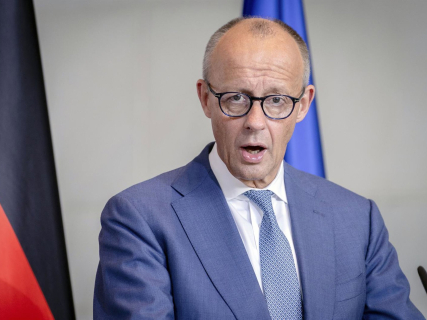

The German chancellor, Friedrich Merz, has admitted the "disaster" of the result achieved by the Christian Democratic Union (CDU) in the elections of Mecklenburg-Vorpommern, although he has insisted that he will continue with his questioned package of political reforms.
"We cannot soften the result in Mecklenburg-Vorpommern. It is a disaster," Merz declared at a public appearance after the exit polls were known in this northeastern German state, where the CDU could even end up without seats in the regional Parliament.
The Christian Democratic leader emphasized that "The CDU has fought, but in the end has been clearly defeated by the polarization between the SPD (Social Democratic Party of Germany) and AfD," Alternative for Germany, a dynamic that, in his opinion, has left his party without political space.
For Merz, Mecklenburg-Vorpommern has transformed into "a very complicated state." "Our economy is in the midst of deep turmoil and the tone and interactions in our society are harsher and less reconcilable," he noted while describing the political and social climate of the region.
The chancellor has also warned of the "sinking" of "trust in institutions" that he attributes to an "active attack by radical left and right parties." In this context, he defended that "In Germany and throughout Europe we need to rethink from the ground up freedom, everyday security, peace, and our own strengths and weaknesses," before warning of "very concrete threats."
Merz has reiterated his "intention" to "move our country forward" because "there are reforms that cannot be postponed." He has assured that he is "firmly convinced that the success of our reforms not only improves our coexistence but also our self-concept and our image abroad. Germany can change." However, he emphasized that to drive that shift requires "strength of character, firmness, and patience" and has also demanded "time."
In his speech, he claimed that "Our country has to be once again the land of new beginnings," referring to the "social elevator" and "prosperity" that, he argued, must be within reach of new generations, "especially the young."