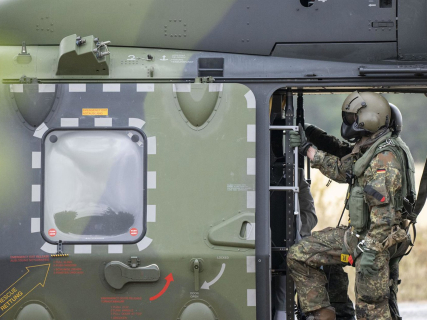

Germany is rebuilding its military recruitment system fifteen years after suspending mandatory enlistment in the Bundeswehr, but that does not mean that all young Germans have to do military service now. The Military Service Modernization Law came into effect on January 1, 2026 and establishes a model that combines registration obligations for men with an enlistment that, for the moment, remains voluntary. The government's goal is to know in advance what population could be available for the Armed Forces and to increase both the number of professional soldiers and the reserve.
The difference is important. Germany legally maintains military obligation in its Constitution, but the general call to arms has been suspended since 2011. The new system does not automatically reactivate it: it first registers young people, progressively assesses their suitability, and tries to attract volunteers through better economic conditions. Only if that model proves insufficient or the security situation changes could a new parliamentary process be opened to impose mandatory enlistments.
The questionnaire is indeed mandatory for men
Starting in early 2026, young people with German nationality will receive upon turning 18 years old a communication from the Bundeswehr with access to a questionnaire about their availability for service. Both men and women can receive it, but there is a fundamental difference: men are required to respond and for women participation is voluntary. The Bundeswehr asks, among other questions, about academic training, qualifications, height and weight, physical condition, disability, other nationalities, and willingness to enlist in the Armed Forces.
The obligation initially affects males born from 2008 and it is estimated that each year it will reach approximately 350,000 young people. Those with dual nationality are also included as long as one of them is German. In contrast, previous generations are not being generally incorporated into this new process, although they can voluntarily apply to serve.
The questionnaire does not equate to accepting incorporation. A young person can answer that they do not want to do military service and, in the current situation, that answer does not imply that they will be sent to a barracks obligatorily. Its purpose is for the Bundeswehr to have a database on availability, capabilities, and possible candidates in case it needs to expand its forces.
The mandatory medical examination will start in July 2027
The next step will be to recover the Musterung, the medical and fitness examination that for decades was part of the old German military service. The law establishes its obligation for men born since 2008, but the general implementation will be done progressively because Germany had to rebuild an infrastructure that practically disappeared after 2011. The official calendar of the Bundestag places the beginning of the mandatory mass reviews on July 1, 2027, initially for males of the 2008 generation.
This clarification is relevant because some informational pages of the Bundeswehr summarize the change by saying that the medical examination "is again mandatory from 2026." The regulation is already in force, but the systematic call-up of the entire generation will begin in July 2027, when the new examination centers are operational. The Bundeswehr is creating 24 specific facilities throughout the country to handle that volume of tests.
The examination includes vision and hearing tests, blood pressure, back, joints, and general physical condition, in addition to an assessment of suitability for different military functions. Even those who have requested to be recognized as conscientious objectors will have to answer the questionnaire and attend the examination when called, although they retain their right to refuse to serve armed subsequently.
What remains voluntary: joining the Bundeswehr
Once the registration and, when applicable, the examination have been completed, actually serving in the Armed Forces remains voluntary. Those who wish to join can do so for a minimum of six months and, within the new voluntary service, remain for between six and eleven months. After a commitment of twelve months, they move to the category of temporary soldiers, with a different contractual regime.
Germany tries to attract candidates also through remuneration. The new voluntary service starts at approximately 2,600 euros gross per month, with accommodation and certain benefits covered by the Bundeswehr. Soldiers who commit for at least one year can also access assistance to obtain driving licenses, while the pay slightly increases with rank and duration of the commitment.
The model is particularly aimed at strengthening territorial defense and the reserve. New recruits receive training for tasks such as infrastructure protection, surveillance, and security, so that they can remain linked later as reservists. The German government aims to reach 260,000 professional or temporary military personnel and around 200,000 reservists by 2035, compared to a Bundeswehr that has struggled for years to meet its personnel goals.
Germany has not yet recovered mandatory military service
The main confusion lies in calling "mandatory military service" the entirety of the new system. What is mandatory now is registration for men and, progressively, the medical examination; what remains voluntary is the actual incorporation into the Armed Forces. The Bundestag expressly reminds that the reform approved in December 2025 did not restore the general conscription that existed before 2011.
However, the law introduces a door to change that model. If the Bundeswehr does not meet the planned personnel goals or the defense situation demands it, the government can ask Parliament to activate a "Bedarfswehrpflicht", a service obligation based on military needs. It would not be automatically activated due to a lack of volunteers: it would be necessary for the Bundestag to approve a new law.
This mechanism would allow selecting a portion of the young people deemed fit instead of necessarily restoring universal conscription for all. Precisely for this purpose, the questionnaire and the examinations serve: Germany wants to have advance information on who could enlist if at any point Parliament decided to resort to a draft due to defense needs.
Men and women have different obligations
Another essential difference is that of sex. The German Fundamental Law allows imposing military obligations on men, while women cannot be forced in times of peace to serve in armed forces. Therefore, they can voluntarily respond to the questionnaire, undergo the tests, and join the Bundeswehr, but they are not subject to the same obligation of registration and recognition as men.
The Government has thus opted for an intermediate system: to recover a good part of the administrative machinery of the former conscription without yet ordering a forced incorporation. In 2026, an 18-year-old German may be obliged to provide information to the Bundeswehr, but not to become a soldier. Starting in July 2027, if he belongs to the 2008 generation, he may also be obliged to undergo the medical examination. For him to be required to enlist against his will, an additional decision from the Bundestag would be necessary.