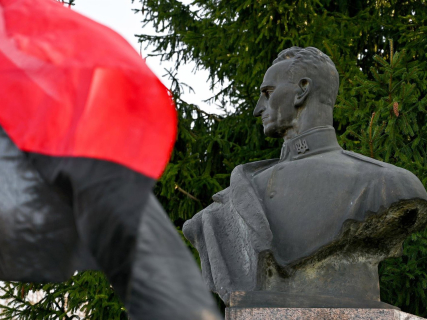

The Polish Government has expressed its discomfort with the decision of the local authorities in Lviv, in western Ukraine, to pay a new tribute to the militia of the Ukrainian Insurgent Army (UPA) and its leader Roman Shukhevych, who are attributed with massacres during World War II.
The dispute over the shared historical memory between both countries has been rekindled after, in the middle of the year, the Ukrainian president, Volodymyr Zelensky, accepted to name a unit of the Ukrainian Army with references to this ultranationalist group with a Nazi past.
The Minister of Defense of Poland, Wladyslaw Kosiniak-Kamysz, has described as "unacceptable" that the Regional Government of Lviv has proclaimed 2027 as the year of the UPA. "This decision does not foster mutual trust between nations, but rather reinforces divisions," he stated.
In the same vein, he insisted that "it is necessary for the authorities of Ukraine to distance themselves from this position." At the same time, the Minister of Foreign Affairs, Radoslaw Sikorski, indicated that he has joined the initiative to declare the councilor who promoted the measure, Sviatoslav Sheremeta, as a persona non grata.
This councilor is a well-known figure both in Ukraine and in Poland for his defense of the Galizien division of the Nazi SS, made up mainly of Ukrainian volunteers from the historic region of Galicia, of which Lviv is currently a part.
The Polish Embassy in Kyiv has maintained that the exaltation of the UPA conflicts with European values, harms neighborly relations, and has emphasized that Shukhevych was a collaborator of Nazism responsible for "the blood of thousands of innocent victims."
Similarly, it has condemned that "irresponsible local activists" are undermining the efforts of President Zelensky and Polish Prime Minister Donald Tusk to ease the tension surrounding an issue that has pitted the two nations against each other for decades.
Warsaw maintains that between 1943 and 1945 the UPA caused the death of nearly 10,000 Polish citizens and defines those events as genocide and ethnic cleansing, while in Ukraine, broad sectors consider these formations as symbols of the struggle for independence and resistance against the Soviet Union.
In recent months, Ukrainian authorities have promoted several measures to vindicate numerous leaders of these organizations, including the repatriation of the remains of some of them, such as the reburial ceremony of Andri Melnik, known Nazi collaborator.
The president of the Polish Institute of National Remembrance, Karol Nawrocki, withdrew the Order of the White Eagle, the highest distinction of the Polish State, from Zelenski after the decision to give a military unit the title of "Heroes of the UPA".
Zelenski himself is also promoting the creation of a national mausoleum intended to house and honor these figures. "No one will ever tell us which heroes to respect," he proclaimed during the presentation of the project, amid controversy with Poland over the recognition granted to the UPA.